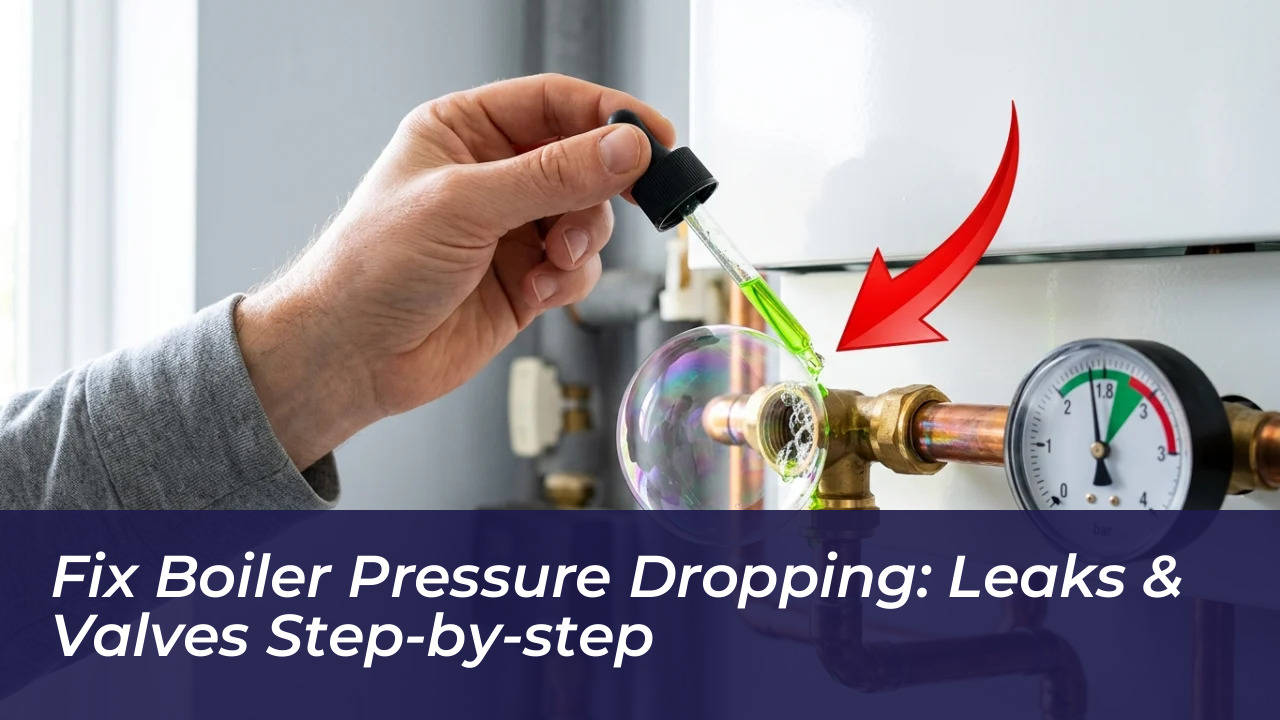


When residential boiler pressure continuously falls below the safe operating threshold of 12 to 15 psi (roughly 1 to 1.5 bar), the root cause is almost always an active water leak in the closed heating loop or a compromised expansion vessel diaphragm. If a heating system fails to hold steady pressure between cycles, simply refilling the unit addresses only the symptom while leaving the underlying defect to worsen.
A closed-loop hydronic system depends on a fixed volume of water sealed under constant pressure to move heat efficiently through radiators, baseboards, or underfloor manifolds. When physical volume escapes or the air cushion responsible for thermal expansion collapses, the pressure gauge drops toward zero, triggering automatic safety shutdowns that leave living spaces without heat or hot water. Diagnosing this mechanical failure requires inspecting three primary vulnerability zones: external plumbing joints, internal safety valves, and the internal expansion bladder.
Primary Mechanical Reasons Why Boiler Pressure Drops
Pressure drops inside a heating loop do not occur spontaneously. Water is an incompressible fluid, meaning any sustained downward movement on the pressure gauge proves that fluid is escaping or the internal air pocket that manages thermal expansion has lost integrity.
The most common mechanical culprit is a slow, weeping leak at a pipe fitting, radiator valve, or buried pipe connection. Because hydronic pipes run hot, tiny pinhole leaks or valve packing seepages often evaporate immediately into the ambient air, leaving behind only faint white limescale residue or rust stains rather than visible puddles on floorboards.
A secondary failure point involves the pressure relief valve (PRV). Engineered to discharge excess water through an external copper pipe whenever system pressure exceeds roughly 30 psi (around 3 bar), a relief valve with worn rubber seals or internal grit deposits can fail to close completely, letting water drip unnoticed outdoors.
When pressure repeatedly rises sharply as the burners fire and then drops to zero once the system cools down, the expansion vessel has almost certainly lost its air charge or ruptured internally. A failing expansion vessel creates dramatic pressure swings. Under normal operating conditions, this steel tank contains a flexible rubber membrane dividing system water from a pressurized air cushion. If the air cushion leaks out through the Schrader valve, heating water expands without resistance, spikes internal pressure, forces the relief valve open, and dumps water outside. When the burner cuts out and the water contracts, the pressure plummets.
The Refilling Myth: Why Constant Repressurizing Causes Long-Term Damage
A widespread misconception among homeowners is that topping up the boiler through the filling loop once a week is a normal maintenance routine. In reality, a sealed hydronic heating system should hold stable baseline pressure for months or years without intervention.
Regularly introducing fresh tap water into the closed loop introduces fresh oxygen and dissolved minerals into the internal plumbing. Dissolved oxygen accelerates internal galvanic corrosion of steel radiators and heat exchangers, generating black iron oxide sludge (magnetite) that clogs circulator pumps and reduces fuel efficiency. Constant refilling turns a minor leak into an expensive mechanical failure.
Troubleshooting System Pressure Loss
Understanding the exact pattern of your pressure loss helps isolate the defective component before calling out a heating technician. Review the common symptoms and their mechanical origins below:

- Pressure gauge reads zero after heating cycle cools down: Depleted air cushion or failed membrane in the expansion vessel.
- Continuous slow drop over days without heating active: Pin-hole leak in radiator pipework, valves, or underfloor joints.
- Water dripping from the external copper discharge pipe outside: Debris stuck in the pressure relief valve seat or weak internal spring.
- Damp patches beneath radiator tails or boiler casing: Degraded compression fitting olive, loose pump seal, or leaky drain.
Step-by-Step Method to Restore Operating Pressure
If an inspection reveals no catastrophic leaks and the system has dropped slightly below operating tolerance, repressurizing the loop can restore operational heat while a technician assesses the circuit.
- Turn off electrical power: Switch off the boiler at the main electrical isolator switch and permit all radiators and internal pipework to cool completely. Reading pressure while the water is cold provides an accurate baseline.
- Locate the filling apparatus: Identify the filling loop beneath the boiler casing or adjacent to the piping manifold, typically consisting of a flexible braided hose with one or two small lever valves.
- Engage the valves smoothly: Slowly open both valves to allow fresh cold mains water to enter the heating system. Listen for the sound of rushing water while watching the needle on the pressure gauge.
- Halt filling at the target zone: Close both valves firmly once the pressure gauge needle rises between 12 psi and 15 psi (1.0 to 1.5 bar on metric gauges). Never overfill into the red zone above 20 psi.
- Inspect the discharge line: Check the exterior wall pipe to ensure the safety valve is not actively trickling water after repressurizing.
If the gauge refuses to stay in the green zone after running a complete heating cycle, ongoing structural water loss requires specialized testing equipment such as thermal imaging cameras or ultrasonic acoustic leak detectors. Check exterior discharge pipes immediately if your boiler loses operating levels every time the heat turns on, as an unnoticed trickle outside confirms pressure relief discharge. Inspect all radiator valves and baseboard fittings with a dry paper towel to catch tiny evaporating leaks before corrosion spreads deeper into the heating loop. Consult a licensed heating technician whenever the expansion vessel shows signs of waterlogging or internal component failure.
Frequently Asked Questions
What is normal boiler pressure when the system is cold?
Most residential hydronic heating systems should maintain a stable pressure between 12 and 15 psi (1.0 to 1.5 bar) when the water is completely cold and the heating is off.
Is it normal to top up my boiler pressure every week?
No. A healthy sealed heating system should retain its pressure for months or even years. Needing to repressurize weekly indicates a slow system leak or failing expansion vessel.
Can low boiler pressure damage my heating equipment?
Yes. Operating with very low pressure can cause circulator pumps to run dry, leading to premature mechanical failure, frequent system lockouts, and complete loss of heat.
Why does my boiler pressure spike and then drop to zero?
This behavior points directly to a failed or waterlogged expansion vessel. Without an air cushion to absorb thermal expansion, pressure surges when heating and drops drastically when cooling.
What should I do if water is dripping from the outside discharge pipe?
A continuous drip from the exterior copper relief pipe usually means your pressure relief valve (PRV) is stuck open or system pressure exceeded safety limits. Call a licensed technician to inspect or replace the valve.