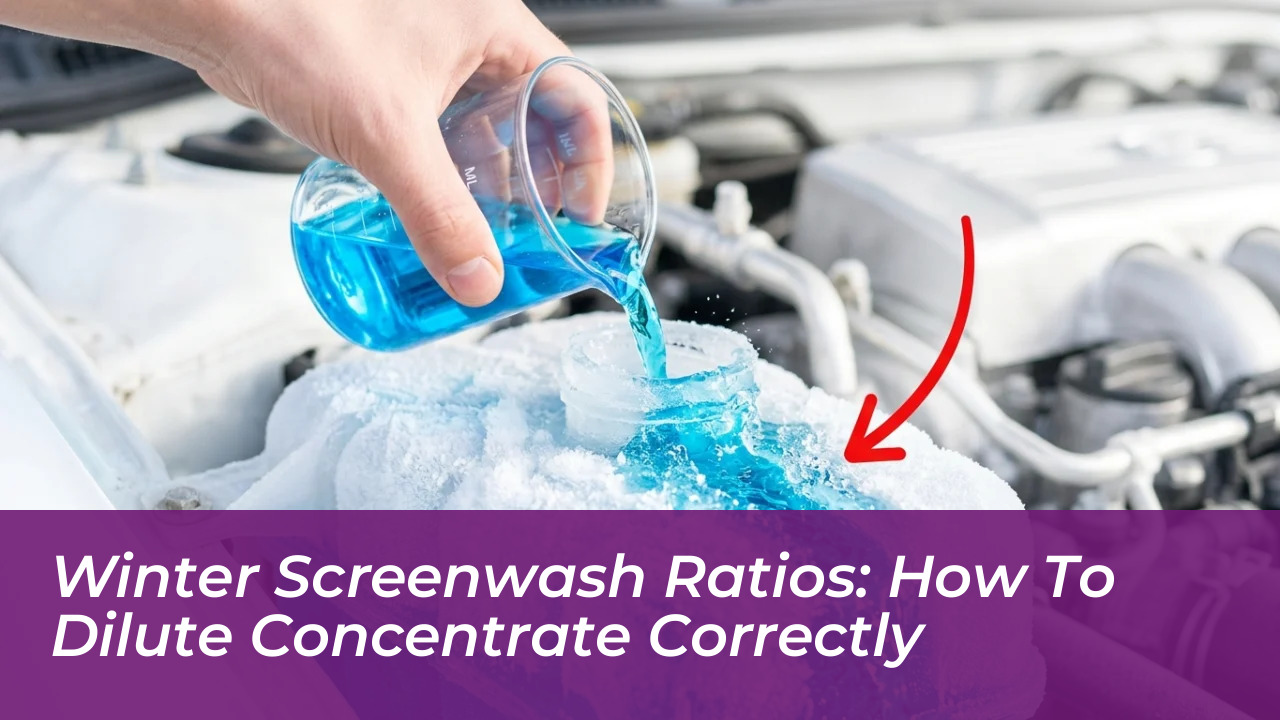


Maintaining clear visibility during freezing weather requires more than simply topping up your vehicle’s fluid reservoir with colored water. A standard screenwash concentrate winter mixture requires either a 1:1 ratio for moderate frost down to around zero degrees Fahrenheit or completely neat, undiluted concentrate when severe deep-freeze conditions hit minus twenty. Getting this chemical balance right prevents washer fluid lines from freezing solid, stops reservoir tanks from cracking, and eliminates dangerous road-salt blinding on the highway.
Most commercial windshield washer concentrates use alcohol blends-predominantly methanol or ethanol-paired with specialized surfactants to lower the freezing point of water. When temperatures tumble, any excess water in the mix crystallizes into slush inside the narrow spray nozzles, choking off washer fluid right when dirty slush covers the windshield. Understanding the exact science and dilution benchmarks ensures your vehicle remains safe and fully functional all winter long.
The Physics of Freeze Protection: How Dilution Ratios Behave
Water expands by roughly nine percent as it freezes, exerting immense pressure on automotive washer systems. If your reservoir carries a weak summer mix, ice formation readily splits the plastic tank, pops fluid delivery hoses, or burns out the electric pump motor when you pull the stalk.
Screenwash concentrates rely on freezing-point depression. Adding concentrated alcohol disrupts the hydrogen bonding that forces water molecules into a rigid ice lattice. The more water you introduce, the higher the freezing threshold climbs. Diluting cold-weather concentrate with too much plain water remains one of the primary reasons windshield washer systems fail completely during sudden cold snaps.
Using improper mixtures does not just threaten the hardware under the hood. At highway speeds, the rapid evaporation of alcohol from the windshield glass causes a chilling effect known as evaporative flash-freezing. Even if fluid sprays freely from the nozzles, a dilute mix can form an opaque sheet of ice instantly across the glass surface.
Winter Dilution Benchmarks for Cold Weather Driving
Screenwash packaging usually provides a printed mixing guide, yet many drivers miscalculate the volume needed for seasonal protection. The baseline rules depend on expected local overnight low temperatures. Drivers facing unpredictable weather patterns benefit from erring on the side of higher concentration. A slightly stronger mix wastes very little product, whereas a weak mixture risks complete mechanical freezing.
- Mild Cold (Down to 20°F): 1 Part Concentrate : 2 Parts Water
- Moderate Freeze (Down to 0°F): 1 Part Concentrate : 1 Part Water
- Severe Sub-Zero (Down to -20°F): Undiluted (Neat) Concentrate
- Arctic Flash-Freeze (Below -20°F): Undiluted Extreme-Weather Formulation
Common Winter Screenwash Myths Debunked
A widespread automotive misconception suggests that pouring household isopropyl alcohol or dish soap into a frozen reservoir provides a safe shortcut. Dish soap contains heavy foaming agents that leave sticky residues on the glass, while uncalibrated household rubbing alcohol can deteriorate rubber wiper blades and dry out windshield cowl seals over time.
Another dangerous practice is pouring boiling water over frozen washer jets to thaw them rapidly. The drastic thermal shock can instantly fracture laminated windshield glass, especially if micro-cracks or stone chips already exist.

Pre-Mixing vs. Pouring Directly into the Tank
Dumping straight concentrate into a half-full washer reservoir does not create an immediate blend. Because fluids of differing densities do not mix instantly without agitation, unmixed water often sits at the bottom where the pump inlet draws, leaving the lines unprotected on freezing mornings.
Follow these steps to ensure a uniform mixture:
- Check your vehicle manual to verify the total capacity of your washer reservoir tank.
- Measure the appropriate amounts of concentrate and distilled water in a clean, portable plastic jug.
- Use distilled or demineralized water rather than hard tap water to avoid calcium and limescale buildup in the spray jets.
- Shake the jug firmly to homogenize the mixture before pouring it directly into the car.
- Operate the windshield washers for five seconds to push old, dilute fluid out of the internal lines and prime the nozzles with winter mix.
Check your fluid ratings before overnight temperatures dip into sub-zero territory, making sure your reservoir contains an adequate cold-weather mix. Have you ever experienced frozen washer lines while driving on the highway? Share your experiences with winter vehicle maintenance in the comments below.
Frequently Asked Questions About Winter Screenwash
Can I use summer screenwash during winter if I add rubbing alcohol?
No, improvising with summer screenwash and household rubbing alcohol is strongly discouraged. Commercial winter concentrates are chemically engineered with precise alcohol-to-surfactant ratios designed to protect rubber seals, paintwork, and wiper blades while preventing flash-freezing. Household alcohol lacks these protective additives and can degrade vehicle components.
Why is tap water discouraged when mixing screenwash concentrate?
Hard tap water contains dissolved minerals like calcium and magnesium. Over time, these minerals precipitate out of the solution when exposed to the heat of the engine bay, leaving behind limescale crusts that clog the tiny spray nozzles and disrupt the spray pattern.
What should I do if my washer reservoir freezes solid?
Never force the washer pump while the system is frozen, as this can burn out the electric motor. Instead, drive your vehicle until the engine bay warms up naturally, or park in a heated garage. Once thawed, empty the system completely and refill it with a proper sub-zero concentrate ratio.
Does screenwash concentrate expire?
Unopened bottles of screenwash concentrate stored in a cool, dry place have a very long shelf life, typically lasting several years. However, once mixed with water or opened, evaporation can gradually reduce the alcohol content, slightly lowering its freezing-point protection over time.
Is it safe to run undiluted screenwash year-round?
While running neat concentrate will not damage your vehicle’s mechanical components, it is generally unnecessary and costly during warm weather. High concentrations of methanol or ethanol can produce stronger chemical odors and may leave light smearing on the glass if not formulated for summer bug removal.