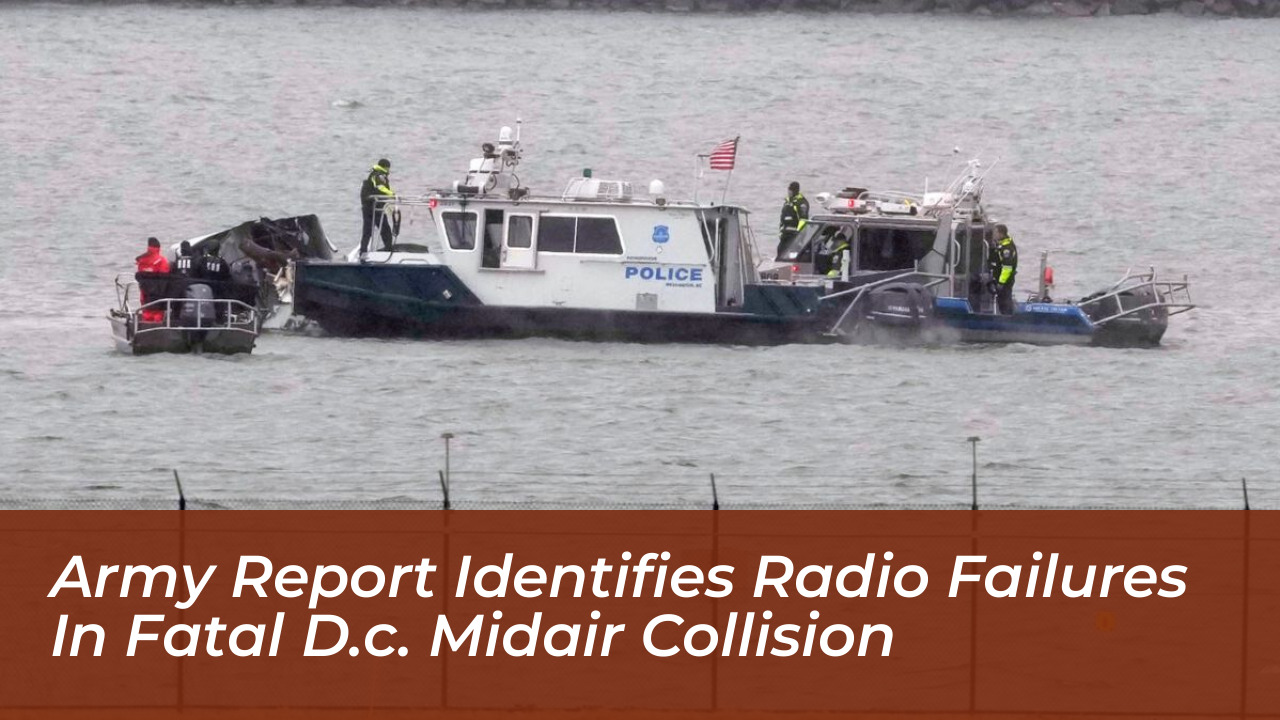


A U.S. Army internal investigation has identified two failed radio transmissions as the primary cause of a midair collision near Washington, D.C., last year. The accident, involving an American Airlines jet and an Army Black Hawk helicopter, resulted in 67 deaths, making it the deadliest aviation disaster on U.S. soil in over two decades.
Systemic Failures and Findings
The report, completed in May and recently released to victims’ families, details a series of systemic breakdowns. Investigators concluded that communication failures prevented the helicopter crew from identifying Flight 5342 as it approached Reagan National Airport’s alternate runway.
The investigation highlighted the following key factors:
- Communication Breakdown: Two failed radio transmissions were the most significant factor in the tragedy.
- Visibility Constraints: Army pilots used night-vision goggles, which restricted their field of view against city lights.
- Air Traffic Control: The tower controller at Reagan National Airport could have potentially prevented the crash with clearer guidance and warnings.
- Inadequate Separation: The designated helicopter flight route provided only 75 feet of vertical separation, which was insufficient given the margin of error in altimeter readings.
Calls for National Safety Reforms
The findings have intensified demands from the victims’ families for congressional action. The group, Families of Flight 5342, is advocating for the mandatory installation of advanced collision-avoidance technology on all commercial and military aircraft operating in congested airspace.
“It’s a simple concept anyone can understand: aircraft should be able to see each other in the sky. The technology is proven. All that’s required is the political will to do the right thing,” the Families of Flight 5342 stated.
Expanding the Scope of Safety Reviews
The Army has initiated a review of helicopter operations in major metropolitan areas, including Los Angeles and the Seattle-Tacoma region, to identify and mitigate risks where military flight paths intersect with civilian traffic.
While the National Transportation Safety Board (NTSB) conducted a separate investigation criticizing the Federal Aviation Administration (FAA) for missing warning signs, the Army report focuses on military procedural failures. The FAA has since prohibited controllers from relying solely on pilots to maintain visual separation in busy airspace.
Legislative Status
As the military implements the report’s recommendations, Congress is working to reconcile competing aviation safety bills. Victims’ families emphasize that with both the NTSB and Army investigations complete, there is no justification for delaying the implementation of mandatory collision-avoidance systems.