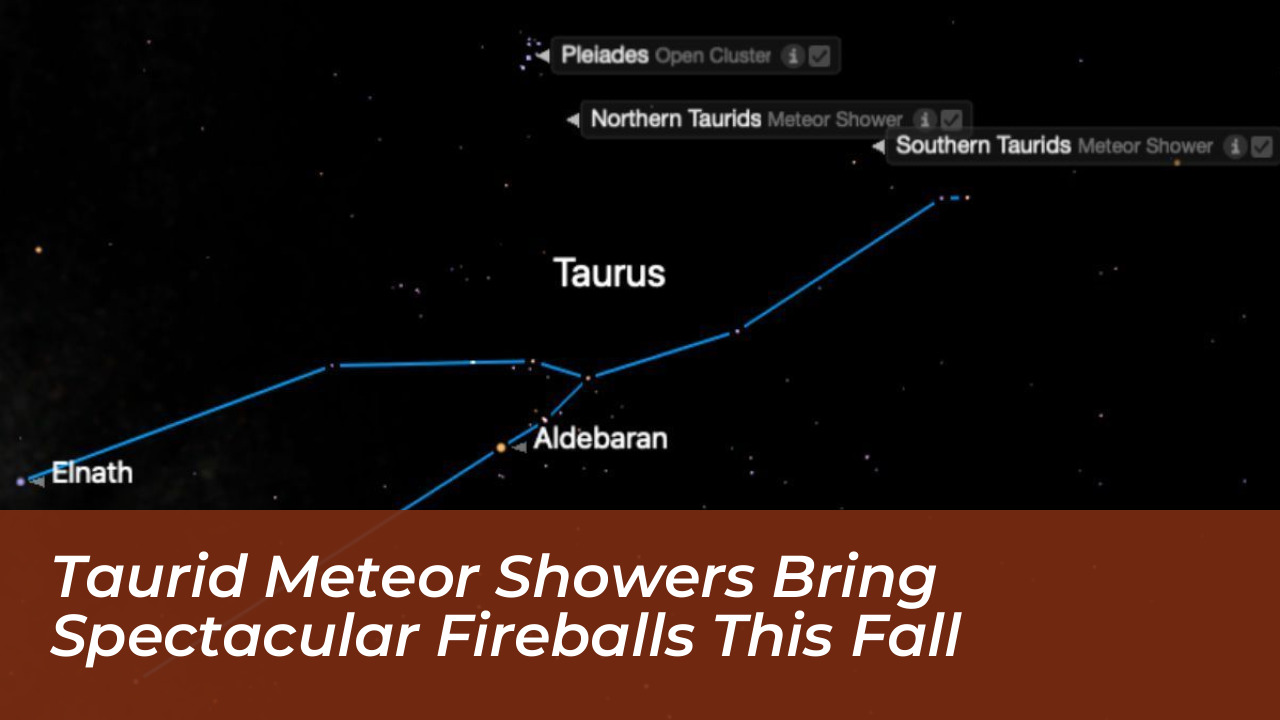

The autumn skies are lighting up as the Taurid meteor showers return, offering stargazers across both hemispheres a chance to spot brilliant, slow-moving fireballs. Rather than producing a sudden burst of shooting stars like August’s Perseids, the Taurid complex provides an extended viewing window throughout October and November as Earth passes through a vast debris stream linked to Comet 2P/Encke.
According to the American Meteor Society, the Southern Taurids are active from Sept. 20 through Nov. 20. They feature two distinct components: an annual component peaking around Oct. 14, and a fireball-associated component reaching its peak overnight on Nov. 4-5. Meanwhile, the companion Northern Taurid stream becomes active on Oct. 20, running through Dec. 10 with a peak overnight on Nov. 11-12.
Why the Taurids Are Called ‘Halloween Fireballs’
Informally known by skywatchers as the “Halloween fireballs,” the Taurids derive their nickname from their timing and visual characteristics. Their broad activity peaks overlap from late October into early November. More importantly, they are famous for producing exceptionally bright, colorful meteors caused when larger pieces of space debris plunge into Earth’s atmosphere.
While hourly rates remain modest-averaging about five meteors per hour for each stream under ideal conditions-the quality of the meteors often makes up for the low numbers. Southern Taurid meteors enter Earth’s atmosphere at about 17 miles (27 kilometers) per second, while Northern Taurids travel at roughly 18 miles (29 kilometers) per second. This relatively slow speed allows observers to watch them streak across the night sky for several seconds, frequently leaving glowing trails and occasionally fragmenting into red, orange, yellow, or green flashes.
The Encke Complex
Both the Southern and Northern Taurid showers are connected to Comet 2P/Encke, a periodic comet with a three-mile-wide nucleus that circles the sun every 3.25 years, marking the shortest known cometary orbit in our solar system. Astronomers classify the Taurids as part of the broader Encke Complex-a sprawling stream of dust, rocks, and debris believed to have formed thousands of years ago when a much larger parent body fragmented.
While normal years see only about one percent of Taurid meteors qualify as fireballs, Earth occasionally passes through denser concentrations of larger debris. Past enhanced fireball displays occurred in 2008, 2015, and 2022. Although an unusually high swarm is not predicted for the immediate future, astronomers note that the complex continues to be heavily monitored for both its meteors and its larger population of near-Earth asteroids.
Favorable Moon Phases Support 2026 Viewing
Stargazers this season benefit from favorable lunar conditions. The early October peak of the Southern Taurids occurs under a minimal moon, while the primary fireball peak on November 4-5 features an 18%-illuminated waning crescent moon that remains too dim to interfere significantly with visibility. Similarly, the Northern Taurid peak on November 11-12 coincides with a slender waxing crescent moon, leaving the night sky dark and clear for optimal viewing.
Tips for Observing the Taurid Showers
Catching a Taurid fireball requires patience and a few simple preparation steps:
- Timing: Head outside around midnight to 2 a.m. local time, when the constellation Taurus-the apparent radiant of the showers-climbs highest into the night sky.
- Location: Find a dark-sky site away from urban light pollution with a wide, unobstructed view of the horizon.
- Equipment: Leave telescopes and binoculars inside. The Taurids are a -eye event; optical instruments narrow your field of view too much to track long meteor paths.
- Technique: Look roughly 30 to 40 degrees away from the radiant in Taurus rather than staring directly at it, which ensures you catch longer, more prominent meteor trails.
- Comfort: Dress warmly in layers, as autumn night temperatures can drop quickly during extended outdoor observation sessions.
Though the Taurids demand patience with their slow burn and low hourly counts, catching a brilliant, fragmenting fireball can easily yield one of the most memorable astronomical sights of the year.