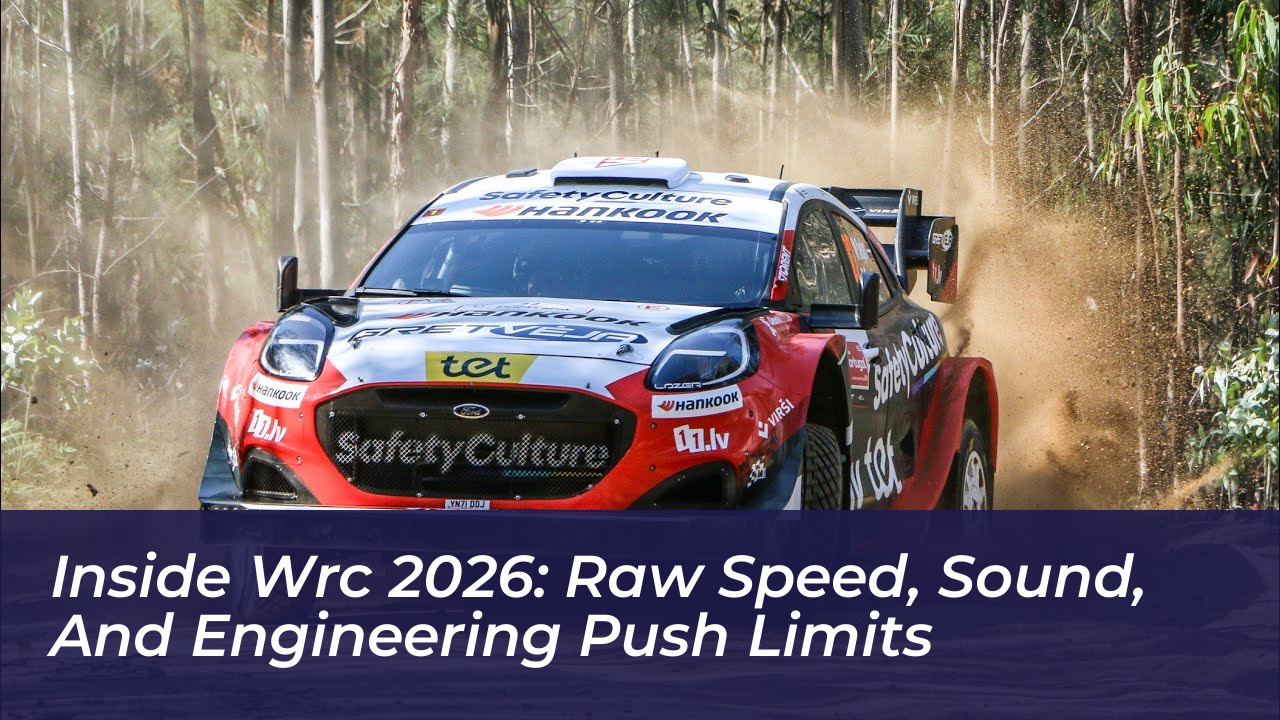

The World Rally Championship competition is accelerating toward a pivotal era. Top-tier machines demand raw mechanical balance, uncompromising top-end velocity, and pure acoustic presence. As the WRC Rally 2026 cycle approaches, governing frameworks emphasize lighter chassis footprints, refined aerodynamics, and raw combustion feedback to deliver unrelenting stage pace. These engineering refinements strip away excess complexity. They force drivers into maximum attack across blind crests, loose gravel, and unforgiving forest tracks.
Modern stage competition operates at the outer edge of human reflexes and mechanical durability. Navigating narrow passes at triple-digit speeds requires an intricate balance between downforce, suspension travel, and instantaneous throttle response. Understanding the technical shifts behind this high-stakes discipline reveals why stage rally remains motorsport’s most visceral proving ground.
The Anatomy of Max Attack: Engineering Flat-Out Speed
Driving on max attack means committing a multi-hundred-horsepower vehicle into unpaved corners with zero margin for error. Top-tier rally vehicles rely on specialized drivelines that must withstand continuous shock loads from violent landings and abrupt surface shifts. The fundamental engineering behind this extreme speed relies on several interconnected systems:
- Long-Travel Dampers: Advanced multi-way adjustable suspension units dissipate immense kinetic energy over severe ruts and massive jumps without unsettling the chassis.
- Mechanical Differential Tuning: Precision torque splitting between front and rear axles ensures instant turn-in response while preserving traction during high-speed power slides.
- High-Downforce Aero Elements: Rear wings and underfloor splitters work together to generate stability on sweeping fifth- and sixth-gear sweeps without adding excessive drag.
When these systems work in harmony, drivers carry flat-out momentum over terrain that would destroy a standard production chassis within seconds. Teams optimize these parameters meticulously during pre-event test sessions, ensuring that every suspension stroke and differential ramp angle translates directly into stage-winning time.
The Science of Pure Sound in Modern Rallying
Acoustic feedback in high-performance rally engineering is not an aesthetic byproduct. It serves as a critical diagnostic indicator for both the driver and telemetry engineers. High-revving, turbocharged internal combustion engines paired with anti-lag systems produce a distinctive, sharp bark that reverberates across natural landscapes.
Anti-lag technology keeps the turbocharger spooled even under zero throttle input by deliberately altering ignition timing and fuel delivery. This ensures instantaneous boost delivery the moment the driver clips the apex and punches the throttle. It eliminates power hesitation and generates the raw, unmuted mechanical sound that defines elite stage competition. Pure mechanical feedback remains the truest measure of performance. When powertrain harmonics and chassis response align, a driver gains the confidence to brake later and carry speed deeper into every sector.
Chassis Dynamics: Gravel, Snow, and Tarmac Demands
Unlike circuit racing where track surfaces are consistent and predictable, rally stages present an ever-changing matrix of grip coefficients. A setup optimized for smooth tarmac will fail catastrophically on the rocky tracks of Kenya or the packed ice of northern Europe.
Engineering priorities shift dramatically depending on the specific event profile:
- Gravel Setup: Maximum suspension travel, heavy-duty underbody protection, and high-clearance wheel geometry.
- Tarmac Configuration: Stiff anti-roll bars, reduced ride height, and aggressive camber settings for cornering bite.
- Aero Efficiency: Targeted downforce generation balanced against top-speed drag limits on open, fast stages.
- Powertrain Cooling: Oversized radiator ducts engineered to function despite heavy dust, mud, and flying debris.
Balancing these conflicting operational windows demands rapid setup adjustments between morning and afternoon loops. This leaves service crews with mere minutes to reconfigure suspension kinematics and differential maps.
Dispelling the Top-Speed Myth on the Stages
A persistent misconception among casual motorsport observers is that stage rally success hinges purely on straight-line top speed. Many assume that the fastest car down a flat straightaway automatically wins the rally weekend. The technical reality contradicts this view.
Stage rallies are won across transitional zones-braking zones, medium-speed off-camber bends, and technical link sections where power-to-weight ratios and lateral grip dictate stage times. A vehicle geared for an excessive theoretical top speed often suffers from sluggish acceleration out of low-speed hairpins, ultimately costing crucial seconds across a 20-mile stage. Real-world rally mastery requires immediate torque delivery, robust low-end pull, and aerodynamic balance that maintains stability while the vehicle is sideways at 100 mph.
How Teams Optimize Performance Under Tight Windows
Maximizing stage velocity requires rigorous procedural execution before the car ever rolls off the ceremonial start ramp. Teams execute a precise operational routine to extract every millisecond:
- Recce Calibration: Crews run two low-speed reconnaissance passes to transcribe every crest, ditch, and grip transition into precise pacenotes.
- Telemetry Analysis: Engineers analyze differential lock rates, suspension stroke data, and tire temperatures after shakedown to optimize damping curves.
- Tire Selection Strategy: Drivers balance compound softness against abrasion risks, choosing cross-mounted setups when unpredictable weather threatens tire wear.
- Service Park Execution: Mechanics replace vital driveline components, bleed braking systems, and reshape aero bodywork within strict 45-minute service allocations.
Every element of this sequence ensures that when the co-driver calls the countdown on the start line, the machine is prepared to tackle the stage at the outer limit of physics. Rallying continues to represent the most intense fusion of driver courage and pure automotive technology.