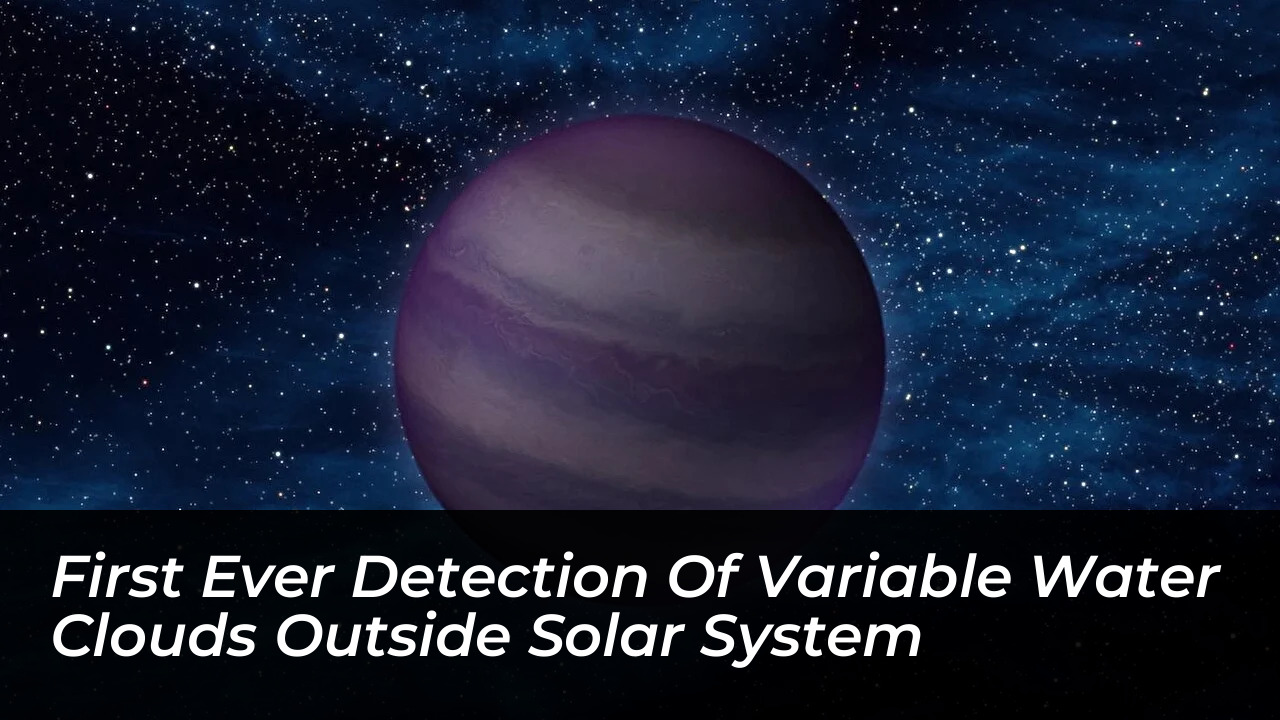

Astronomers using the James Webb Space Telescope (JWST) have captured the first direct confirmation of variable water clouds outside our solar system. The discovery centers on WISE 0855, the coldest known brown dwarf, located just 7.5 light-years away from Earth. By examining light spectra collected every 15 minutes over an 11-hour observation window, researchers tracked how water clouds in the distant object’s atmosphere shift in thickness over time, closely mirroring weather patterns seen on Earth and Jupiter.
The groundbreaking research was led by Brittany Miles, an assistant astronomer at the University of Arizona’s Steward Observatory. Her team found that WISE 0855’s atmospheric behavior is driven by two simultaneous physical processes: high-altitude water clouds growing thicker and thinner as the body rotates, and deep chemical gases being dredged upward through convection. The findings have been accepted for publication in The Astrophysical Journal and are currently available on the arXiv preprint server.
Reading the Atmosphere of a Frigid Brown Dwarf
Brown dwarfs occupy a strange astronomical middle ground. They are too massive to be standard planets yet too small to ignite nuclear fusion and become stars, glowing dimly with leftover heat from their formation. At roughly 265 kelvins (17°F or -8°C)-colder than Earth’s surface-WISE 0855 sits at the very bottom of the brown dwarf temperature scale. With roughly twice the mass of Jupiter and a nearly identical physical size, it behaves much like a free-floating giant planet.
Co-author Mark Marley, director and department head of the Lunar and Planetary Laboratory at the University of Arizona, compares studying such a cold world’s atmosphere to looking through a screen door.
“The photons go through the atmosphere and escape to space,” Marley said. “It’s like looking at the world through a screen door, where the screen is filtering out some of the light. We’re learning about the world on either side of the screen-but we also have to understand the screen itself.”
As WISE 0855 rotates, distinct patches of its surface rotate into view. Each patch features varying cloud cover and temperature levels. Utilizing JWST’s medium-resolution spectrograph, the research team isolated these differences across individual molecular features for the first time on an object this cold, moving past older photometric methods that blurred clouds, temperature, and chemistry together.
Deep Gases Rise via Convection
Along with tracking temperature variations tied to rotation, the spectrograph captured a rhythmic, wavelike signal corresponding to specific chemical gases: carbon monoxide and phosphine. These compounds fluctuate because heat churning from deep inside the brown dwarf pushes warmer material upward toward the surface-a process identical to a pot of hot soup circulating heat from the bottom.
This mechanism, known as disequilibrium chemistry, is well-documented on Jupiter, where convective mixing dredges gases from deep, hot layers into the visible atmosphere. However, capturing this dynamic in real time, molecule by molecule, on an extrasolar body represents a major milestone for observational astronomy.
Universal Physics Across Distant Worlds
According to Miles, the broader significance of the discovery lies in what it reveals about planetary atmospheres across the universe. The fundamental physics governing convection, cloud formation, and chemistry on Jupiter also applies to cold, free-floating worlds over seven light-years away. If these physical laws remain universal, they will directly inform how astronomers study gas giant exoplanets using JWST.
- Target Object: WISE 0855, the coldest known brown dwarf.
- Distance: Approximately 7.5 light-years from Earth.
- Temperature: Roughly 265 kelvins (17°F / -8°C).
- Key Findings: First observation of variable water cloud thickness and real-time convective gas shifting outside the solar system.
- Instrumentation: James Webb Space Telescope medium-resolution spectrograph.
“Even though brown dwarfs are not true planets, they exhibit planet-like behavior,” Miles noted. “There is a spectrum of behaviors-not a hard line between brown dwarfs and planets. Jupiter and this object look distinctly different, but they have similar weather patterns. There are basic physics and chemistry that can be applied across all of these worlds.”
With this initial success, the research team plans to log additional observation hours with JWST to refine baseline data on WISE 0855’s rotational period and uncover further three-dimensional nuances of its atmospheric dynamics.