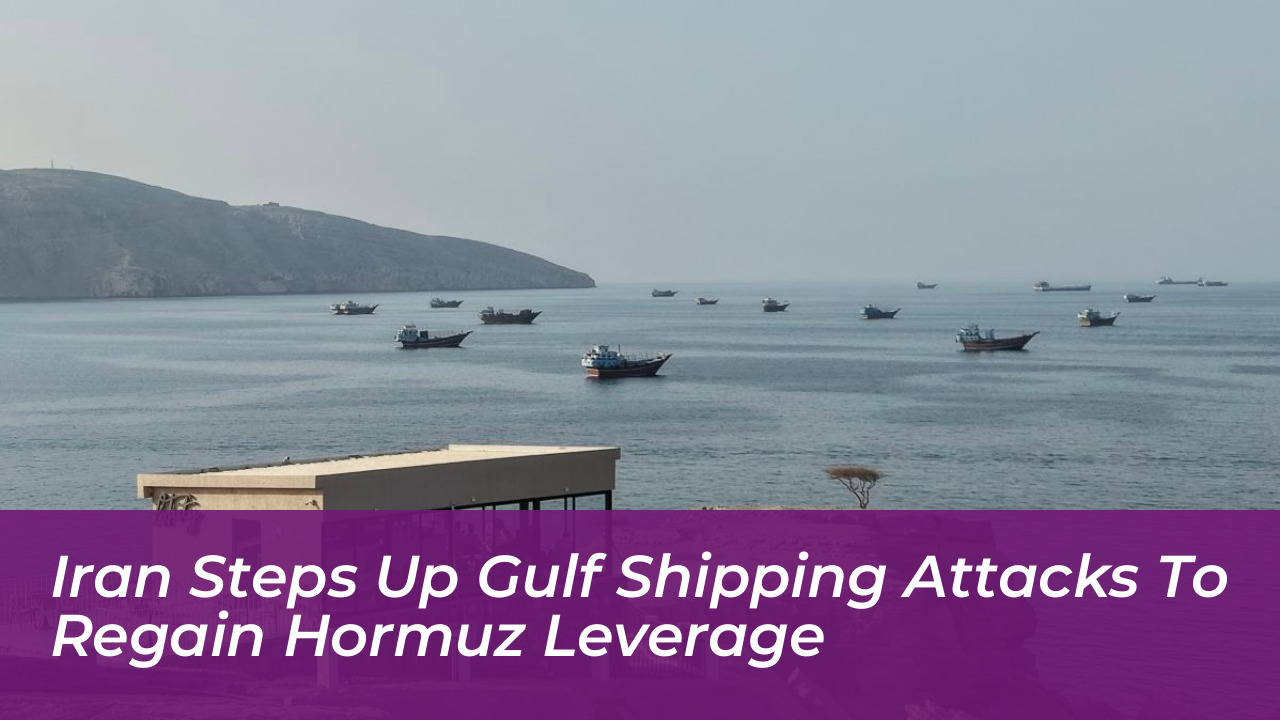

Iran has stepped up attacks and threats against commercial shipping in the Strait of Hormuz and the Persian Gulf since late September. Tehran seeks to restore its influence over a vital oil transit route as U.S. economic pressure intensifies. The escalating incidents have reduced tanker traffic through the strategic waterway. They have also helped keep global crude oil prices elevated above $100 a barrel, according to maritime security and shipping industry reports.
More than a dozen strikes against commercial shipping have occurred since the end of September. According to data from the International Maritime Organization (IMO), a United Nations agency, eleven tankers came under attack while transiting the Strait of Hormuz during the week ending October 4 alone. This marked the highest volume of strikes on commercial vessels since the current conflict began in late February.
Maritime security firms and coalition monitoring groups reported further incidents following the October spike. Twelve sailors were injured on a Monday when a projectile struck their tanker during its transit through the strait. According to the maritime security firm Marisks, the affected vessel, named On Peace, is owned by the United Arab Emirates, and the injured crew members are Indian nationals.
"These actions continue to demonstrate Iran's intent to assert its presence along key transit lanes and maintain pressure on transiting vessels," the Joint Maritime Information Center warned commercial ships in a notice. The center is a coalition of U.S.-allied militaries headquartered in Bahrain that monitors regional maritime security.
Impact on Crude Exports and Regional Traffic
The surge in attacks comes as crude oil exports from the Middle East had briefly rebounded in September to pre-war levels. U.S. military escorts utilizing routes along Oman's coast helped bolster this temporary recovery. However, the renewed targeting has quickly choked off those flows. Kpler data indicated that crude exports through the Strait of Hormuz fell to 8.5 million barrels per day (bpd) for the week ending Wednesday, roughly 40% below normal pre-war levels. Meanwhile, total shipments from the broader Middle East stood at 15.3 million bpd, down 10% from pre-war baselines.
"Volumes are getting through, but they're getting through at a time of extremely high maritime risk," said Michelle Wiese Bockmann, a senior maritime intelligence analyst at Windward. Richard Meade, editor-in-chief of the shipping trade journal Lloyd's List, added during a briefing that the current environment represents an unsustainable operational reality for global trade.
Iranian officials have defended the military posture, signaling that operations will not remain restricted to the immediate strait. A senior Islamic Revolutionary Guard Corps (IRGC) official stated that Tehran intends to block all unauthorized routes through the waterway. State media outlet Tasnim reported that the Guard will pursue vessels throughout the region that violate Iranian transit rules. Additional attacks have been documented further inside the Persian Gulf, including an incident where a tanker was struck off the coast of Qatar. Another vessel, the Gem No. 2, suffered a fire following a projectile strike off the coast of the UAE.
U.S. Political Strategy and International Diplomatic Efforts
Amid rising maritime tensions and energy market volatility, U.S. President Donald Trump addressed the geopolitical situation via social media. He stated that Washington will not launch offensive military strikes against Iran prior to the November 3 midterm elections. Administration officials expressed concern that surging energy costs could negatively impact Republican candidates defending congressional majorities.
Trump emphasized that his administration is actively pursuing diplomatic discussions with Tehran while prioritizing the primary objective of preventing Iran from acquiring nuclear weapons. Parallel diplomatic tracks have also advanced at the United Nations General Assembly in New York. There, regional mediators, including Qatar and Pakistan, have exchanged proposals between Washington and Tehran aimed at securing a short-term agreement to reopen formal negotiations and restore safe navigation through the Strait of Hormuz.
Despite these diplomatic engagements, the U.S. Treasury Department continues to enforce strict economic pressure. Treasury Secretary Scott Bessent announced measures targeting the international operations of Iranian airlines. He warned global service providers, airports, and financial institutions against supplying fuel, ground handling, or ticket sales to sanctioned carriers under threat of exclusion from the U.S. dollar financial system.
Frequently Asked Questions
Why is Iran targeting shipping in the Strait of Hormuz?
Iran has increased attacks on commercial tankers to reassert its regional leverage, disrupt vital energy transit lanes, and push back against heavy U.S. economic sanctions and naval blockades.
How have the attacks affected global oil prices and shipping volumes?
The security disruptions have reduced tanker transit volumes through the Strait of Hormuz by approximately 40% compared to pre-war levels. This reduction has helped sustain international crude oil prices above $100 per barrel.
What role are international mediators playing in the crisis?
Countries like Qatar and Pakistan have engaged in shuttle diplomacy between Washington and Tehran. They are attempting to broker short-term agreements that could restore navigation through the strait and revive broader diplomatic talks.
What is the official U.S. political and military stance regarding direct conflict?
The U.S. administration stated it would prioritize diplomatic channels and avoid large-scale military action ahead of the November midterm elections. Simultaneously, it maintains a regional naval presence to protect select commercial vessels and deter further escalation.
How are international airlines responding to recent U.S. sanctions?
Major international carriers, including Turkish Airlines, Emirates, Lufthansa, and Austrian Airlines, have suspended flights to and from Iran following strict new U.S. Treasury penalties targeting foreign companies servicing Iranian aviation assets.