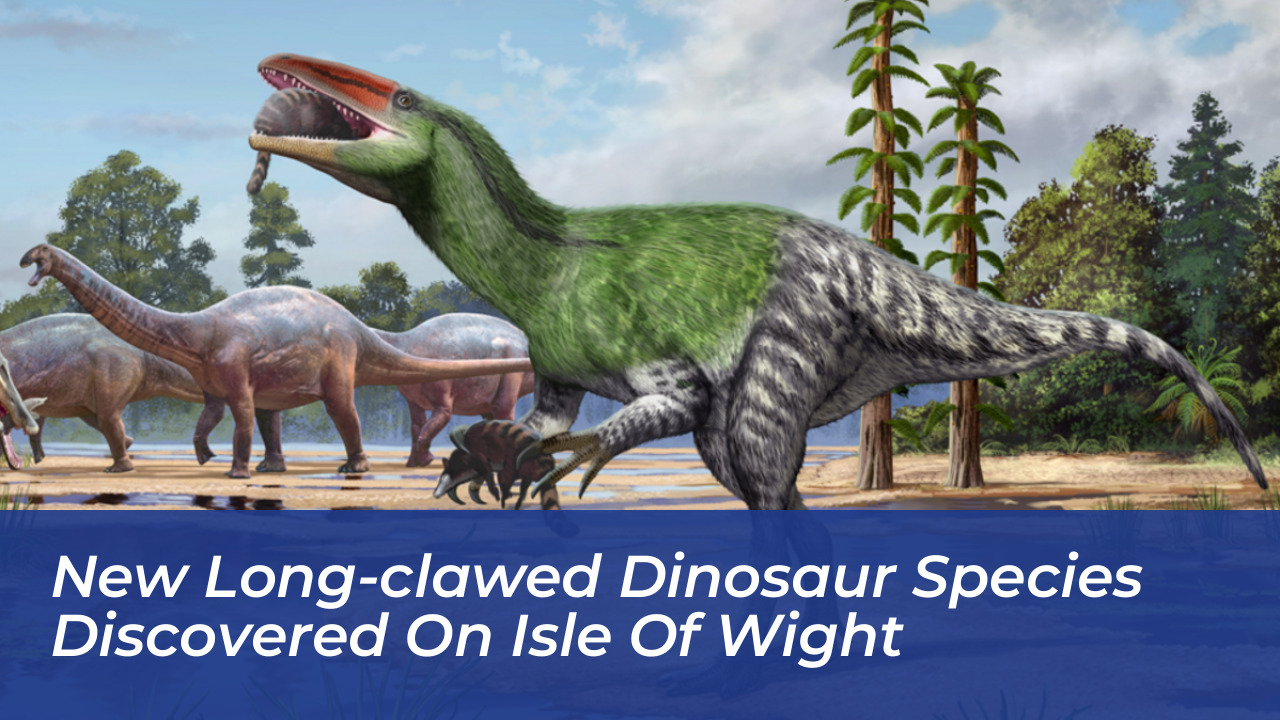

Researchers from University College London (UCL) and the Natural History Museum have identified a brand-new species of carnivorous dinosaur from a fossil that sat unexamined in a museum drawer for nearly a century. Named Invictibellatrix amberina, the long-clawed predator roamed the United Kingdom approximately 120 million years ago during the Early Cretaceous period.
The groundbreaking study, published in the journal Royal Society Open Science, reveals that the dinosaur belonged to a group of agile, two-legged carnivores known as megaraptorans. While closely related to apex predators like Tyrannosaurus rex, megaraptorans featured slender heads and captured their prey using massive arms and giant, curved claws instead of relying primarily on their jaws.
A Century-Old Mystery Solved
The fossilized specimen, consisting of a chunk from the back of a skull, was originally unearthed at the foot of a cliff on the south-west coast of the Isle of Wight by amateur palaeontologist Reginald Walter Tooley. Following his passing, the specimen was acquired by the Natural History Museum in London in 1924 alongside more than 1,000 other historical fossils.
Lead author Dr. Cassius Morrison of UCL Earth Sciences expressed astonishment that the specimen remained unstudied for so long. “It is a real mystery that this fossil was overlooked for so long, sitting in a drawer for nearly 100 years,” Dr. Morrison noted. “Lots of bones are found on the Isle of Wight-who knows what else is waiting to be discovered.”
Physical Characteristics and Ecological Role
Based on comparisons with related species, researchers estimate that Invictibellatrix amberina measured roughly three to four metres (10 to 13 feet) in length and stood just over 1.5 metres tall-roughly the height of an adult human. The predator likely possessed feathers and featured formidable claws measuring between 10 and 20 centimetres (four to eight inches) in length.
- Diet: Small dinosaurs, lizards, and mammals, occupying a niche similar to that of a modern-day hyena.
- Name Meaning: Invictibellatrix translates to “unconquered female warrior,” honoring megaraptorans’ eventual rise as apex predators, while amberina refers to the amber found in the surrounding rocks and serves as a female given name.
- Significance: It represents one of the smallest and earliest megaraptorans ever discovered.
Unlocking European Megaraptoran History
Prior to this discovery, no megaraptoran fossils had ever been found in Europe. Although these mysterious carnivores are thought to have originated in Asia before migrating through Europe and ultimately dominating the southern landmass of Gondwana (including modern-day South America, Africa, and Antarctica), concrete European fossil evidence was previously missing.
Co-author Charlie Scherer, a PhD student at UCL Earth Sciences, highlighted the significance of the find: “This new species is the first proof we have that megaraptorans were also present in Europe and that they reached Gondwana this way rather than island-hopping further south.”
To verify the classification, the research team performed high-resolution CT scans to construct a 3D digital model of the skull and braincase. Using advanced computer algorithms and mathematical modeling, they compared the bone traits against other theropods, confirming its unique placement within the megaraptoran lineage.
Professor Paul Barrett, senior author of the study from the Natural History Museum, emphasized the ongoing importance of historical museum archives. “Despite over 200 years of collecting, the Isle of Wight continues to surprise us with new dinosaur species,” Professor Barrett said. “Work like this shows the exceptional value of working with historical museum collections where there are still many discoveries to be made.”