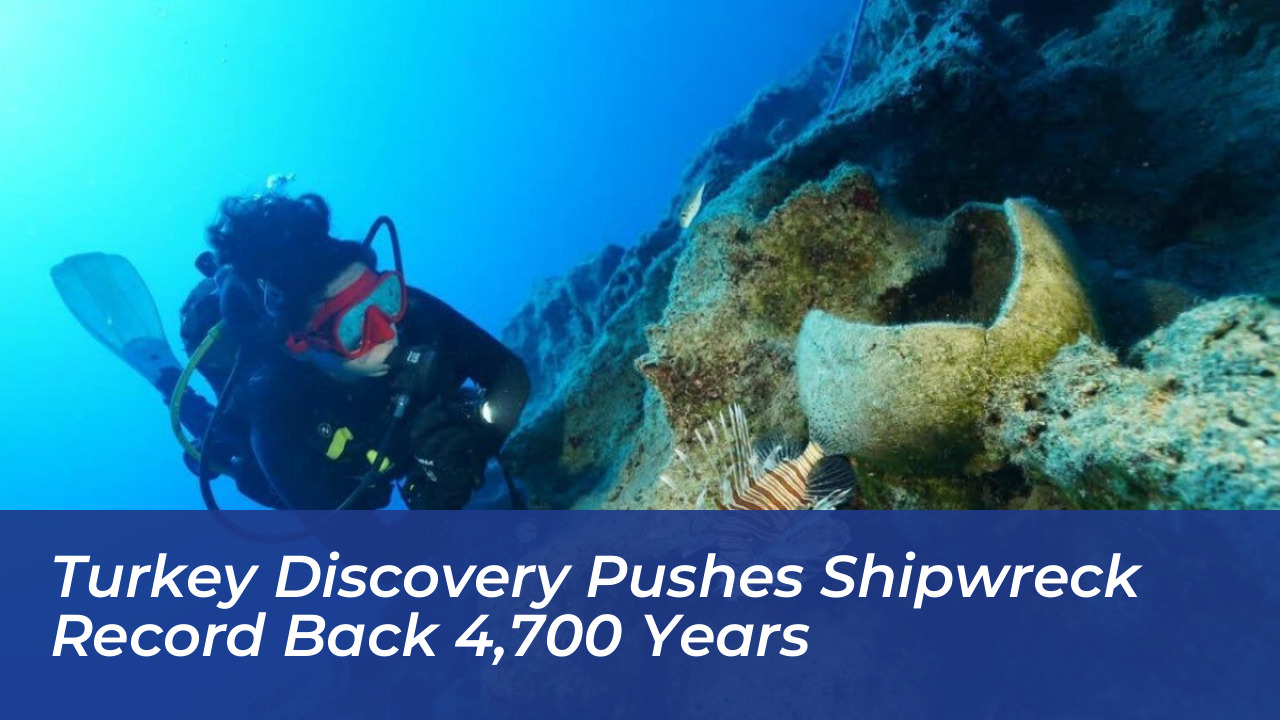

Archaeologists working off the southern coast of Turkey have identified what is now recognized as the world’s oldest known shipwreck. Discovered near Kekova Island in Antalya, the vessel dates back approximately 4,400 to 4,700 years to the Early Bronze Age. Announced by Turkey’s Culture and Tourism Ministry alongside major news organizations on October 14, 2026, the find shatters previous underwater archaeology records and sheds new light on ancient Mediterranean trade networks.
A 4,700-Year-Old Maritime Time Capsule
The shipwreck rests roughly 100 feet underwater. While the wooden hull of the nearly 33-foot-long trading vessel did not survive nearly five millennia submerged in the sea, its cargo remained remarkably well-preserved. Researchers recovered about 30 ceramic storage jars, known as amphorae, along with three stone anchors. Hakan Öniz, an associate professor at Turkey’s Akdeniz University who oversaw the expedition, described the site to media outlets as a true time capsule at the bottom of the sea.
The dating of the wreck places it in the exact same historical era when the ancient Pyramids of Giza were being constructed in Egypt. According to Turkey’s Culture and Tourism Minister Mehmet Nuri Ersoy, the discovery provides unprecedented insights into ancient trading connections and the everyday lives of early seafarers navigating the Mediterranean.
Tracing the Voyage and Cargo Origin
Scientific analysis of the clay used to manufacture the amphorae revealed critical clues about the ship’s journey. Researchers determined that the storage jars were produced in workshops located in the Jordan Valley, stretching along Jordan’s border with Israel and the West Bank. Experts believe the vessel was sailing westward from the Levantine coast, carrying essential commodities like olive oil or wine, possibly bound for ancient Troy or the Minoan civilization in Crete.
Similar amphora styles have previously been uncovered near Egyptian sites such as Giza, Saqqara, and Abusir, as well as in Troy and Crete. This widespread distribution pattern confirms that the newly discovered wreck was part of an extensive, highly active maritime trade network during the third millennium B.C.
Unique Markings Offer a Glimpse Into Sailor Life
Among the recovered artifacts, one specific amphora drew intense interest from archaeologists due to two distinct holes in its body and nine carved marks. Initial examinations indicate that the vessel may have served as a churning amphora used for producing cheese or butter on board. This detail suggests that ancient sailors may have transported live goats on long voyages, milking them during the journey to sustain themselves with fresh dairy products.
Reflecting on the dive, Öniz shared the emotional weight of interacting with objects untouched for nearly 5,000 years. The discovery not only edges the world shipwreck record back from a 4,200-year-old vessel previously found in the Aegean Sea near Greece, but it also humanizes the ancient producers, transporters, and sailors whose lives were linked to the sea.
Frequently Asked Questions
Where was the 4,700-year-old shipwreck discovered?
The shipwreck was discovered underwater off the southern coast of Turkey near Kekova Island in Antalya.
How old is the newly discovered shipwreck?
Archaeologists estimate the shipwreck dates back between 4,400 and 4,700 years, placing it in the Early Bronze Age.
What cargo did the ancient trade ship carry?
The ship carried roughly 30 ceramic storage jars called amphorae, which likely transported olive oil or wine produced in the Jordan Valley.
Who led the archaeological excavation team?
The scientific excavations were led by Associate Professor Hakan Öniz of Akdeniz University, operating under permits from the Turkish Ministry of Culture and Tourism.
Why is this discovery historically significant?
This find surpasses the previous record-holder for the world’s oldest known shipwreck-which was dated to 4,200 years ago in Greece-and offers vital evidence of extensive maritime trade networks in the Eastern Mediterranean during the third millennium B.C.