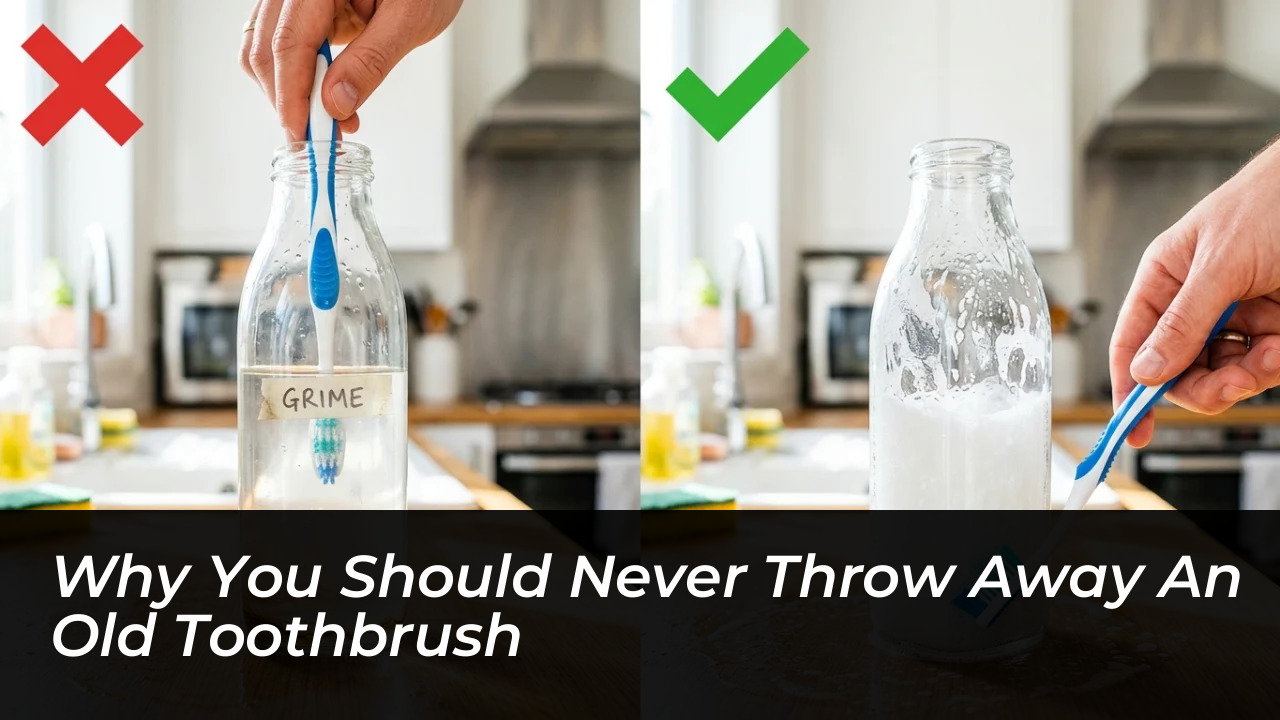

Instead of spending money on single-use scrubbers or throwing away worn oral-care plastics, you can transform an ordinary old toothbrush into a specialized cleaning tool in under five minutes. By applying controlled heat from an everyday cigarette lighter, standard straight handles can be reshaped into angled instruments capable of scrubbing the deepest corners of narrow-neck bottles, thermoses, and sports water vessels.
Everyday containers with narrow openings present a persistent cleaning challenge. Standard kitchen sponges and straight cleaning brushes simply do not fit through tight necks, leaving moisture, beverage residue, and stubborn grime to build up along bottom rims. Modifying standard household items offers a direct, low-cost fix that eliminates the need to buy specialty novelty tools.
How Thermal Reshaping Solves the Narrow-Bottle Problem
Standard manual toothbrushes feature straight plastic stems engineered strictly for linear mouth movement. This straight design prevents the bristle head from making flush contact with the interior base of a jar or bottle. Heating the polymer neck softens the material just enough to take on an intentional bend without snapping the handle.
Once angled, the bristles point directly into hard corners that straight scrubbers miss completely. The goal is to produce a durable 90-degree angle or gentle U-curve tailored to the exact depth and width of your containers. This structural transformation turns a discarded hygiene product into an effective detail brush that navigates tight openings while maintaining firm scrubbing pressure against interior walls.
Step-by-Step: Bending the Handle in Under 5 Minutes
The entire modification process requires just an old toothbrush and a standard cigarette lighter. Follow these simple steps to craft your custom cleaning tool:
- Apply controlled heat: Take an old toothbrush and run the flame of a lighter back and forth across the neck, directly behind the bristle head. Rotate the flame steadily for several seconds so the plastic warms evenly without burning, charring, or dripping.
- Bend into position: Once the neck feels pliable, gently fold the bristle head backward-facing away from the front of the handle-until it forms an angle close to 90 degrees or a tight U-shape.
- Set the shape with cold water: Hold the bent brush firmly in position and run it directly under a cold tap. The rapid temperature drop locks the plastic into its new shape within seconds.
Comparing Household Options for Deep-Reach Cleaning
Many households default to buying dedicated kitchen brushes or attempting to force bulky sponges inside narrow bottlenecks with cutlery. The table below outlines how this quick modification compares to conventional approaches.
| Cleaning Approach | Practical Performance |
|---|---|
| Modified old toothbrush | Zero extra cost; angled bristles reach tight corners; reusable and takes five minutes to prepare. |
| Standard sponge or cloth | Fails to fit narrow openings; cannot apply targeted pressure to container bottoms. |
| Commercial bottle brushes | Adds retail cost; straight handles often miss the curved interior corners of specialty bottles. |
Environmental and Everyday Household Benefits
A widespread misconception is that once bristles begin to fray for oral care, the entire tool becomes completely useless and belongs in the trash. In reality, bristles that are too worn for sensitive gumlines remain plenty firm enough to lift dried beverage residues, tea stains, and deep grime.
- Fast and effortless: The full process takes less than five minutes from heating to cold-water setting.
- Inexpensive: Eliminates the need to buy specialized bottle brushes for odd-sized containers.
- Eco-conscious reuse: Extends the practical lifespan of bathroom plastics before disposal.
- Deep reach: Fits through tight bottle necks while keeping stiff bristles pressed against the base.
- Multi-surface utility: Functions smoothly for routine maintenance around faucets, grout, and tight fixtures.
Try this simple kitchen hack the next time you replace your toothbrush. Take a close look at your hardest-to-reach bottles before tossing worn cleaning tools away, and enjoy a cleaner home with zero extra expense.
Frequently Asked Questions
Can any toothbrush be bent using a lighter?
Most standard plastic manual toothbrushes made from polypropylene or polyethylene can be successfully heated and bent. However, results may vary with rigid specialty plastics or bamboo handles, which will scorch or burn rather than soften flexibly.
Is it safe to use a heated plastic toothbrush for food containers?
Yes, as long as you do not burn or char the plastic. Heating the polymer only softens it to a pliable state. Be sure to thoroughly wash the modified brush with soap and warm water before using it on kitchenware.
How do I clean the modified toothbrush before use?
Before putting your repurposed toothbrush to work, give it a thorough cleaning. Soak it in a mixture of half vinegar and half water for 30 minutes, rinse with hot water, and let it air dry completely.
What temperature drop locks the plastic handle in place?
Running the newly bent plastic handle directly under cold tap water causes a rapid temperature drop that solidifies the polymer into its new 90-degree or U-shape within seconds.
Will the bent plastic handle straighten out over time?
Once the polymer has been thermally reshaped and cooled rapidly with water, the structural change is permanent. The handle will maintain its rigid angle during normal scrubbing pressure.