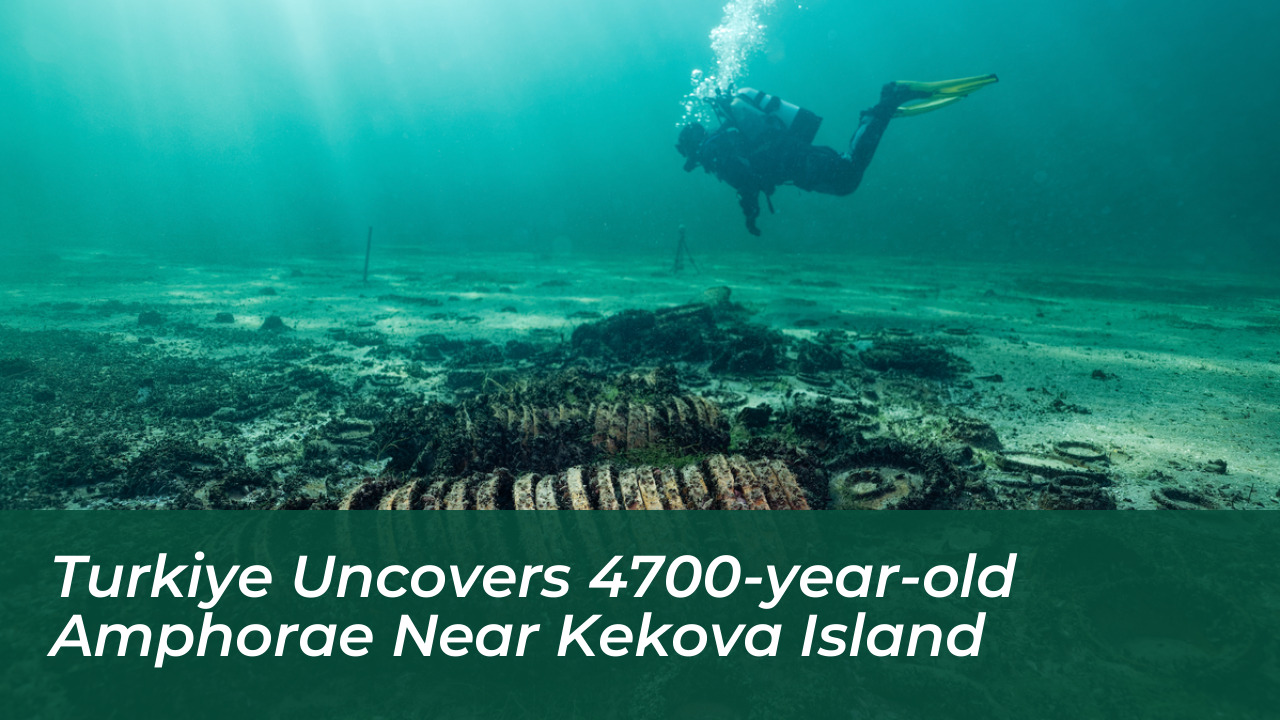

Underwater archaeologists working off the southern coast of Antalya, Turkiye, have uncovered a remarkable collection of approximately 4,700-year-old amphorae. Announced on October 14, 2026, by Turkish Minister of Culture and Tourism Mehmet Nuri Ersoy, the discovery near Kekova Island brings to light vessels connected to what experts describe as one of the world’s oldest known shipwrecks.
The excavation site rests along an underwater slope about 30 meters beneath the surface of the Mediterranean Sea. Although the wooden hull of the merchant vessel completely dissolved over millennia, researchers identified three large stone anchors and more than 30 ceramic storage containers known as amphorae. Some of these jars still preserve interior organic residues.
Dating the Early Bronze Age Merchant Vessel
Because no organic timber survived for traditional radiocarbon dating, scientific teams determined the age of the site by analyzing the distinct typology of the pottery. Led by Associate Professor Hakan Öniz of Akdeniz University and the Mediterranean Archaeology Association, researchers matched the flat bases, central ridges, and double-handle design of the Kekova pots to artifacts found in Egypt and the Middle East.
Dr. Karin Sowada, an archaeologist from Macquarie University in Australia who examined the recovered containers, noted that several vessels contained a thick, glossy residue. Initial evaluations indicate the jars were used to transport staple commodities of the ancient world, such as olive oil, wine, or tree resins.
“The shipwreck is a time capsule at the bottom of the sea,” Öniz stated, emphasizing the rare opportunity to study a merchant vessel dating back to the period when Egypt’s Great Pyramid was constructed.
Tracing Ancient Eastern Mediterranean Trade Routes
Clay analyses conducted on the ceramic vessels suggest they were manufactured in workshops located within the Jordan Valley. The presence of identical ceramic styles across archaeological sites in Egypt-including Giza, Saqqara, and Abusir-as well as in Troy and Crete, highlights extensive maritime trade networks operating across the Eastern Mediterranean during the Early Bronze Age.
Historians believe the ship likely departed from a port along the Levantine coast before attempting a voyage northward toward Troy or westward toward Minoan Crete. Navigating these waters proved perilous, as strong coastal winds and severe currents around Kekova Island historically claimed numerous vessels.
Clues to Sailor Daily Life and Unusual Artifacts
Beyond commercial cargo, the excavation yielded unusual findings that offer a glimpse into the daily lives of ancient mariners. One unique amphora features nine distinct exterior markings and two body holes. Researchers hypothesize that it functioned as a churn for producing butter or cheese at sea, suggesting sailors may have maintained live goats aboard their cargo ships during lengthy voyages.
Minister Mehmet Nuri Ersoy confirmed that the recovered artifacts will soon be displayed for the public at the newly established Mediterranean Underwater Archaeology Museum in Antalya. The find officially surpasses previous ancient shipwreck records, including a 4,200-year-old site discovered off the coast of Dokos in Greece.
Frequently Asked Questions
Where was the 4,700-year-old shipwreck discovered?
The shipwreck site is located approximately 30 meters underwater near Kekova Island off the coast of Antalya in southern Turkiye.
How did archaeologists date the shipwreck without wood?
Because the wooden hull completely degraded over time, archaeologists analyzed the specific shape, handle placement, and decorative styles of the recovered ceramic amphorae, matching them to dated artifacts from Egypt and the Middle East.
What cargo did the Bronze Age ship carry?
Researchers recovered ceramic amphorae that preserve residues believed to be olive oil, wine, or tree resins, alongside three massive stone anchors.
Who led the underwater archaeological expedition?
The underwater excavations were supervised by Associate Professor Hakan Öniz of Akdeniz University under the Antalya Museum Directorate and the Turkish Ministry of Culture and Tourism.
Where will the recovered amphorae be exhibited?
The artifacts are currently undergoing conservation and are scheduled to be placed on public display at the new Mediterranean Underwater Archaeology Museum in Antalya.