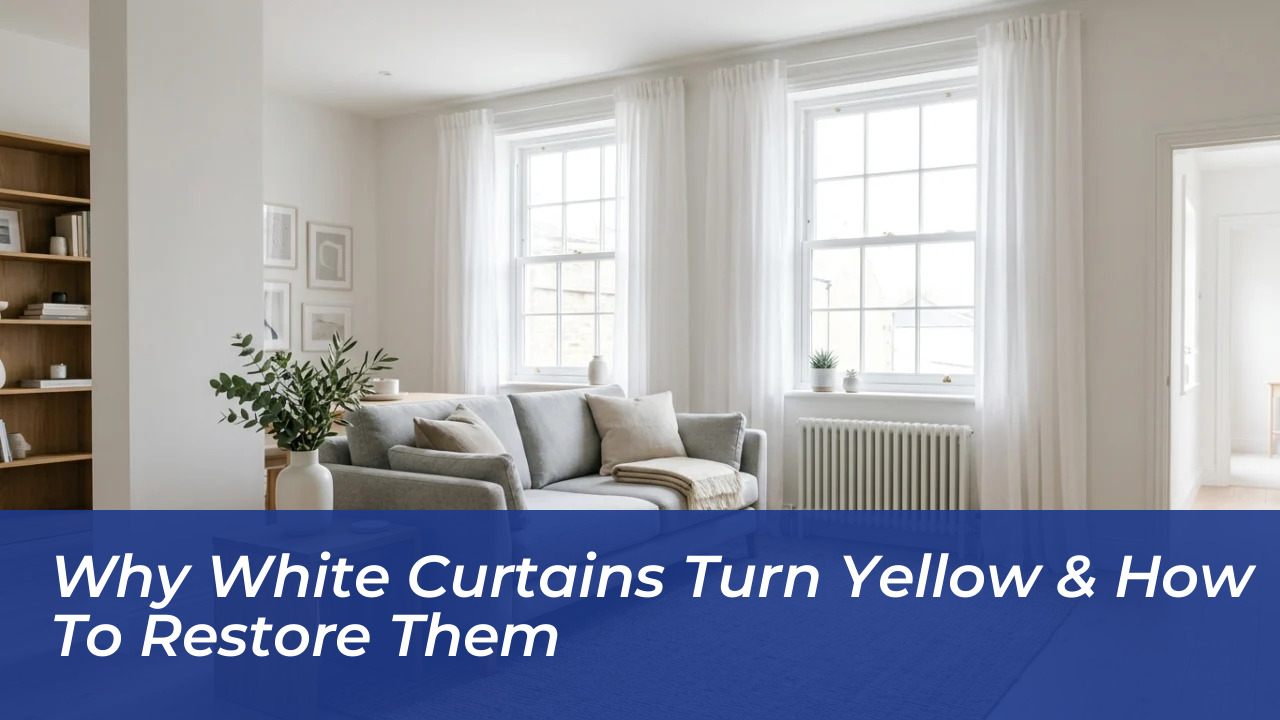

When bright daylight streams through a window, thin curtain fabrics expose every trace of discoloration. Regular machine cycles frequently remove surface dust while leaving behind an unflattering yellow or dull gray cast. This contrast often leads homeowners to believe the fabric is permanently ruined, prompting premature replacements. However, restoring yellowed curtains does not require aggressive chlorine bleach or an expensive trip to the store. A targeted soak using an oxygen-based whitening agent dissolves accumulated grease, mineral deposits, and detergent buildup within one to two hours, visibly brightening delicate sheers without dissolving fragile synthetic threads.
The true culprit behind the haze is rarely surface dirt alone. Daily environmental exposure, kitchen steam, and even standard laundry practices leave behind unseen residues that bake directly into the weave. Understanding the root causes of this discoloration helps you choose the correct revival method and prevents further damage to your window dressings.
The Hidden Science Behind Fabric Discoloration
A pristine living room is no guarantee against dull window treatments. Even in immaculate spaces, window sheers act as passive air filters, absorbing fine airborne particles, humidity swings, and temperature shifts throughout the day. In dining areas and kitchens, microscopic aerosolized cooking grease settles deep between fibers, bonding with dust to form a stubborn film. Over time, exposure to air and light oxidizes these oils and body secretions, turning them yellow in a process very similar to how white shirt collars discolor with age.
Hard wash water and excessive detergent often compound the problem. When too much laundry soap is added to a delicate cycle, the washing machine cannot rinse away the suds completely. Surfactants and dissolved tap minerals remain trapped inside synthetic yarns, attracting more grime over time and creating a chalky, grayish tone.
A common mistake in practice is treating fiber age and fiber dirt as the same problem. Not every type of yellowing can be washed away. Prolonged exposure to solar ultraviolet rays chemically degrades delicate synthetic fibers like polyester. When sunlight breaks down the core polymer chains, the resulting amber shift is permanent, making aggressive chemical treatments useless.
The Chlorine Myth vs. Oxygen Whitening
Reaching for traditional chlorine bleach is the most common mistake made when reviving thin window fabrics. While chlorine works as an aggressive disinfectant, it weakens synthetic fibers, corrodes fine seams, and can chemically react with certain textile coatings to turn synthetic whites permanently bright yellow.
A gentler and far more effective alternative is an oxygen-based laundry booster. These formulations typically rely on sodium percarbonate, a compound that releases hydrogen peroxide upon contact with water. Hydrogen peroxide breaks down organic discoloration and dissolves oily residues without eroding polyester, cotton, or blended fabrics.
Step-by-Step Restoration Soak
Executing a successful oxygen bleach soak requires careful preparation and adherence to water temperature guidelines:
- Prep the hardware: Take down the panels, detach all plastic or metallic drapery hooks, and shake the fabric gently outside to dislodge loose surface dust.
- Dissolve the powder: Fill a clean tub or large basin with lukewarm water between 85°F and 105°F (30°C to 40°C). Add the packaging-recommended dose of oxygen bleach, stirring thoroughly until every granule is completely dissolved.
- Submerge and rest: Immerse the fabric fully into the solution. Allow it to soak undisturbed for 60 to 120 minutes, avoiding aggressive scrubbing or wringing that could stretch fragile threads.
- Rinse and cycle: Drain the basin, rinse out the soaking solution with clear water, and transfer the curtains to the washing machine for a gentle final cycle.
Oxygen whiteners are safe for synthetic and cotton fabrics, but they should never be used on natural wool or pure silk. Additionally, different chemical cleaning agents and bleaches must never be mixed together in the same soak.
Washing and Spinning Without Damaging Delicate Weaves
A successful chemical lift can be ruined instantly inside an overloaded wash drum. Wet curtains gain significant weight, and cramming multiple large panels together causes severe friction, permanent creasing, and uneven detergent distribution. Wash large panels individually or in pairs to leave ample space for free movement.
Place delicate sheers inside a spacious mesh laundry bag to prevent snags on drum perforations. Select a delicate or wool cycle with a low spin speed. Standard high-velocity spins twist sheer fabrics under heavy centrifugal forces, breaking delicate stitching and locking in wrinkles that are nearly impossible to remove later.
Maintenance Factor Best Practice
- Soak Water Temperature: 85°F to 105°F (30°C to 40°C)
- Recommended Brightener: Sodium percarbonate oxygen bleach
- Machine Wash Program: Delicate cycle with a mesh bag
- Spin Setting: Low or gentle speed reduction
- Drying Technique: Damp hang directly on the rod
Laundry bluing products can provide temporary visual improvement by depositing a minute blue tint that neutralizes yellow light reflection. However, optical bluing does not remove embedded soils, and uneven dilution risks leaving noticeable blue blotches across sheer panels.
The Gravity Drying Technique That Eliminates Ironing
Ironing wide sheer panels is notoriously awkward and introduces the risk of melting heat-sensitive synthetic fibers on the board. The simplest way to achieve a crisp, wrinkle-free finish bypasses the iron entirely through natural hanging.
As soon as the delicate wash cycle finishes, take the panels out while they remain uniformly damp. Reattach the hooks and hang them directly back onto the curtain rod. The downward pull of moisture and fabric weight naturally pulls out surface creases as the panels air-dry in position. Ensure the fabric is damp rather than soaking wet so water does not drip onto hardwood floors or window sills. Ventilate the room thoroughly to promote airflow, keeping your window dressings bright and fresh without unneeded fabric stress.
Frequently Asked Questions
Why do my white curtains turn yellow even when I wash them regularly?
Curtains absorb airborne dust, cooking grease, cigarette smoke, and humidity swings daily. Over time, these organic residues combine with detergent buildup and oxidize when exposed to sunlight and heat, resulting in a yellowed or dingy gray cast.
Can I use chlorine bleach to whiten my polyester or nylon sheer curtains?
No. Chlorine bleach chemically reacts with synthetic polymers and finishes, often turning them permanently yellow while simultaneously weakening the delicate fibers and seams over time.
How long should I soak yellowed curtains in oxygen bleach?
For best results, submerge your curtains in a lukewarm solution of water and sodium percarbonate (oxygen bleach) for 60 to 120 minutes, or longer for heavy organic discoloration, before transferring them to a gentle machine wash.
What should I do if the yellowing does not wash out?
If a hydrogen peroxide or oxygen soak yields no change and the fabric feels brittle, the discoloration is likely permanent ultraviolet (UV) photo-degradation. At this stage, chemical treatments cannot reverse the structural damage, and replacement is recommended.
How can I dry my curtains without getting wrinkles?
Skip the clothes iron and the tumble dryer entirely. Reattach your damp curtains directly to the hanging hardware; the natural weight and moisture will pull out wrinkles smoothly as they air-dry in place.