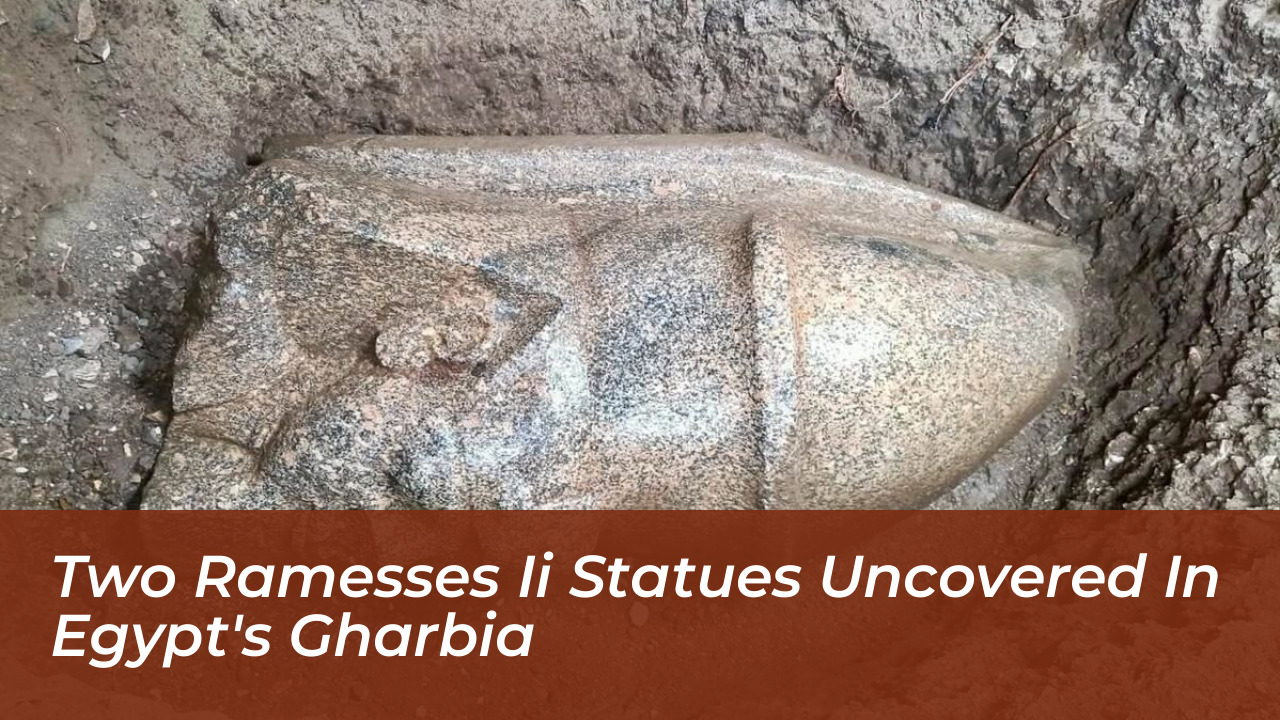

Egyptian archaeological authorities have announced the discovery of two monumental royal statues believed to depict the Pharaoh Ramesses II. The artifacts were unearthed during rescue excavations conducted by the Supreme Council of Antiquities in the village of Behbeit El-Hagar, located within Egypt’s Gharbia Governorate.
The discovery began when a local resident encountered an inscribed stone block while working on a plot of land in front of his home. Demonstrating civic awareness, the resident immediately notified the local antiquities inspectorate. An initial examination confirmed the site’s historical significance. Officials then completed legal procedures and deployed a specialized excavation team from the Supreme Council of Antiquities.
Details of the Monumental Statues
Dr. Hisham El-Leithy, Secretary-General of the Supreme Council of Antiquities, detailed the specific finds recovered from the Nile Delta site:
- The First Statue: This piece consists of a massive head measuring approximately 1.60 meters in height. It depicts Ramesses II wearing the double crown, or pschent, which symbolized the unification of Upper and Lower Egypt. Archaeologists also recovered part of the back pillar featuring the king’s Horus name, “Hor Ka-nakht Mery-Ma’at.” Based on these dimensions, researchers estimate the complete statue originally stood around 8.5 meters tall, including its base.
- The Second Statue: This figure measures approximately 2.40 meters in length, though it is missing its legs and base. It portrays the king wearing the traditional nemes headdress. Its facial features remain remarkably well-preserved and closely resemble the first sculpture.
- The Granite Block: Discovered roughly one meter north of the second statue, this pink granite block measures 1.30 meters long. It features hieroglyphic inscriptions displaying two royal titles of Ramesses II: “Nesu-Bity” (King of Upper and Lower Egypt) and “Sa-Ra” (Son of Ra).
Significance of Behbeit El-Hagar
Minister of Tourism and Antiquities Sherif Fathy praised the quick actions of the local resident. He emphasized that the discovery enriches the archaeological record of Behbeit El-Hagar. The village is already widely recognized as a significant archaeological zone in the Nile Delta, renowned for the ruins of a massive temple dedicated to the goddess Isis.
Ramesses II, commonly referred to as Ramesses the Great, ruled Egypt during the 19th Dynasty of the New Kingdom period from approximately 1279 to 1213 BC. His long reign was defined by extensive architectural and military undertakings across Egypt and Nubia.
The Supreme Council of Antiquities confirmed that excavation work and scientific analyses remain ongoing at the site. Researchers aim to establish the precise chronological and architectural relationship between the newly uncovered statues, the inscribed granite block, and the broader remains of the ancient temple complex.