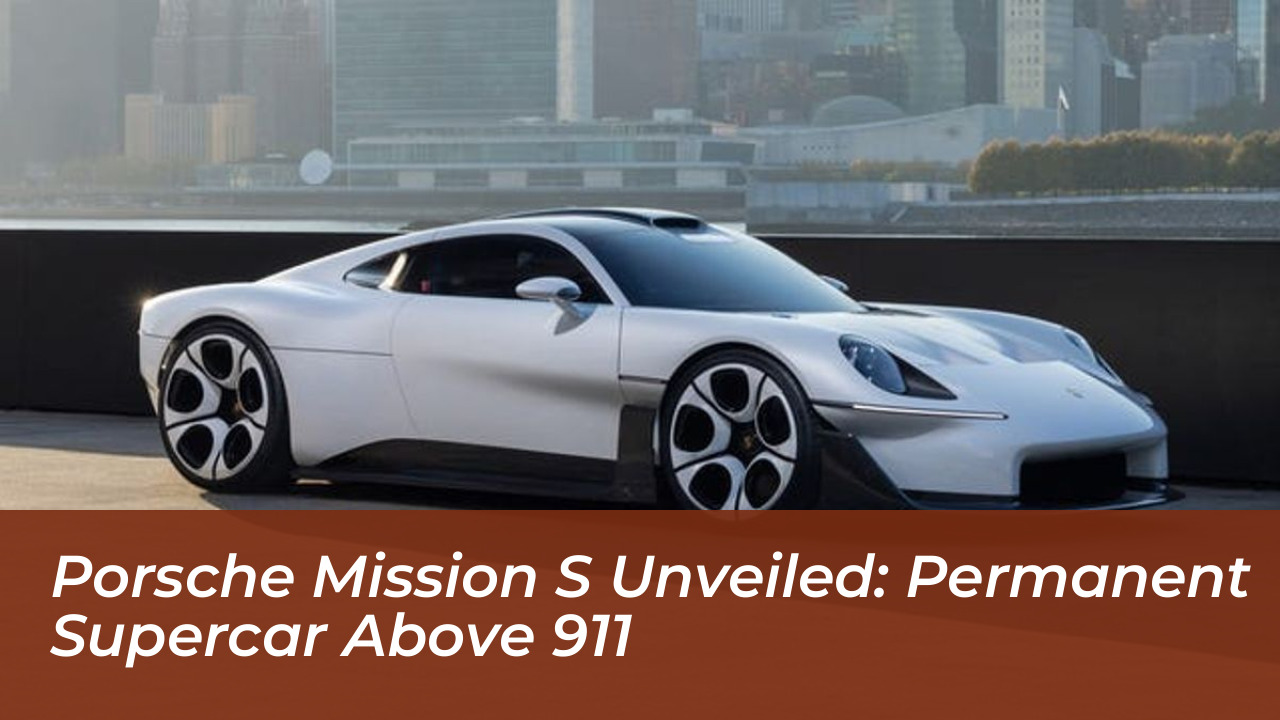

Porsche has officially pulled the cover off the Mission S concept during a global debut in Queens, New York. Unveiled on October 15, 2026, the striking vehicle previews a brand-new mid-engine supercar platform strategically positioned above the iconic 911. Unlike previous ultra-exclusive halo cars such as the Carrera GT or the 918 Spyder, German automaker leadership has confirmed that the upcoming production variant will serve as a permanent, versatile addition to the core commercial lineup rather than a limited-production hypercar.
The debut location carried profound historical weight for the brand. The Queens pier serves as the exact site where the original 550 Spyder was first photographed back in 1953 against the Manhattan skyline. By returning to this location, Porsche is signaling a strategic shift under its new “Sportwagenschmiede ’35” realignment. Facing fluctuating profit margins across the automotive industry, Porsche is pivoting toward a “value over volume” strategy that prioritizes high-margin, highly individualized sports car platforms.
Historic Exterior Design Cues and Styling
Led by Tobias Sühlmann, Head of Style Porsche, the exterior of the Mission S serves as a comprehensive visual timeline of the company’s greatest motorsport hits. The design philosophy relies on a mid-engine layout to create a sculptural appearance characterized by floating volumes and a continuous wraparound line linking the front and rear light signatures.
- Front End: The flat, aggressive nose takes direct inspiration from the legendary 911 GT1.
- Side Profile: Shut lines seamlessly merge into lighting graphics as an intentional homage to the classic G model, while cooling intakes reference the historic 917 Le Mans racer.
- Roofline: The dynamic, sweeping roof sits neatly beneath the rear wing, instantly recalling the silhouette of the 959.
- Wheels: The dial-style wheel design traces its roots back to the 928, re-engineered with modern lightweight construction techniques.
To honor its racing roots further, the concept is coated in a bespoke color palette consisting of Firn White Metallic, Light Red Metallic, and Black Chrome, purposefully reinterpreting classic Porsche Motorsport liveries.
A Driver-Focused Cabin Rejecting Digital Clutter
Inside the cabin, the Mission S takes a radical stance against the modern automotive industry’s obsession with massive dashboard displays and digital saturation. Taking layout inspiration from the early 356 and 550 Spyder, the interior features a clean, uncluttered layout finished in a specialized “Special Black” tone.
Porsche has completely omitted a permanent center touchscreen and passenger display. Instead, the dashboard features a retractable, MagSafe-compatible smartphone mount. This allows the driver’s personal iPhone to function seamlessly as the primary navigation and infotainment hub only when requested, keeping the dash entirely uninterrupted the rest of the time.
Behind the steering wheel sits a reimagined instrument cluster featuring five round analog-digital hybrid displays. The central rev counter houses a physical analogue needle with a digital backdrop, and the entire physical unit adjusts its positioning closer to the driver depending on the chosen driving mode. Drivers can even utilize the My Porsche App to select historically inspired digital renderings for these circular gauges.
Powertrain Expectations and Internal Combustion Clues
While Porsche executives have confirmed that the mid-engined platform is locked in for official series production, comprehensive technical specifications remain under wraps. Following the quiet shelving of the all-electric Mission X concept originally shown in 2023, automotive enthusiasts have looked closely at the Mission S for clues regarding its propulsion system.
Visual clues inside the cabin confirm the presence of an internal combustion engine. Imagery of the instrument cluster reveals an 8,000-rpm redline in “Normal” driving mode, alongside outer digital gauges actively displaying live oil pressure (reading 4.8 bar) and oil temperature. These metrics entirely rule out a pure battery-electric drivetrain.
Industry insiders and rumors strongly point toward a newly developed, high-performance internal combustion engine-potentially a hybrid-assisted or turbocharged flat-eight configuration-designed to meet stringent modern emissions regulations while delivering uncompromising racetrack performance.
Strategic Importance Under Sportwagenschmiede ’35
The introduction of the Mission S is much more than a design exercise; it is a foundational pillar of Porsche’s long-term business plan. Dr. Michael Leiters, Chairman of the Executive Board of Porsche AG, emphasized that the new platform addresses a long-standing gap in the company’s portfolio.
“The Mission S represents a mid-engined super sports car platform positioned above the 911, not as a one-off hypercar, but as a permanent and versatile addition to our customer offering,” stated Dr. Michael Leiters during the global reveal.
By establishing a permanent tier above the 911, Porsche intends to capture a dedicated segment of buyers looking for ultimate engineering excellence, lightweight construction, and authentic analog driving dynamics. Official pricing, exact powertrain details, and production release timelines are expected to be announced in the coming months as development progresses toward series manufacturing.
Frequently Asked Questions
What is the Porsche Mission S?
The Porsche Mission S is a vision model and concept vehicle unveiled in Queens, New York, on October 15, 2026. It previews a permanent mid-engine super sports car platform that will sit directly above the 911 in Porsche’s lineup.
Will the Mission S go into production?
Yes. Unlike previous one-off electric concepts like the Mission X, Porsche has confirmed that the Mission S previews a permanent, series-production sports car platform rather than a limited-run hypercar.
What type of powertrain does the Mission S have?
While official technical specifications are unreleased, interior cabin imagery reveals an 8,000-rpm redline and live oil pressure gauges, confirming the presence of an internal combustion engine-with strong industry rumors pointing toward a hybrid flat-eight layout.
Does the Mission S feature a large touchscreen display?
No. Rejecting the modern automotive trend of large digital screens, the Mission S features no permanent center screen or passenger display. It uses a clean dashboard layout equipped with a retractable, MagSafe-compatible smartphone mount.
Which historic Porsches inspired the exterior design?
The exterior styling draws inspiration from several historic models, including the 550 Spyder, 911 GT1 (flat nose), 959 (roofline), 917 (cooling intakes), and the 928 (dial-style wheels).