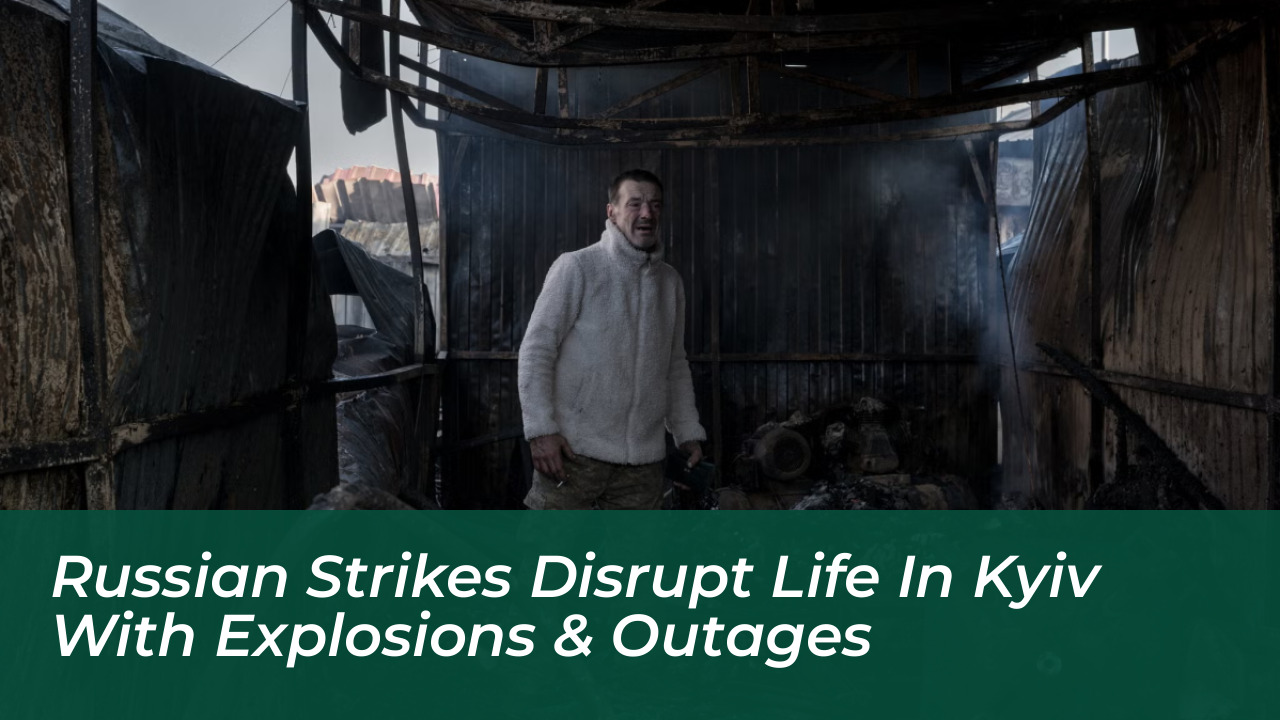

Repeated Russian missile and drone attacks have severely disrupted daily life in the Ukrainian capital, forcing residents to seek shelter in hallways and basements as explosions shake the city. The sustained bombardment has targeted critical infrastructure, damaged key transportation routes, and triggered widespread power outages across Kyiv.
For residents like Nikita Horskyi and Alona Horska, air-raid alarms have become a terrifying routine. When sirens sounded at 3:11 a.m., nearly 10 explosions struck within three minutes, jolting the family awake. Because their 16-story apartment building lacks a proper bomb shelter, Horskyi carried their two children into the apartment hallway, relying on the two-wall rule for protection while Horska prepared makeshift beds.
The human toll of these relentless assaults continues to mount. Officials reported that two security guards were killed when nearby missiles struck during the predawn barrage. The attacks have extended far beyond residential areas, directly impacting Kyiv’s vital transit and energy networks.
Infrastructure and Transportation Under Fire
Recent strikes have forced the full or partial closure of critical bridges crossing the Dnipro River. Kyiv Mayor Vitalii Klitschko confirmed that a strike on Kyiv’s Northern Bridge damaged the road surface and trolleybus cables, suspending vehicular traffic and causing massive tailbacks for commuters. This follows a pattern of attacks affecting gas stations, warehouses, data centers, and historic markets like the “Shayba” railway market near Kyiv Central Station.
Energy facilities have also borne the brunt of the offensive. Widespread power and voltage drops have temporarily halted Kyiv Metro train services, escalator operations, and water pumping networks across districts such as Holosiivskyi, Solomianskyi, and Shevchenkivskyi. Emergency power cuts implemented by Ukrenergo and DTEK have plunged neighborhoods into near-total darkness, bringing the familiar hum of generators back to city streets ahead of winter.
Broader Regional Impact and Air Defense Challenges
The aerial war has intensified as Moscow deploys hard-to-intercept ballistic missiles, jet-powered drones, and low-cost loitering munitions like Banderol cruise missiles. Ukrainian air force officials noted that these tactics are designed to overwhelm air defense systems and target critical civilian nodes, including pharmaceutical facilities and railway lines.
The ripples of the conflict are crossing borders. Moldovan President Maia Sandu reported that Russian air attack weapons violated Moldovan airspace, with several drones exploding on national soil. Meanwhile, Ukrainian authorities and international leaders continue to grapple with supply constraints on vital interceptor missiles and air defense equipment as regional security risks escalate.
Despite the constant disruptions, residents across Kyiv navigate daily life under the persistent threat of air raids. They attempt to maintain routine activities while coping with the physical and psychological exhaustion of a protracted war.