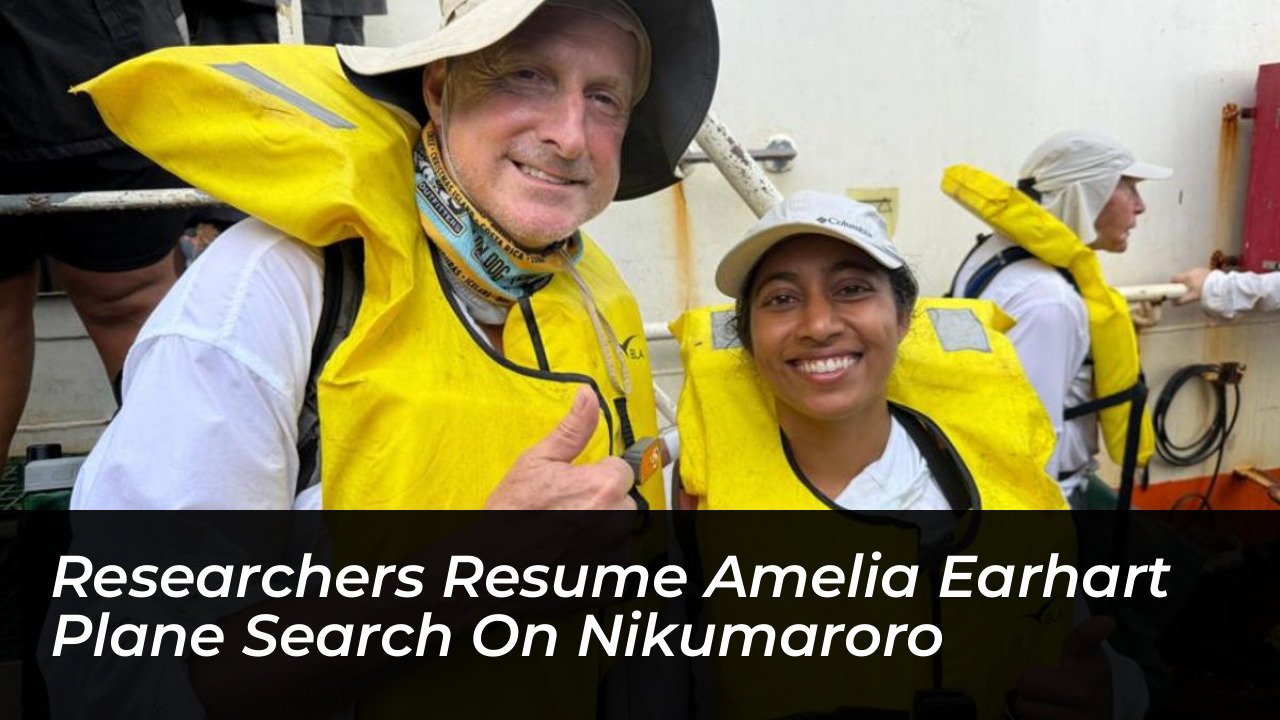

Researchers investigating the disappearance of legendary American aviator Amelia Earhart have resumed fieldwork on Nikumaroro, a remote coral atoll in the Republic of Kiribati. Operations on the uninhabited island temporarily stalled after rough seas and strong winds driven by El Niño conditions battered the region, forcing a 17-member expedition team to remain aboard their research vessel for three days.
The expedition is a joint effort spearheaded by Purdue University and the Archaeological Legacy Institute (ALI). The team arrived at the Phoenix Islands atoll aboard the vessel Marin Mainiku to inspect an underwater feature known as the Taraia Object. First identified in modern satellite imagery and visible in historical aerial photographs dating back to 1938, the anomaly rests in shallow lagoon waters and matches the general proportions of a small aircraft fuselage and tail.
Overcoming Pacific Weather and Island Hazards
Severe weather disrupted the early stages of the project. Strong winds gusting up to 27 knots (31 mph) made boat transfers across the atoll’s perimeter reef hazardous. Sirisha Bandla, a technology specialist and Purdue alumna participating in the mission, noted that the weather prevented the team from advancing past initial underwater surveys into active probing and sediment dredging phases.
To make up for lost time, the crew extended the expedition timeline. Even with improved weather allowing researchers to finally go ashore, daily operations remain dictated by shifting tides and challenging marine conditions. The team must return to the Marin Mainiku each evening to sleep safely offshore, avoiding Nikumaroro’s massive population of nocturnal coconut crabs, which pose a distinct physical hazard to campers.
The Castaway Hypothesis and the Taraia Object
Amelia Earhart and her navigator, Fred Noonan, vanished on July 2, 1937, while attempting to fly around the globe along an equatorial route. After departing Lae, Papua New Guinea, their twin-engine Lockheed Electra 10-E failed to reach Howland Island to refuel. While official records concluded the plane ran out of fuel and crashed into the open ocean, proponents of the “castaway hypothesis”-championed extensively by The International Group for Historic Aircraft Recovery (TIGHAR)-theorize that Earhart and Noonan successfully navigated south to Nikumaroro and lived as castaways.
The current expedition aims to test that theory using non-destructive maritime archaeology tools. The multi-step investigation protocol includes:
- Magnetometer Surveys: Scanning the lagoon floor for ferrous metals, such as steel cables and engine components, which persist even if aluminum structures corrode.
- Sonar Mapping: Employing high-frequency acoustic technology to map objects buried beneath sediment.
- Hydroprobe Inspection: Probing directly beneath silt layers to determine the precise depth, orientation, and composition of the Taraia Object.
- Hydraulic Dredging: Using water-induction equipment to clear loose sand for direct visual inspection.
Purdue University’s Enduring Legacy
Purdue University holds a deeply historic connection to Earhart, who worked on campus as a women’s career counselor and aviation advisor starting in 1935. The Purdue Research Foundation famously funded her Lockheed Electra 10-E, known as the “Flying Laboratory,” through the Amelia Earhart Fund for Aeronautical Research.
Expedition leaders and university representatives, including Purdue general counsel Steve Schultz, have expressed hope that confirming the aircraft wreckage could eventually lead to efforts-with the explicit permission and partnership of the Kiribati government-to recover the plane and return it to West Lafayette.
As the team continues its fieldwork on Nikumaroro, experts remain publicly cautious, noting that natural formations like fallen pandanus trees can closely mimic artificial shapes in coastal lagoons. Expedition director Rick Pettigrew and his team have stated they will share verifiable findings with the public as soon as the archaeological analysis concludes.
Frequently Asked Questions About the Amelia Earhart Search
What is the latest update on the Amelia Earhart plane search?
In October 2026, a 17-member research expedition led by Purdue University and the Archaeological Legacy Institute resumed fieldwork on Nikumaroro Atoll in Kiribati after weather delays, focusing on an underwater target called the Taraia Object.
What is the Taraia Object?
The Taraia Object is a submerged anomaly located in the lagoon of Nikumaroro Island. First spotted in 2020 satellite imagery and visible in aerial photographs dating back to 1938, its shape matches the rough dimensions of a Lockheed Electra fuselage and tail.
Where and when did Amelia Earhart disappear?
Amelia Earhart and her navigator Fred Noonan vanished on July 2, 1937, in the South Pacific while flying from Lae, New Guinea, toward Howland Island during their historic attempt to circumnavigate the globe.
Why are researchers searching Nikumaroro Island?
Nikumaroro is the central focus of the “castaway hypothesis,” which suggests Earhart and Noonan ran low on fuel, steered south of Howland Island, and landed safely on the uninhabited coral atoll where they ultimately perished.
What equipment are researchers using to inspect the site?
The expedition is utilizing marine magnetometers to detect ferrous metals, advanced sonar systems to map subsurface structures, hydroprobes to measure object depth, and water-induction dredges to clear sediment for visual inspection.