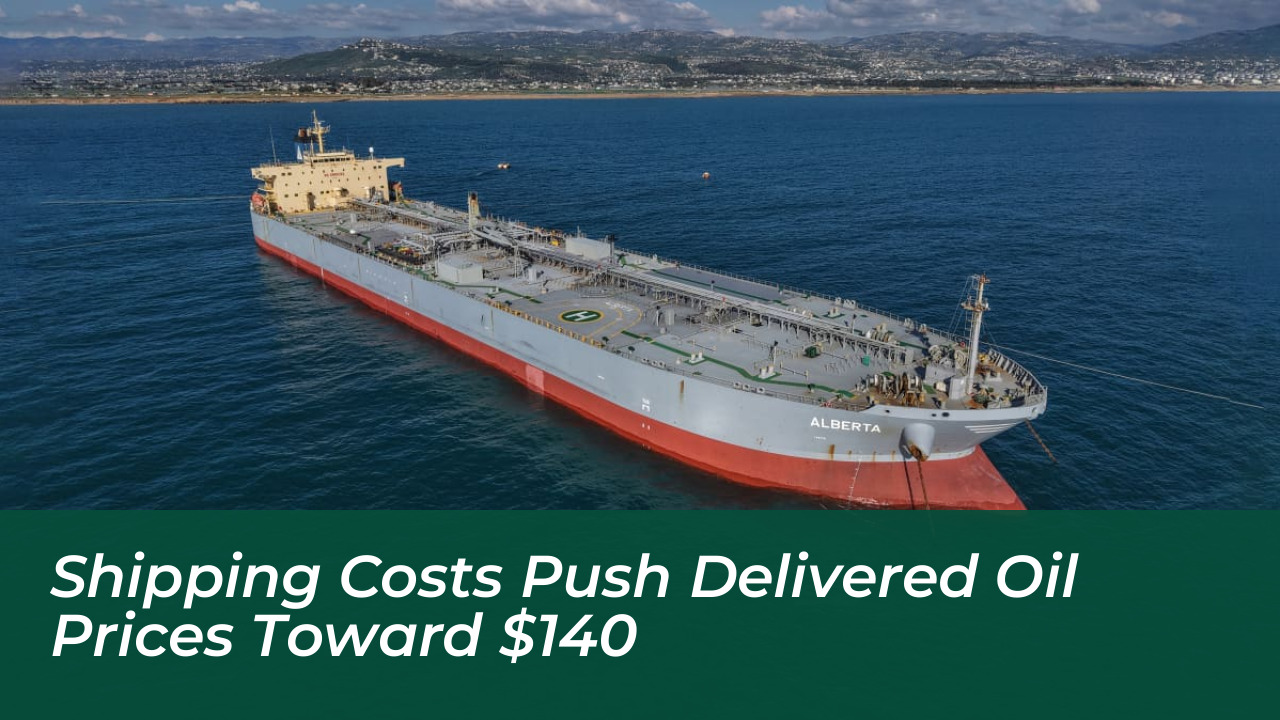

Rising maritime transport costs and security risks across major international shipping lanes are pushing physical crude oil prices toward $140 per barrel in key Asian markets. According to market reports published by OilPrice.com and CNBC, expensive tanker charters, war-risk insurance premiums, and severe shipping delays are widening the gap between benchmark oil valuations and the actual cost of delivered crude.
The financial pressure is most pronounced in the Middle East. Very large crude carrier (VLCC) freight rates from the Middle Eastern Gulf to China climbed to $33 per barrel by late September. This surge followed the expiration of a U.S.-Iran ceasefire in August. Earlier in the year, after initial wartime spikes from approximately $4 per barrel to $17, rates had temporarily eased to $11 through $12 per barrel between April and July.
Soaring Freight Rates and Landed Costs in Asia
The latest freight increases have driven delivered Middle Eastern crude prices toward $140 per barrel in China. Landed costs in Japan and South Korea have reached approximately $145 per barrel. CNBC separately reported that a VLCC charter from the U.S. Gulf Coast to China cost $76 million, while a comparable voyage to South Korea reached $77 million. Because each vessel carries roughly 2 million barrels, these charter expenses add about $38 per barrel directly onto the underlying oil price.
Alternative loading points have offered uneven financial relief. Freight costs from Saudi Arabia’s Yanbu terminal to China hovered between $6 and $7 per barrel after the initial wartime spike. However, Houthi restrictions on Saudi cargoes moving through the Bab el-Mandeb strait drove that figure to $28 per barrel by mid-October, bringing landed costs to roughly $140 per barrel. Saudi loadings at Yanbu subsequently slowed to between 1.6 million and 1.8 million barrels per day-about half their March-July average-following intensified attacks on Red Sea energy infrastructure.
To secure buyers under these constrained conditions, Saudi Aramco set its November Official Selling Price (OSP) for its flagship Arab Light grade at a $5 per barrel discount to Oman/Dubai benchmarks. This discount helps partially offset the $10 to $15 per barrel cost of shipping oil outside the Strait of Hormuz.
Global Trade Routes and Refining Shifts
The freight surge extends far beyond the Middle East. By mid-October, Brazil-to-China VLCC freight reached around $36 per barrel, taking landed Tupi crude prices to approximately $140 per barrel. Consequently, Brazilian offers to China have slowed down, making India a more appealing destination for Latin American sellers.
West African producers face similar market realities. While Djeno crude trades at a free on board (FOB) discount of roughly $10 per barrel to ICE Brent, VLCC freight from West Africa to China costs about $34 per barrel-some $9 higher than shipping the same cargo to India. This transport advantage has redirected shipments toward Indian refiners. India’s imports from Angola rose significantly, accompanied by additional cargoes from Gabon and Congo heading to India’s West Coast.
Broader Economic Impacts and Consumer Inflation
Beyond baseline transport costs, loading reliability has become a primary factor in purchasing decisions. Ship-to-ship transfers outside the Strait of Hormuz face routine delays due to escalating security incidents. Demurrage rates for Gulf-origin cargoes have surged to $1 million per day, equivalent to about $0.50 per barrel for a fully laden VLCC for each day of delay.
War-risk insurance premiums have climbed to between 7% and 8% of hull and machinery values, translating to roughly $9 million to $10 million, or $4 to $5 per barrel, for an average VLCC. Kenneth Medlock, a fellow in energy and resource economics at the Baker Institute for Public Policy, noted that every $10 per barrel increase in shipping costs adds about 23 cents per gallon to retail gasoline.
“It’s sort of like a slow-moving train. It doesn’t all happen instantly… but the longer this drags on, the more sticky it becomes,” Medlock explained regarding the broader economic trickle-down effect on supply chains, logistics, and grocery prices.
Tanker Owners Realize Historic Windfalls
While refiners and consumers absorb the financial blow, market upheaval has created record profits for independent tanker operators and shipping firms. Tanker owners recently earned as much as $1.3 million per ship per day for round trips from the Persian Gulf through the Strait of Hormuz to Asia, compared to average daily earnings of $55,000 in 2025.
Industry analysts emphasize that tanker rates will remain elevated as long as global crude demand outpaces available vessel supply, though rates could correct quickly should the broader physical oil market loosen.
Frequently Asked Questions
Why are shipping costs for crude oil rising so rapidly?
Surging maritime freight rates are driven by security risks, geopolitical conflicts in the Middle East and Eastern Europe, war-risk insurance surcharges, and longer transit routes as vessels avoid high-risk chokepoints like the Strait of Hormuz and the Red Sea.
How much are VLCC charters currently costing oil producers?
Very large crude carrier (VLCC) freight rates from the Middle East to China reached $33 per barrel by late September, while chartering a VLCC from the U.S. Gulf Coast to Asia has cost between $76 million and $81 million, translating to roughly $38 to $40.50 per barrel.
How do high shipping costs affect retail gasoline prices?
Energy economists estimate that every $10 per barrel increase in shipping expenses adds approximately 23 cents per gallon to gasoline prices, subsequently driving up transportation, logistics, and consumer goods inflation.
Which regions are shifting their crude trade routes?
Asian buyers, particularly in India, are increasingly sourcing Latin American and West African crude barrels to avoid the expensive war-risk premiums and logistical delays associated with Middle Eastern shipping lanes.
What impact is this having on oil refineries?
High delivered costs and expensive freight rates are squeezing the profit margins of Asian refiners, forcing producers to offer larger FOB discounts or absorb portions of the transport expenses to secure buyers.