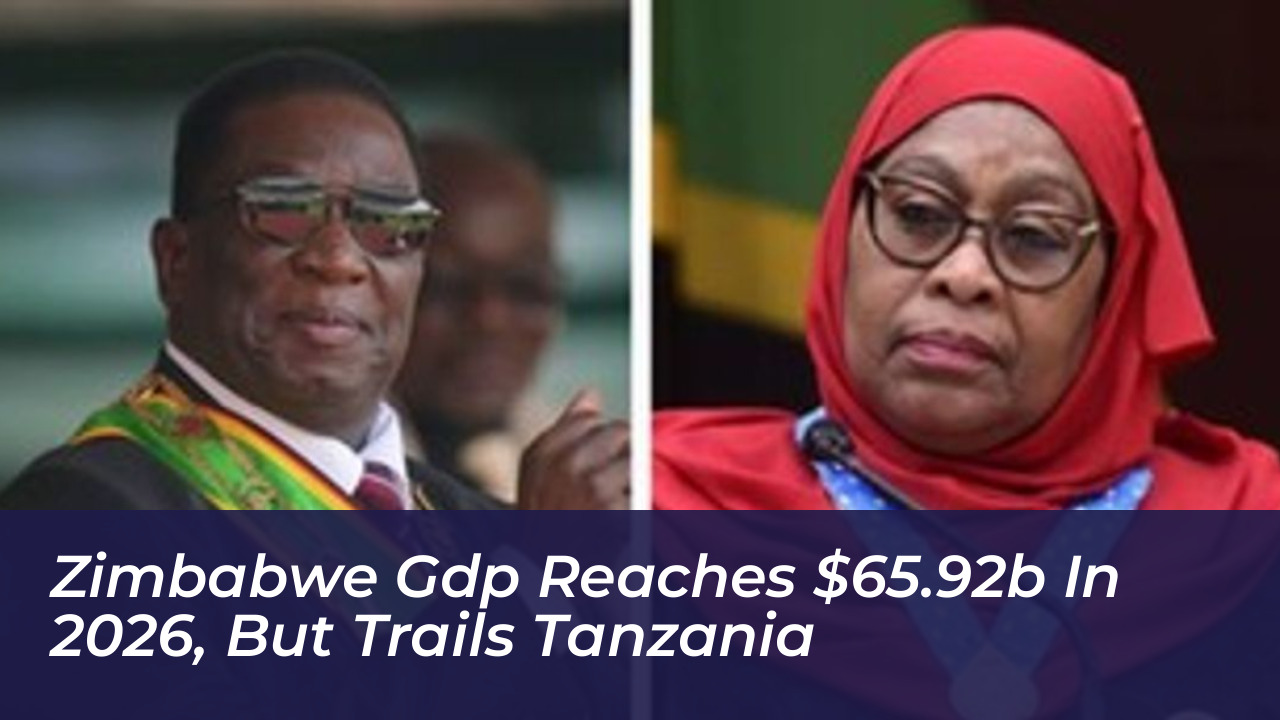

Zimbabwe’s economy is projected to reach $65.92 billion in 2026. This places the country 14th among Africa’s largest economies. However, its expected 5% growth rate remains below Tanzania’s 5.9%, according to the International Monetary Fund’s October 2026 World Economic Outlook. This economic comparison highlights differences in monetary momentum, growth drivers, and currency management as Zimbabwe relies heavily on the US dollar.
The latest IMF figures show Zimbabwe’s projected gross domestic product exceeds Cameroon’s $64.81 billion and Tunisia’s $62.74 billion. This estimate marks an upward movement from the country’s 17th-place ranking in 2025, when its GDP was estimated at $51.22 billion. It also improves upon its 16th-place position in April 2026, when the estimate stood at $56.71 billion.
Drivers of Growth and Economic Momentum
The economy is forecast to expand by 5% in 2026 after growing an estimated 8.3% in 2025. Several positive macroeconomic factors support this outlook:
- Favourable international gold prices boosting export earnings
- A steady recovery in domestic agricultural production
- Consistent remittance inflows sent home by the diaspora
- Stronger mining activity across key mineral sectors
Despite these gains, persistent inflation, currency volatility, and legacy debt arrears constrain broader access to international financing and lower-cost capital for local enterprises and agricultural development.
Currency Policy Divergence: Zimbabwe vs. Tanzania
A major point of contrast in the IMF outlook lies in how Zimbabwe and Tanzania manage their national currencies. Zimbabwe’s history of high inflation, currency depreciation, and repeated monetary reforms has weakened public confidence in local legal tender, driving widespread adoption of the US dollar.
In April 2024, the Zimbabwean government introduced the Zimbabwe Gold (ZiG) to replace previous currency iterations and restore monetary stability. However, the US dollar remains the dominant medium of exchange. It accounts for roughly two-thirds of payments by value in the national payment system, according to IMF data from May 2026. While dollarization protects households and businesses against local currency erosion, it limits the central bank’s control over monetary policy.
In contrast, Tanzania has pursued an assertive approach to strengthen the domestic use of the Tanzanian shilling. In March 2025, Tanzanian authorities implemented regulations requiring businesses to price goods, services, and transactions in shillings, with limited exceptions. Powered by a diverse mix of agriculture, construction, mining, tourism, and a proposed $42 billion liquefied natural gas project, Tanzania’s economy is projected to reach $96.18 billion in 2026, surpassing Zimbabwe by over $30 billion.
Inflation and Financial Reforms
To cool price pressures, the Reserve Bank of Zimbabwe has maintained tight monetary measures. The Zimbabwe National Statistics Agency reported annual ZiG inflation at 3.7% in September 2026, up slightly from 2.9% in August. While the IMF acknowledged improvements in macroeconomic stability, international financial bodies continue to advise strict fiscal discipline and ongoing reforms to rebuild trust in the national financial system.
As Zimbabwe leverages its $65.92 billion economy to improve its regional standing, bridging the gap between headline gross domestic product figures and daily financial stability remains a primary objective for policymakers, businesses, and smallholder producers alike.