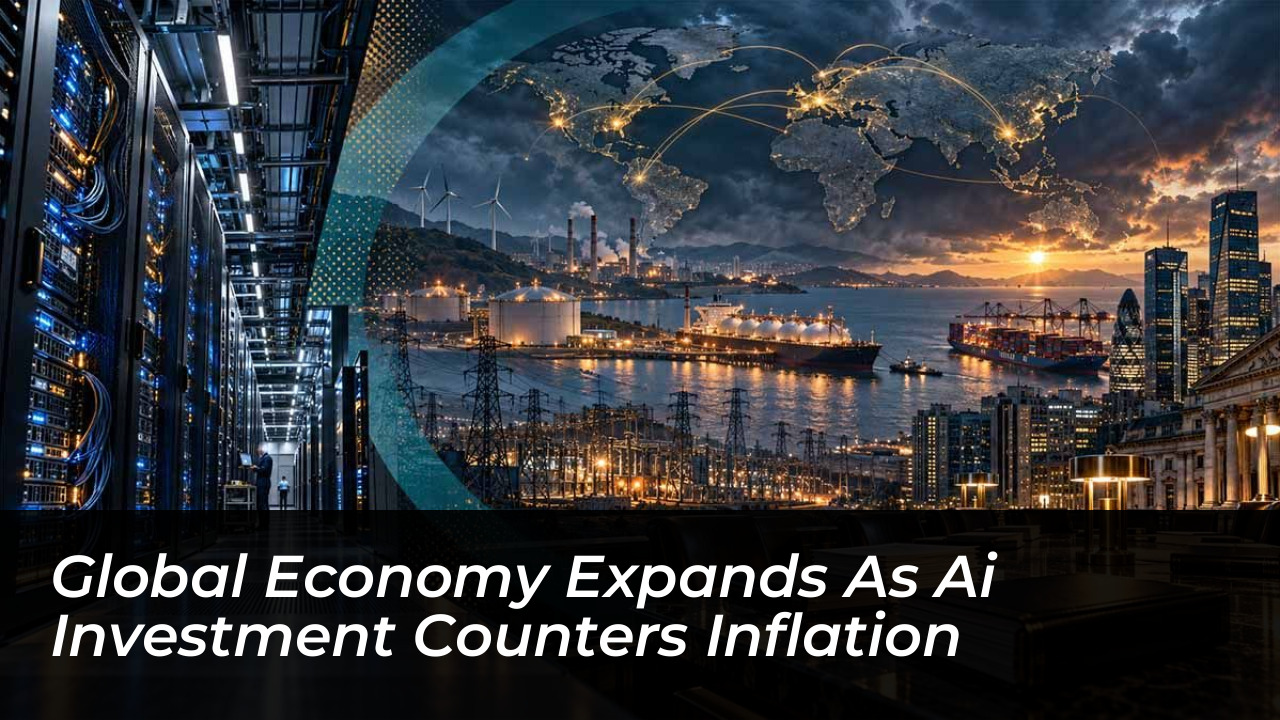

The global economy is projected to maintain solid expansion. Unprecedented artificial intelligence investment supports growth despite persistent higher energy prices, inflation, and elevated borrowing costs. According to reports from the Peterson Institute for International Economics and the October 2026 Brookings FT TIGER survey, real global GDP growth is projected at 3.2 percent for 2026 and 3.1 percent for 2027.
This economic resilience is largely driven by a massive capital expenditure supercycle in AI infrastructure. Analysts note that this financial wave helps cushion the broader global economy from simultaneous energy shocks and tighter financial conditions across major markets.
The Dual Pressures: Energy Shocks Versus AI Demand
International Monetary Fund Managing Director Kristalina Georgieva framed the global economy as being pulled in two directions simultaneously. On one side, a negative energy supply shock-stemming from the ongoing war in the Gulf, which pushed Brent crude prices to around $100 per barrel-has strained manufacturing and transport supply chains. On the other side, a positive demand shock driven by the AI investment boom creates robust economic activity.
Data from LSEG Data & Analytics reveals that major hyperscalers including Amazon, Anthropic, Google, Meta, Microsoft, OpenAI, and Oracle committed an estimated $300bn to AI infrastructure in 2025. Looking ahead, the five largest U.S. hyperscalers are projected to spend roughly $720bn on capital expenditures during 2026, supported by rapidly expanding cloud and AI revenues.
Inflationary Impacts Across Sectors and Utilities
While the AI building boom acts as a vital growth engine, it is also proving inherently inflationary. Prices for computer software and accessories climbed nearly 14% over a 12-month period, reversing years of steady decline, while wholesale prices for electronic components jumped 28%.
The physical requirements of artificial intelligence are also straining energy grids and public utilities:
- U.S. electricity production rose 3.0% year-on-year, following steady gains in previous years, driven heavily by expanding data center electricity demands.
- Consumer electricity prices increased by 4.6% over the same timeframe, extending inflationary pressures beyond high-tech hardware into everyday household utilities.
- U.S. imports of computers more than doubled in the first quarter of 2026 to approximately $93bn, with semiconductor imports climbing 40% year-on-year.
Long-Term Outlook: From Inflationary Capex to Disinflationary Productivity
Economists and central bankers face a delicate balancing act as they monitor these trends. While heavy investments in semiconductors, data centers, and specialized labor create near-term price pressures, market analysts suggest that AI will ultimately prove disinflationary over the longer term.
As automation, enhanced decision-making, and structural productivity gains permeate the broader economy, businesses are expected to generate stronger output without proportional increases in labor or capital costs. However, this transition is widely viewed as sequential rather than immediate.
Regional Winners: The Case of South Korea
Geographically, the distribution of economic benefits remains uneven. Economies deeply integrated into the advanced semiconductor supply chain have emerged as clear beneficiaries. South Korea, anchored by major manufacturers like Samsung Electronics and SK Hynix, has experienced significant momentum in high-bandwidth memory production.
Despite experiencing short-term market corrections driven by profit-taking and shifts in global monetary policy, foundational demand from cloud providers and enterprise AI developers continues to outpace available semiconductor supply. As the global economy navigates this transformative capital expenditure cycle, strategic positioning within technological infrastructure will likely dictate relative economic fortunes worldwide.