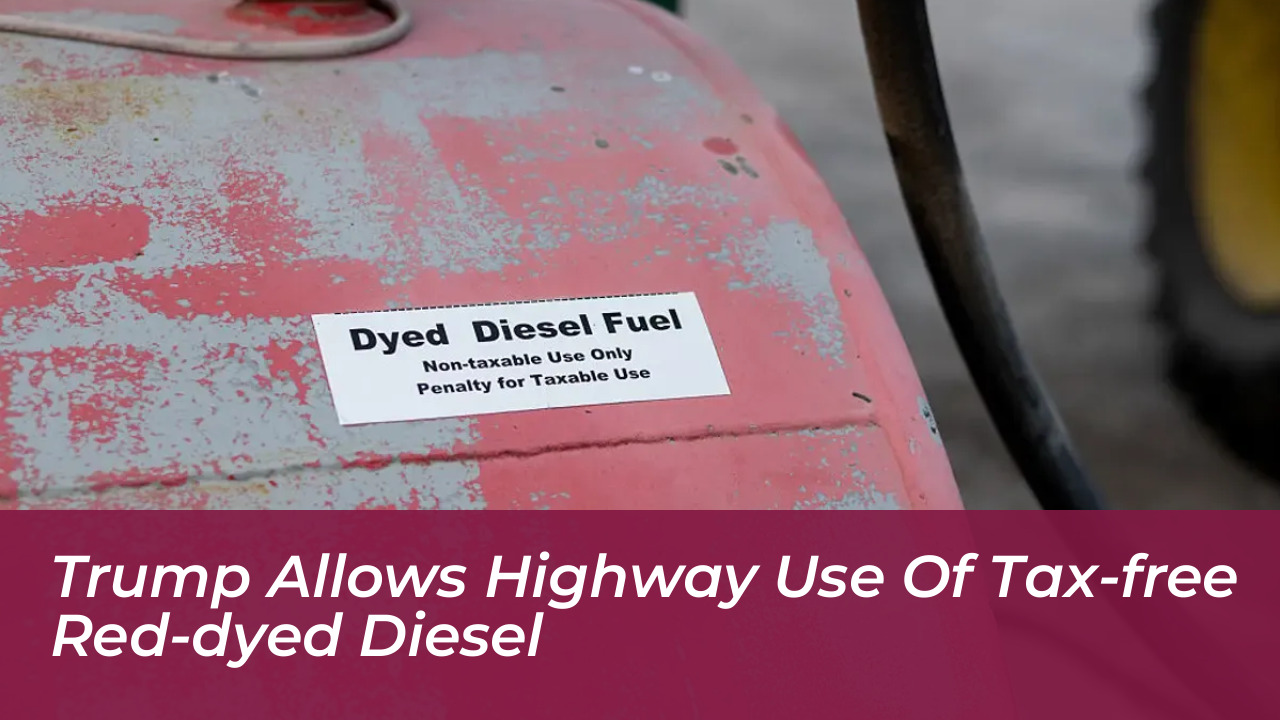



President Donald Trump signed an executive order on October 5, 2026, waiving the off‑road restriction on red‑dyed diesel and deferring the federal excise tax of 24.4 cents per gallon through the end of the year. The move aims to ease surging fuel costs for truckers and farmers.
Details of the Executive Order
The order allows highway vehicles to use tax‑free red‑dyed diesel, a fuel normally reserved for off‑road equipment such as tractors and construction machinery. It is dyed red to distinguish it from taxed diesel.
It directs the secretaries of the Treasury, Transportation, Agriculture and Defense to temporarily allow off‑road dyed diesel for highway use and to defer the applicable federal excise tax. The Treasury is instructed to explore ways to eliminate the obligation to pay the deferred taxes.
The waiver lasts through December 31, 2026, without interest or penalties, and encourages states to halt inspections and suspend state taxes for on‑road use of the fuel.
Impact on Fuel Prices and Estimated Savings
According to White House calculations, the measure could save commercial truckers about $60 per 250‑gallon fill‑up, with potential savings exceeding $100 if state authorities match the federal tax suspension.
National average diesel prices were $6.32 per gallon on Monday, October 5, 2026, according to AAA, following global supply disruptions linked to the war involving Iran and Ukrainian strikes on Russian oil refineries.
Prices remain roughly 77% higher year‑to‑date despite a slight dip from a record peak of $6.53 per gallon recorded on September 22, 2026.
Normally, on‑road diesel carries a federal tax of 24.4 cents per gallon and an average state tax of 35.5 cents per gallon, bringing the total tax burden to roughly 59.9 cents per gallon.
Reactions and Statements from Trump and Officials
Speaking at the rally, Trump said, “They’re going to be very happy in about two seconds,” and later said, “So tonight I’m going to sign a historic executive order to officially waive the off‑road requirement and allow anyone to purchase tax‑free red‑dye diesel for any reason.”

Supporters praised the move; Rep. Jason Smith of Missouri called it “a much‑needed step to lessen the burden that increased fuel prices have had on farmers, ranchers and the entire agricultural community,” while Louisiana Gov. Jeff Landry described it as “a HUGE WIN.”
Broader Administration Efforts to Lower Fuel Costs
The executive order is part of a wider strategy to curb fuel expenses. Last week the Group of 7 nations, including the United States, agreed to release 100 million barrels of diesel and crude oil reserves over four months.
In August the administration extended the Jones Act Waiver, permitting foreign‑flagged vessels to transport gasoline, diesel and other energy products between U.S. ports to ease shipping bottlenecks.
Earlier, Trump secured the release of up to 100 million barrels of diesel oil from European reserves, and he has weighed a ban on U.S. diesel exports, though analysts warn such a ban could raise gasoline and jet fuel prices and provoke retaliation against agricultural exports.
Several states have already acted independently: ten states-Alabama, Arkansas, Indiana, Louisiana, Missouri, Nebraska, North Carolina, North Dakota, Oklahoma and Texas-temporarily permitted dyed diesel for some on‑road use, often waiving fines and penalties for agricultural and timber haulers.
North Dakota, for example, charges 23 cents per gallon in state tax on regular diesel but only 4 cents on dyed diesel, while Arkansas, Indiana, Missouri, Nebraska and North Dakota also offered state‑tax relief for certain highway use of the fuel.
While the measure offers immediate relief, experts caution that it does not address the underlying refinery shortage caused by war‑related damage in the Middle East and Russia and export restrictions in China, which continue to pressure diesel supplies.