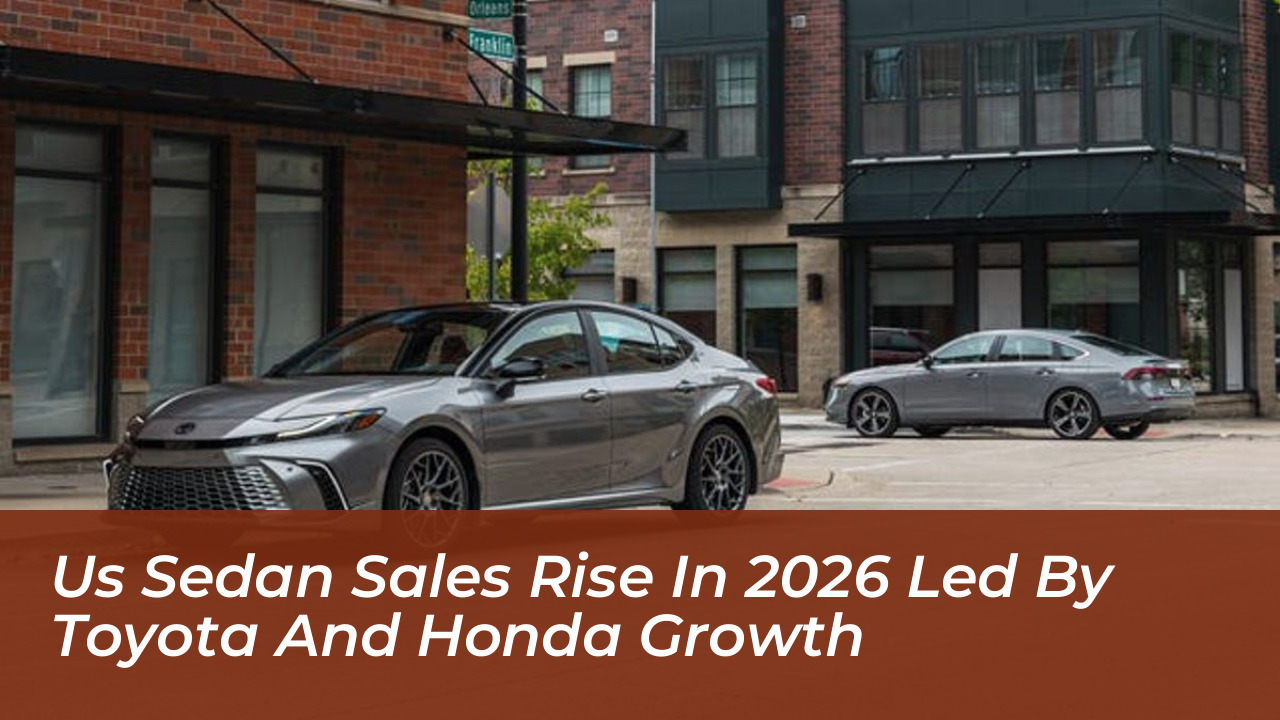



Rising vehicle prices and persistent fuel costs have driven a surprise surge in American sedan purchases through the first three quarters of 2026. Major automakers report that passenger car sales growth noticeably outpaces traditional SUV and truck lines. Industry stalwarts Toyota and Honda spearhead this broader expansion across the U.S. auto market.
For years, the mainstream automotive industry treated the conventional sedan as an endangered body style, pushing it aside for crossovers and pickup trucks. However, sales figures through September 2026 prove that obituary was written far too early. While utility vehicles still command the lion’s share of the market, hundreds of thousands of budget-conscious consumers are rediscovering the core advantages of conventional passenger cars: lower sticker prices, high fuel economy, and everyday practicality.
Toyota and Honda Lead the 2026 Car Market Rebound
Japanese automakers Toyota and Honda have captured this momentum by keeping high-volume sedans fresh and efficient. Through September 2026, the Toyota Camry cemented its position as America’s best-selling car, increasing sales by 11.2 percent year-over-year to 260,684 units. Meanwhile, the Honda Accord delivered an even sharper rebound, climbing 32.7 percent to reach 145,520 units.
The compact segment is putting up equally impressive numbers. The Toyota Corolla reached 195,141 sales, marking an 8.4 percent increase. The Honda Civic climbed 5.4 percent to 195,135 units-a razor-thin margin of just six vehicles separating the two fierce competitors. Honda reported that the third quarter of 2026 was its strongest for passenger-car sales since 2020. This was powered by a 15.6 percent year-over-year jump in its overall car lineup, compared to a meager 0.3 percent gain for its SUVs and light trucks.

Affordability and Fuel Economy Drive Consumer Choice
Market analysts point to two primary catalysts for the sudden resurgence: vehicle affordability and fuel efficiency. With new car prices remaining high for the average household, buyers looking to keep monthly loan payments under control find that sedans deliver significantly more financial value.
- Lower Entry Costs: Popular models like the Honda Civic and Honda Accord still offer starting price points comfortably below $30,000. Stepping into a comparable compact utility vehicle often adds several thousand dollars to the bottom line.
- Superior MPG Ratings: Modern hybrid variants of the Civic and Accord can return more than 48 mpg combined. This gives commuters a massive advantage at the pump without forcing an immediate commitment to fully electric vehicles.
- Broad Market Participation: The trend extends beyond economy classes. Korean automakers Hyundai and Kia reported steady sedan gains. This includes an 11 percent bump for the Hyundai Elantra, alongside double-digit growth for the Hyundai Sonata and Kia K5. Luxury options like the BMW 3 Series, Lexus IS, and Acura Integra also posted strong year-over-year improvements.
Not Every Brand Shares in the Sedan Resurgence
Despite the broader passenger car market recovery, not all manufacturers are experiencing upward momentum. Nissan serves as a notable outlier within the segment. Sales for the Nissan Sentra and the outgoing Altima slipped by double digits. This dragged Nissan’s overall car division down even as the brand’s truck and SUV lineups grew by 14.4 percent.
As the auto industry looks toward the final quarter of 2026 and into 2027, the unexpected strength of the passenger car market forces a strategic re-evaluation. While trucks and crossovers remain the bedrock of American showrooms, automakers that resisted the temptation to abandon sedans entirely are reaping the rewards of a changing consumer landscape.