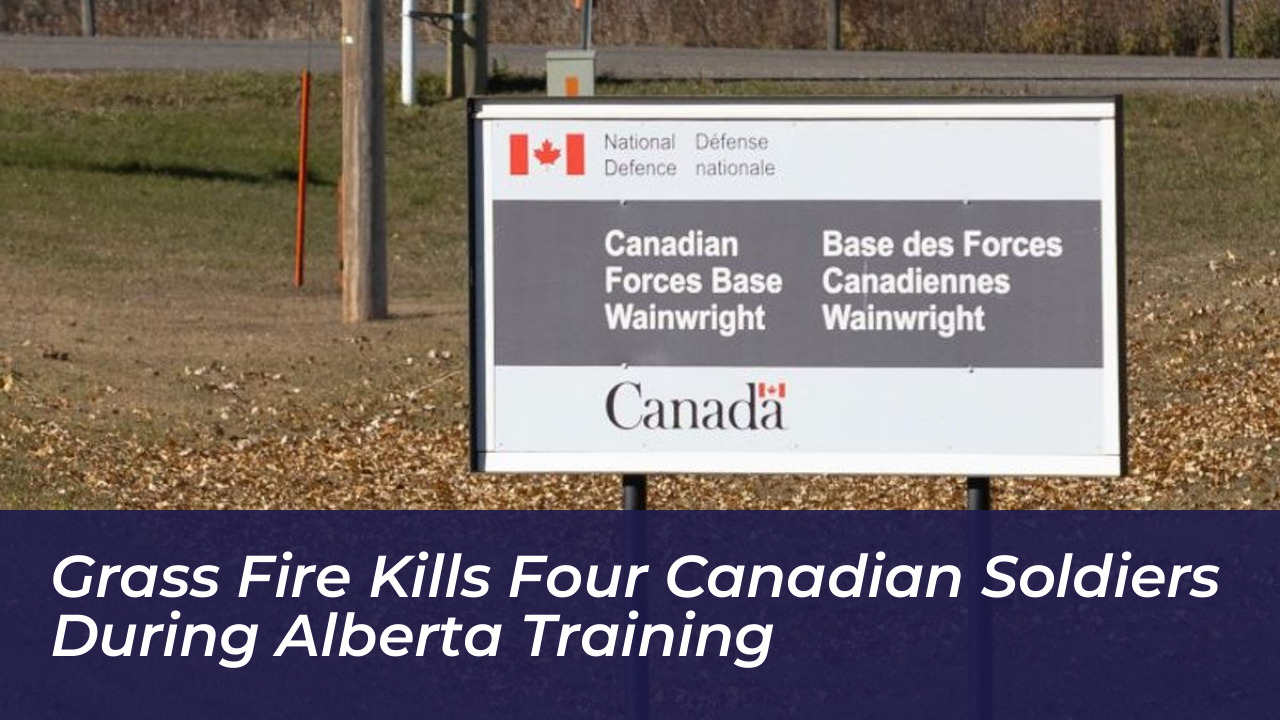

Four Canadian soldiers were killed and 39 people were injured when a fast-moving grass fire swept through a live-fire combat exercise at Canadian Forces Base Wainwright in Alberta. Strong winds drove the flames toward troops training at the facility, leaving 19 people in critical condition, according to Canadian military officials.
The incident occurred on Saturday afternoon during training involving Charlie Company of the 3rd Battalion, Princess Patricia’s Canadian Light Infantry. Soldiers were practicing attacks on simulated enemy positions and utilizing live munitions when the blaze overtook the area.
Details of the Tragic Incident at CFB Wainwright
Major-General Wade Rutland, commander of the 1st Canadian Division, stated at a news conference in Edmonton that the flames advanced with extraordinary speed after a sudden wind shift. Range control had been aware of a fire on the base for several hours, but training was allowed to continue because conditions initially fell within standard operating procedures.
"The fire was a kilometre away when the wind shifted. That is not normal for a fire to move a kilometre in 36 seconds," Rutland told reporters on Sunday.
The Department of National Defence confirmed the identities of the four service members who lost their lives:
- Sgt. Morgan Wong of Edmonton (serving with the Loyal Edmonton Regiment attached to the 3rd Battalion, PPCLI)
- Pte. Shaun Farrell of Prince Albert, Saskatchewan
- Pte. Aidan Goulding of North Vancouver, British Columbia
- Pte. Hayden Lykkemark of Langley, British Columbia
National Reaction and Emergency Response
Prime Minister Mark Carney addressed the nation from Ottawa, describing the disaster as one of the worst peacetime tragedies for the Canadian Armed Forces on domestic soil. He announced that flags at federal buildings across the country would fly at half-mast to honor the fallen service members.
"The nation is in mourning for those brave members of our Armed Forces whom we have lost," Carney said, extending gratitude to first responders and community members who aided the injured.
Acute Care Alberta activated a provincewide "code orange" response, deploying 22 ground ambulances and multiple aircraft to transport victims from the Wainwright Health Centre to major hospitals in Edmonton, Red Deer, and Calgary. Medical facilities near the base reported being overwhelmed by the sudden influx of critical casualties.
Investigation and Weather Factors
Environment and Climate Change Canada had issued a wind warning for large parts of Alberta on Saturday, predicting gusts up to 90 km/h. A cold front moving through the region between 3 p.m. and 4 p.m. shifted winds from southwesterly to northwesterly, driving speeds up to 69 km/h and fueling the rapid spread of the grass fire.
Military and civilian investigators are examining whether the fire was sparked by training activities or an independent source, and how the flames managed to breach established firebreaks undetected. Major-General Rutland noted that a comprehensive safety investigation is expected to take at least a month to complete.
Frequently Asked Questions
When and where did the grass fire occur?
The fire occurred on Saturday afternoon at Canadian Forces Base (CFB) Wainwright in Alberta, Canada.
How many casualties resulted from the fire?
Four Canadian soldiers were killed, and 39 people were injured, with 19 individuals listed in critical condition following the blaze.
Which military unit was involved in the exercise?
The training exercise involved Charlie Company of the 3rd Battalion, Princess Patricia’s Canadian Light Infantry (PPCLI), alongside personnel from the Loyal Edmonton Regiment.
What caused the fire to spread so quickly?
A sudden cold front caused strong, shifting winds that pushed the grass fire forward by approximately one kilometre in less than a minute, catching troops in the training area off guard.
How are authorities investigating the incident?
The Canadian Armed Forces and Department of National Defence have launched an official investigation into the exact cause of the fire, the rapid wind-driven spread, and whether existing safety protocols require revision.