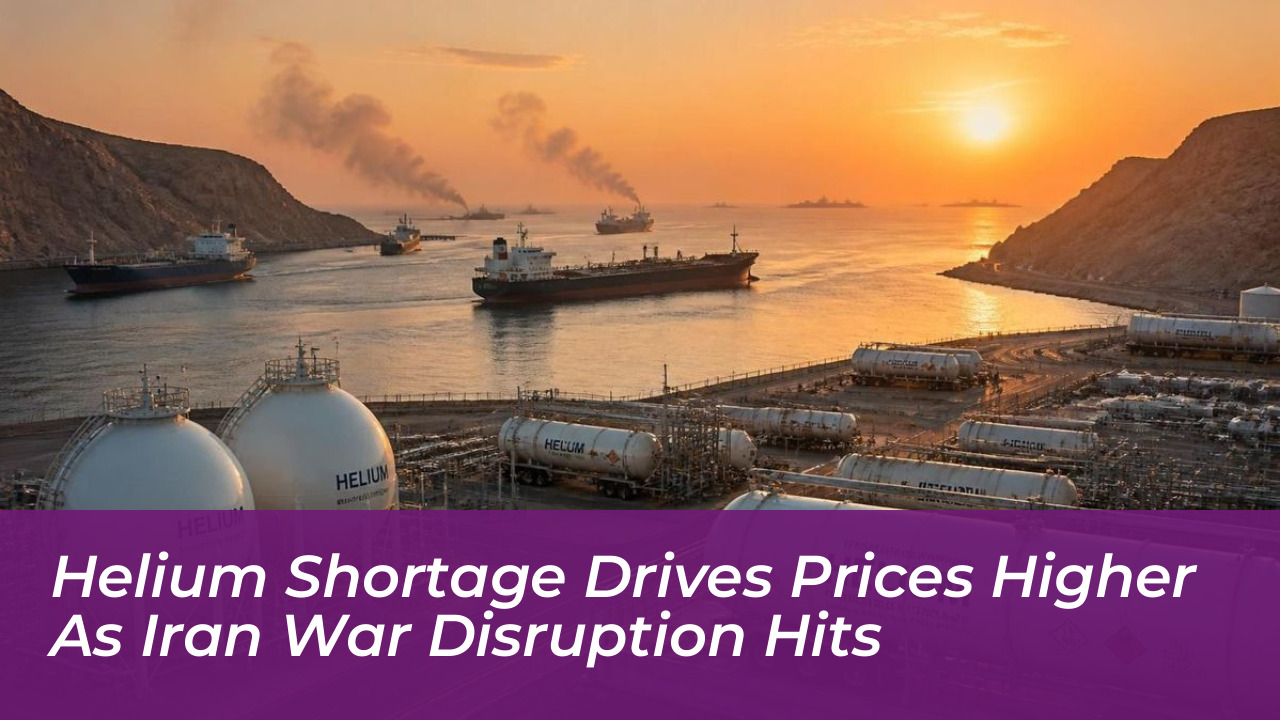

A prolonged conflict involving Iran has severely disrupted the global helium market. This crisis threatens semiconductor manufacturing, scientific research, and healthcare systems that depend on the scarce gas. The effective closure of the Strait of Hormuz in February 2026 trapped a substantial share of global supplies. Subsequent strikes on Qatar’s Ras Laffan facility halted production, intensifying worldwide shortages.
The Geopolitical Trigger: Strait of Hormuz and Qatari Infrastructure
Following military escalations between the U.S., Israel, and Iran, Iran’s Islamic Revolutionary Guard Corps declared the Strait of Hormuz closed. Approximately one-third of the world’s commercial helium was caught in the Persian Gulf after shipping restrictions took effect. Qatar, the world’s second-largest commercial helium producer after the United States, supplied roughly 63 million cubic meters in 2025. This output represented about 33% of global production.
Helium is extracted as a byproduct of liquefied natural gas (LNG) processing at mega-complexes like Ras Laffan Industrial City. Consequently, attacks and forced shutdowns have immediate downstream effects. QatarEnergy indicated that restoring damaged facilities to full operation could require at least three years. This leaves international buyers competing aggressively for alternative supplies.
Market Impact: Surging Prices and Allocation Protocols
The supply shock has triggered immediate financial and logistical adjustments across industrial gas sectors. According to market intelligence and bank estimates, spot helium prices have surged significantly. Reports indicate jumps of 40% to upwards of 100% in certain spot markets within weeks of the disruption. Major industrial suppliers, including Air Liquide, have warned customers regarding potential order fulfillment issues.
With global supply tight, industrial gas distributors rely heavily on customer allocation programs, or rationing. High-value, mission-critical sectors sit at the top of the pecking order:
- Semiconductor Manufacturing: Vital for chip etching and wafer temperature control.
- Medical Imaging: Essential for cooling superconducting magnets in MRI scanners.
- Scientific Research: Required for ultra-low temperature cryogenic research labs.
- Non-Essential Uses: Party balloons and secondary commercial applications face steep reductions or complete cutoffs.
Vulnerability in Advanced Technology and Semiconductor Supply Chains
The semiconductor industry has evolved into one of the largest consumers of helium. It uses the gas to cool manufacturing equipment and maintain clean environments during photolithography. Nations heavily reliant on Middle Eastern gas imports-particularly South Korea, Taiwan, Singapore, and Japan-face intense pressure.
In South Korea, manufacturers sourced nearly 65% of their helium from the Gulf Cooperation Council in 2025. Trade ministries there have launched supply exposure investigations. Industry experts note that while some companies maintain short-term stockpiles, semiconductor fabrication leaves little room for alternative gases like argon or nitrogen without massive facility re-engineering and costly delays.
Scientific and Healthcare Sectors Face Critical Strain
Beyond commercial electronics, academic and medical institutions feel the pinch. University laboratories running nuclear magnetic resonance (NMR) spectrometers and medical centers operating MRI machines rely on liquid helium to maintain temperatures at 452 degrees below zero Fahrenheit.
Facilities like those at the University of Chicago reported being placed on strict 50% allocation caps by primary vendors. This forces researchers to ration supplies and prioritize high-stakes medical and cancer research over secondary projects. While alternative cooling and recycling technologies exist, they remain far from universal deployment.
Looking Ahead: Long-Term Market Realities
The market entered the crisis period benefiting from a minor pre-existing global oversupply. Experts estimate this cushions the net deficit to roughly 15%. However, the longer the Strait of Hormuz remains closed, the deeper the structural damage will become. Major U.S. producers in Wyoming and emerging startups are scaling export capabilities. Despite this, expanding helium extraction and overcoming complex cryogenic supply chain logistics cannot happen overnight.
Industry leaders are briefing government officials and defense contractors on single-point-of-failure vulnerabilities. The current crisis serves as a stark reminder that even the lightest element on the periodic table carries monumental weight for global security, technology, and healthcare.