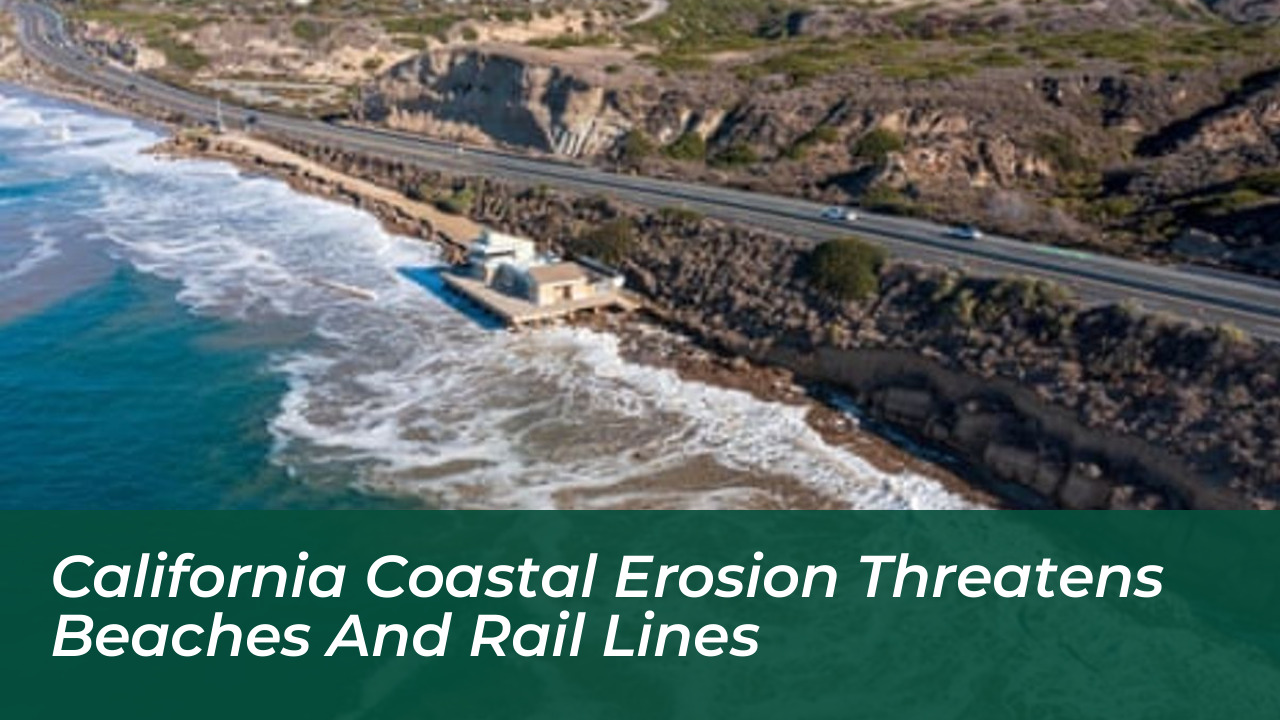

Southern California is facing an accelerating crisis of worsening coastal erosion. This threatens public beaches, coastal homes, tourism, and critical transportation infrastructure. Communities from Newport Beach and Long Beach to Dana Point and San Clemente are scrambling to protect their shrinking shorelines. Driven by severe waves, high tides, and unusually warm waters, the ongoing erosion has devastated local coastlines. It has also triggered repeated disruptions to one of the nation’s most vital passenger and freight rail corridors.
The Vital LOSSAN Rail Corridor Under Siege
San Clemente has emerged as a major flash point in this regional crisis. A critical regional railway runs directly along the narrow strip of land between the Pacific Ocean and towering coastal bluffs. The route serves as part of the LOSSAN rail corridor, which runs between San Diego, Los Angeles, and San Luis Obispo. As the nation’s second-busiest passenger rail line, it carries commuter trains via Metrolink, Amtrak Pacific Surfliner services, $1 billion in freight annually, and essential military transport.
According to the Orange County Transportation Authority (OCTA), severe waves and high tides during major storms in early September overtopped the tracks and severely eroded the surrounding embankments. The line has experienced repeated service interruptions. It has been shut down seven times since 2021 due to landslides, surging tides, and unstable slopes. Total closure time for repairs over the past five years has exceeded a full year. This underscores the severe vulnerability of coastal infrastructure.
The situation highlights a difficult geographic reality. Much of Southern California’s coastal development took place during an unusually calm climate period from the 1940s to the 1970s. With stronger storm cycles and rising sea levels returning, cities built on cliffs, bluffs, and dunes are now directly exposed to intense wave energy.
Amplified Risks From Incoming El Niño Weather Patterns
Experts warn that current extreme weather conditions are merely a preview of what lies ahead. Oceanographers with the US Geological Survey (USGS) note that the potential development of a historic El Niño season, overlapping with massive warm-water surges known as Kelvin waves, could unleash exceptional erosion events along the coast.
When beaches lose their natural width, they can no longer absorb the energy of incoming waves. Instead of breaking harmlessly offshore, powerful waves slam directly into coastal bluffs, seawalls, and railroad beds. Up and down the coast, recent storms have already caused widespread damage:
- Dana Point sustained approximately $33 million in private property damage and $25 million in public beach damage after early September waves red-tagged 10 coastal residences as uninhabitable.
- Laguna Beach experienced severe damage to a beachside parking lot, while a dramatic cliffside crack forced the continued closure of parts of the Pacific Coast Highway.
- Newport Beach saw abnormally high tides flood low-lying neighborhoods, with residents spotted paddle-boarding through residential streets.
- Malibu suffered a sinkhole in the driveway of a prominent coastal mansion, and Long Beach reported structural wave damage to multiple homes.
Diverging Solutions: Sand Replenishment, Armor, and Managed Retreat
Coastal communities are divided on how best to respond to the escalating threat. Historically, short-term solutions involved hardening the shoreline using riprap, sea walls, and rock revetments. While these barriers protect immediate infrastructure, environmental experts warn they act as a death knell for adjacent beaches by blocking sediment flow and dragging existing sand away.
A more sustainable middle-ground option supported by many communities is beach nourishment. This involves hauling and dumping truckloads of sand to artificially widen the shoreline. In San Clemente, local resident Cameron Cosgrove authored a proposed local ballot measure to voluntarily impose a 1% sales tax to fund extensive beach restoration and wildfire prevention. City officials estimate San Clemente has a sand deficit of roughly 3 million cubic yards.
Concurrently, OCTA has advanced plans to place up to 540,000 cubic yards of sand along vulnerable portions of the railroad corridor, balanced with localized rock reinforcement. However, coastal experts caution that sand replenishment is a temporary fix. A single major winter storm can wash away hundreds of thousands of cubic yards overnight.
Looking further ahead, some scientists and environmentalists advocate for “managed retreat”-the systematic relocation of homes, roads, and rail lines inland. Although widely considered the only permanent solution for rising sea levels, managed retreat remains deeply unpopular among coastal property developers and homeowners. Meanwhile, state authorities are examining whether the vulnerable San Clemente and Del Mar rail lines should eventually be relocated inland at an estimated cost exceeding $5 billion, leaving communities facing difficult choices as the Pacific Ocean steadily reclaims the shore.