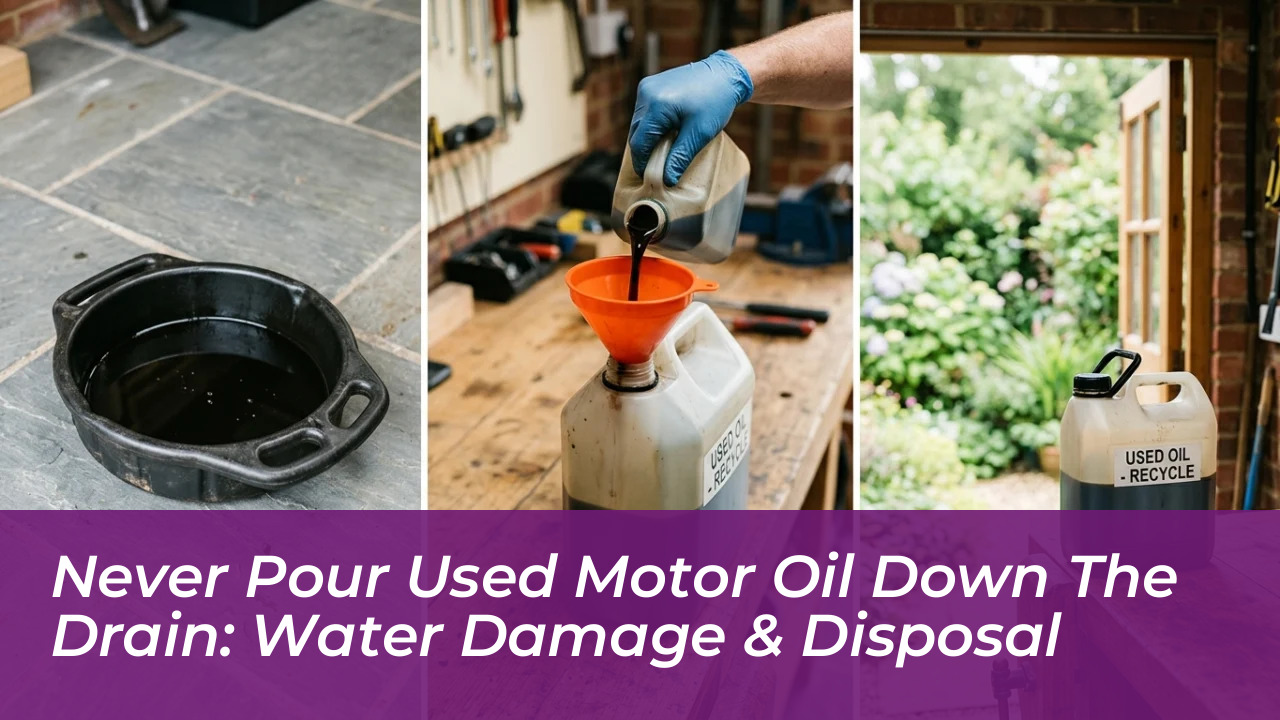

Pouring used motor oil down a household drain or onto bare soil can ruin up to one million gallons of fresh water from just a single vehicle oil change. According to the Environmental Protection Agency (EPA), that single home servicing volume pollutes an amount of water equivalent to the entire annual supply needed for 50 people. The substance does not simply dissolve away. Instead, it binds to physical surfaces, travels through ground systems, and poisons clean waterways with heavy metals and toxic chemicals. Every home mechanic tackling vehicle maintenance faces the question of what to do with the thick black liquid that drains from the sump. While discarding it in standard household bins or washing it away might feel convenient, the persistent nature of automotive lubricants makes ordinary disposal methods an environmental disaster.
Improper disposal of engine lubricant leads to enduring environmental damage because oil is completely insoluble in water and contains persistent toxic residues. Understanding the hidden dangers of used motor oil and adhering to correct recycling channels prevents severe ecological harm and protects local drinking water reserves.
The Hidden Chemical Hazard in Every Drop
Motor oil is essential for cooling and lubricating moving engine parts, but mechanical operation fundamentally alters its chemical profile. Over hundreds of miles, clean oil gathers abrasive dirt particles, microscopic metal fragments, fuel residue, and unburnt chemicals. These impurities degrade the liquid’s protective qualities, demanding a routine fluid change.
However, the fluid does not lose its fundamental lubricating core. The real issue stems from the toxic chemicals and heavy metals-such as lead, arsenic, zinc, and cadmium-that become suspended inside the lubricant during high-temperature combustion. When this mixture meets water or soil, it creates an impervious barrier that blocks oxygen and leaves long-lasting contamination behind. Municipal water treatment plants are not designed to filter out these heavy hydrocarbons, meaning they pass directly into community water supplies.
Common Myths vs. Reality About Used Oil
Many motorists harbor dangerous misconceptions regarding how engine fluids behave after disposal. Addressing these widespread myths is critical for environmental protection:
- Myth 1: It breaks down naturally on soil. Reality: Engine lubricants do not biodegrade rapidly. They remain insoluble, clinging tenaciously to soil particles, pipe linings, and riverbeds.
- Myth 2: Used oil is completely ruined. Reality: Industrial re-refining proves that used base oil retains its fundamental structural properties indefinitely.
- Myth 3: It can be burned safely in open fires. Reality: Burning waste oil releases volatile organic compounds (VOCs), polycyclic aromatic hydrocarbons (PAHs), and toxic ash that destroy air quality and soil health.
- Myth 4: Any container is fine for storage. Reality: Inappropriate containers degrade over time, leading to leaks, structural cracking, and groundwater pollution.
How the Industrial Recycling Loop Works
Used lubricant does not need to end up in landfill sites or storm drains. Modern recovery facilities use sophisticated industrial processes to return old fluids back into circulation at consumer-grade specifications. The industrial recovery pathway follows a structured cycle:
- Safe containment: Used oil is gathered in clean, leak-proof drums and transferred directly to authorized industrial facilities.
- Re-refining: Specialized plants subject the contaminated fluid to chemical and thermal processes to extract pristine lubricant base stocks.
- Energy repurposing: Portions of recovered fluids are formulated into commercial fuel used in regulated industrial manufacturing.
- Petrochemical synthesis: Refineries utilize the recovered base stocks as essential raw feedstocks.
- Return to service: The finished, re-refined oil returns to vehicle engines, meeting identical purity and performance standards as brand-new products.
Environmental and Resource Efficiency
Refining crude oil into vehicle-grade lubricants requires immense thermal energy and resource extraction. Re-refining existing stocks significantly lowers energy expenditure while conserving finite reserves.
- Freshwater at risk per oil change: Up to 1,000,000 gallons
- Equivalent human water needs: Annual supply for 50 individuals
- Lube oil yielded from 1 gal used oil: Approximately 2.5 quarts
- Crude oil needed for 2.5 quarts lube: Roughly 42 gallons
The yield numbers demonstrate this efficiency: extracting approximately 2.5 quarts of fresh lubricant base requires an astonishing 42 gallons of raw crude oil. By contrast, that exact same volume can be recovered from just one single gallon of carefully collected used motor oil.
The Safe Disposal Checklist for Vehicle Owners
Preventing chemical leaks requires careful physical handling from the moment the drain plug comes loose. Environmental regulators urge DIY motorists to apply four practical disposal habits during every service:
- Drain the engine over a wide drip pan to prevent surface contamination and avoid accidental driveway spills.
- Transfer the liquid into a clean, airtight container made of durable plastic (such as a dedicated oil jug), ensuring the cap seals firmly. Never use old milk jugs or containers that previously held bleach, antifreeze, or gasoline.
- Allow all oil filters to drain completely for at least 12 hours by puncturing the dome and inverting them, as filter casings retain significant chemical fluid.
- Transport both sealed containers and drained filters to authorized civic recycling centers, auto parts stores (like AutoZone, O’Reilly, or Advance Auto Parts), or registered waste collection points.
Never discard oil containers into household rubbish bags, and never pour residual waste down outdoor drains, domestic sinks, or onto garden patches. Utilizing free local drop-off networks guarantees that your vehicle maintenance protects rather than harms the surrounding ecosystem.
Frequently Asked Questions
Can I pour used motor oil down the drain or onto the ground?
No. Used motor oil is classified as a hazardous material under federal and state laws. Pouring it down a sink, storm drain, or onto soil is illegal, ruins water supplies, destroys pipes, and carries severe fines.
Where can I drop off used motor oil for free?
Most major auto parts retailers-including AutoZone, O’Reilly Auto Parts, Advance Auto Parts, and Walmart Auto Care Centers-accept used motor oil and filters at no cost, typically up to 5 gallons per visit.
How should I prepare my used oil filters for recycling?
Puncture the dome end of the used filter with a screwdriver and invert it over a drain pan for at least 12 hours to extract residual oil. Place the drained filter into a sealed plastic bag and recycle it alongside your oil jug.
What happens if I mix motor oil with antifreeze or gasoline?
Mixing fluids contaminates the batch, making standard re-refining impossible. Mixed fluids must be handled as full hazardous waste through specialized household hazardous waste (HHW) facilities.
What should I do with larger quantities of oil from garage cleanouts?
Retailer drop-off limits typically cap drop-offs at 5 gallons. For estate cleanouts or inherited workshops with larger volumes, contact a licensed hazardous waste transporter or professional cleanout service.