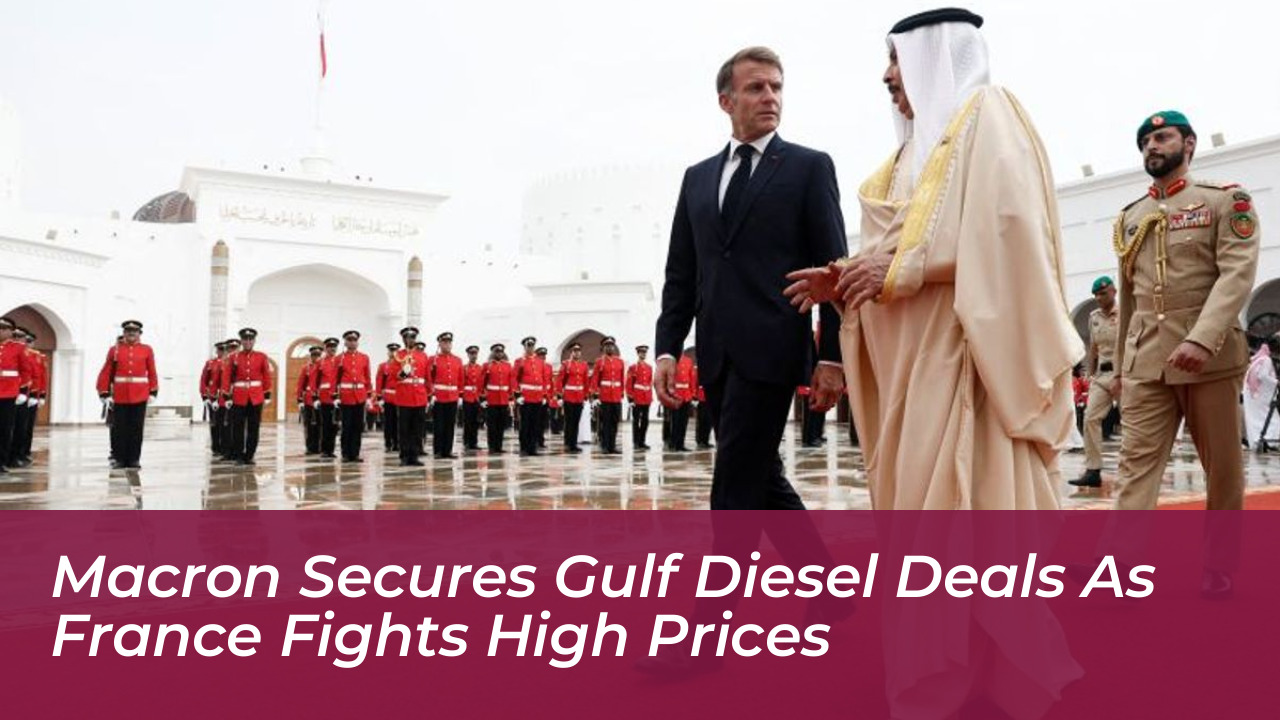

French President Emmanuel Macron has secured vital commitments for an additional 200,000 metric tonnes of diesel per month from the United Arab Emirates and Bahrain. The agreements were finalized during Macron’s high-stakes three-day diplomatic tour of the Gulf. The tour aims to secure national energy supplies as France grapples with soaring fuel costs and violent domestic protests over the cost of living.
According to an official statement released by the Elysee Palace on Tuesday, the newly secured volume comprises roughly 100,000 metric tonnes monthly from the UAE. It also includes an identical 100,000 metric tonnes per month agreed upon during Macron’s stop in Bahrain.
Total Gulf Commitments Cover 10% of French Consumption
When combined with existing delivery agreements from Saudi Arabia, France has locked in a total of 295,000 metric tonnes of diesel per month from the Gulf region. The French presidency confirmed that this total represents just over 10 percent of the country’s overall diesel consumption.
In addition to mainland supply arrangements, Kuwait has committed to deliver crucial shipments of diesel and kerosene to the French overseas territories of Mayotte and Réunion in the Indian Ocean. To mitigate logistical risks, these specific shipments will be routed through Oman, completely bypassing the heavily disrupted Strait of Hormuz.
Regional Conflict Strains Global Energy Markets
The urgent diplomatic push comes in response to severe market disruptions linked to the ongoing US-Iran war, which began in February. Crude oil and refined product prices have surged globally as Iran maintains a blockade on the Strait of Hormuz, which is the primary maritime corridor for Gulf energy exports. Diesel has emerged as one of the hardest-hit commodities, triggering severe inflationary pressure across Europe.
Earlier in October, G7 nations under the French presidency agreed to release up to 100 million barrels of crude oil from strategic reserves to calm markets. Domestically, France has also authorized the release of 10 million barrels of diesel from its own reserves. Government officials project this localized reserve release will lower retail fuel prices by 12 cents to 18 cents per litre-roughly a 5% to 8% reduction-starting next month.
Industry Response and Logistical Challenges
Accompanying President Macron on his Gulf tour, TotalEnergies CEO Patrick Pouyanné welcomed the diplomatic breakthroughs. He stated that the newly negotiated supply lines would reassure the French public that the nation faces no immediate shortage risks.
“We are not going to run out of diesel,” Pouyanné affirmed during the visit.
Despite these reassurances, energy analysts remain cautious regarding the direct impact these shipments will have on immediate consumer prices. They cite lingering security risks and elevated maritime insurance rates for tankers navigating the Persian Gulf. The Elysee Palace noted that active discussions are underway with regional governments to reduce insurance premiums. This will enable shipping companies to transport larger volumes through the vital trade chokepoint at a lower cost.
Frequently Asked Questions
Why is France securing extra diesel from the Gulf?
France is securing additional diesel supplies to combat soaring fuel prices and domestic unrest caused by supply disruptions stemming from the US-Iran conflict and blockades in the Strait of Hormuz.
How much diesel has France secured from Gulf nations?
France has secured a total of 295,000 metric tonnes of diesel per month from Gulf suppliers, including commitments from Saudi Arabia, the UAE, and Bahrain. This covers over 10% of national consumption.
How are shipments protected from Strait of Hormuz disruptions?
Shipments destined for French overseas territories like Mayotte and Réunion are being routed through alternative maritime paths via Oman to bypass the disrupted Strait of Hormuz entirely.
What is France doing domestically to lower fuel prices?
France has released 10 million barrels of diesel from its strategic national reserves. This move targets a reduction in pump prices by 12 to 18 cents per litre.
Who accompanied President Macron on his Gulf tour?
Key business leaders, including Patrick Pouyanné, the chief executive of French energy giant TotalEnergies, accompanied President Macron on the diplomatic tour.