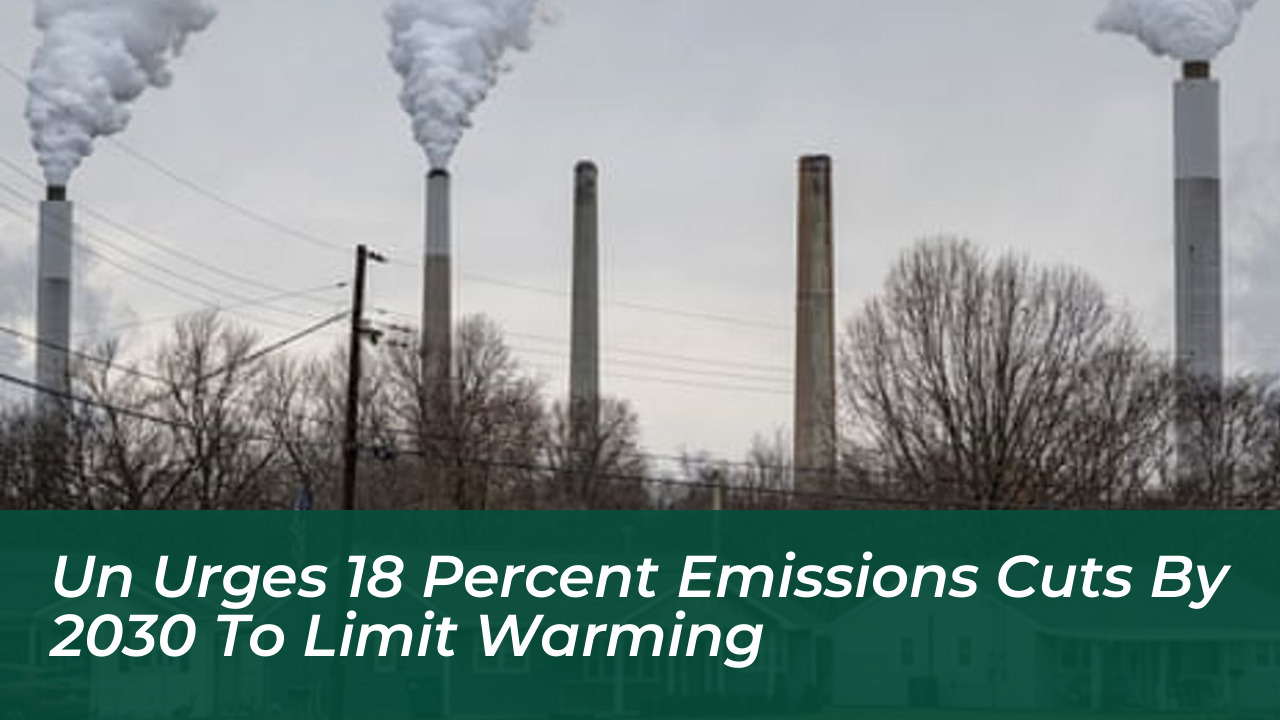

The world must rapidly reduce greenhouse gas emissions to limit damage from global warming, the United Nations Environment Programme (UNEP) stated in a report published on October 21, 2026. According to the findings, global emissions must fall by 18 percent by 2030 and by 45 percent by 2035 to give the planet a strong chance of limiting temperature increases to 1.7 degrees Celsius above preindustrial levels.
The international community’s previously agreed goal of limiting warming to 1.5C is no longer achievable without a temporary overshoot, UNEP analysts warned. However, reducing both the extent and the duration of that climate overshoot remains entirely possible if governments implement substantial and immediate greenhouse gas reductions.
Stalled Carbon Levels and Geopolitical Realities
The UNEP report revealed that global carbon emissions in 2025 remained broadly similar to levels recorded in 2024. Analysts cautioned against interpreting this flatlining as a definitive peak. This temporary stabilization persists despite rapid growth in renewable energy sources, hindered heavily by continued geopolitical uncertainty and an enduring reliance on fossil fuels.
Inger Andersen, the executive director of UNEP, noted that the window of opportunity to avoid a severe temperature overshoot has officially closed due to years of global procrastination.
“We used to say there’s still an opportunity if we make this herculean effort to stay within the 1.5C limit. It’s now clear the herculean effort was not made. We procrastinated, and now we are saying this window has closed,” said Inger Andersen.
Despite the grim outlook, Andersen urged world leaders not to abandon the Paris climate agreement goals entirely, emphasizing that immediate policy adjustments can still guide the world back onto a safer trajectory.
Weak Pledges and Major Producer Resistance
The report highlights a persistent failure among nations to translate long-term emissions targets into aggressive short-term actions. Fresh commitments submitted under the Paris agreement remain dangerously weak. Current national projections indicate that even if all updated pledges are fully met, global temperatures could still rise to 2.6C above preindustrial levels, threatening widespread ecological collapse.
Critics have pointed directly to major fossil fuel producers and shifting political landscapes. Bill Hare, chief executive of the Climate Analytics think tank, criticized major producers such as the United States and Saudi Arabia-which account for 20 to 25 percent of global fossil fuels-for avoiding scientific realities. The recent withdrawal of the United States from the Paris climate agreement under Donald Trump has further complicated international cooperation and emboldened policy inaction.
Pathways to Close the Emissions Gap
Scientists stress that closing the widening emissions gap is strictly a matter of political will rather than a lack of technological solutions. Wind and solar power installations continue to outpace early expectations, yet political leadership frequently lags behind technological capabilities.
Johan Rockström, director of the Potsdam Institute for Climate Impact Research, noted the stark contrast between current trajectories and necessary goals:
- Projected global emissions by 2035 under current national commitments: Approximately 50 gigatonnes of carbon dioxide equivalent annually.
- Required global emissions level by 2035 to meet safety thresholds: Below 35 gigatonnes annually.
- Immediate mitigation lever: Targeting sharp cuts in methane emissions, a greenhouse gas roughly 80 times more potent than carbon dioxide in the short term.
As the international community looks ahead to upcoming global stocktakes and scientific assessments, experts maintain that every five years of emissions at current levels pushes global heating forecasts up by an additional 0.1C, making decisive intervention more urgent than ever.