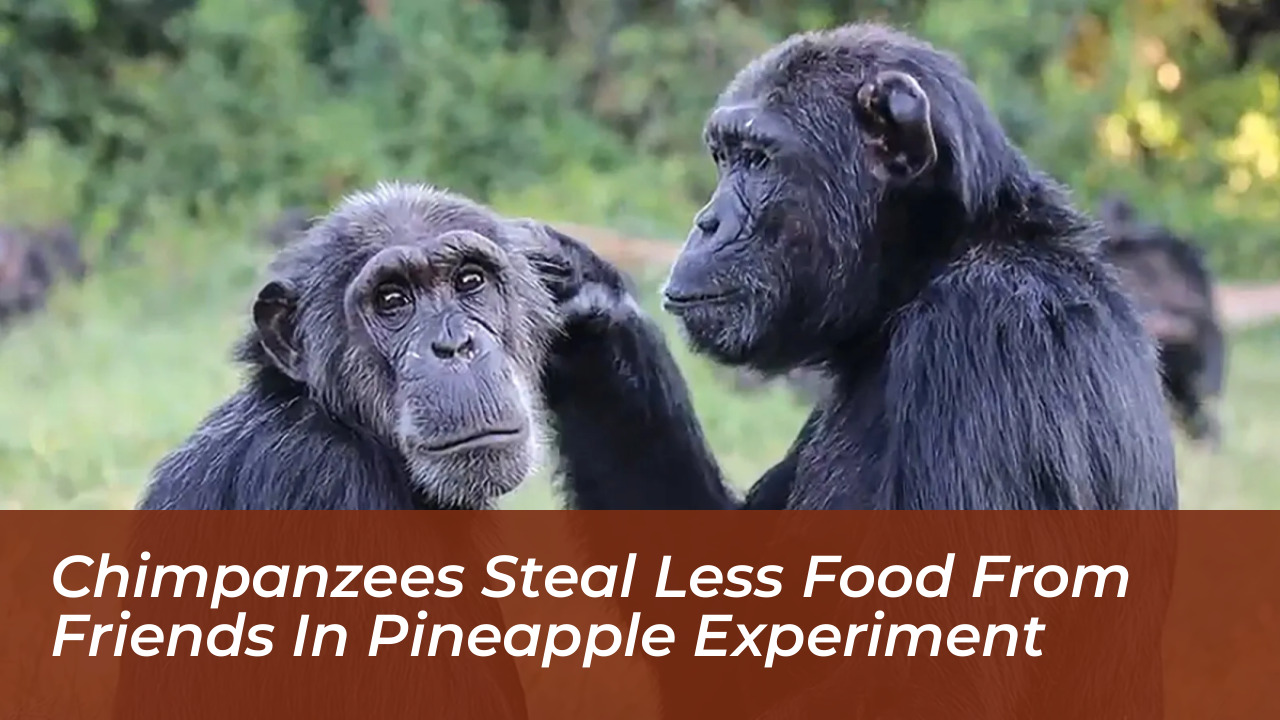

Close social bonds significantly influence how chimpanzees treat one another, according to a behavioral experiment at the Ngamba Island Chimpanzee Sanctuary in Uganda. Researchers found that the animals were noticeably less likely to steal food from their friends, even when tempted with fresh pineapple slices. The study, led by scientists including University of California, Berkeley social psychologist Oded Ritov, suggests that primates may follow unwritten social expectations in their relationships.
Published in the academic journal Evolution and Human Behavior, the research provides experimental evidence that primates can prioritize friendships over obtaining desirable food. According to the study authors, these findings offer vital clues regarding the evolutionary origins of human social norms surrounding friendship and cooperation.
Mapping Chimpanzee Friendships at Ngamba Island
To establish baseline relationships before testing the animals, researchers observed 26 chimpanzees living at the Ugandan sanctuary for more than 800 hours. Scientists documented daily interactions, grooming patterns, and how routinely individual animals remained physically close to one another within arm’s reach. These detailed observations allowed researchers to accurately map out the sanctuary residents’ friendship networks.
Among the pairs studied were Pasa and Yoyo, two female chimpanzees who regularly spend time together grooming, sharing food, and occasionally exploring outside the sanctuary grounds. Scientists are traditionally hesitant to describe close animal bonds as human-like friendships out of concern for projecting human emotions onto other species. However, accumulating evidence shows that animals form deep, meaningful alliances.
The Pineapple Rope Experiment
Following the observation period, researchers designed a controlled two-room setup to measure theft behaviors. In one room, a designated victim chimpanzee sat beside three trays baited with pineapple pieces. A rope attached to the trays ran through a partition into an adjacent room, where a second chimpanzee-the potential thief-could choose whether to leave the rope alone or yank it to pull the fruit toward themselves.
Each chimpanzee participated in multiple trials involving both bonded friends and non-friends. This methodology allowed researchers to compare how the exact same animal behaved depending on the relationship status of its peer. When paired with non-friends, chimpanzees stole the pineapple in 70 percent of trials. However, that figure dropped to 61 percent when dealing with friends.
Emotional Reactions and Mutual Expectations
Although a nine percentage point drop may appear modest, the within-subject design provided researchers with high confidence that the reduction reflects meaningful social restraint rather than random chance. , the emotional reactions of both parties shifted depending on whether a friendship was present.
Researchers evaluated the victims’ responses by tracking visible signs of agitation, including stomping, fist-pounding, and screeching. Interestingly, victims were initially angrier when friends stole from them, reflecting a violation of the trust associated with closeness. Yet, those victims calmed down rapidly compared to when non-friends committed the theft.
- Chimps stole from non-friends in 70 percent of trials.
- Chimps stole from friends in 61 percent of trials.
- Victims calmed down faster when the thief was a trusted friend.
- Thieves displayed negative emotions longer when stealing from non-friends.
The behavior of the thieves shifted as well. When stealing from non-friends, thieves expressed negative emotions for a longer duration, treating the interaction as hostile. When taking food from a bonded partner, thieves showed less prolonged hostility, indicating that the act carried a different emotional texture.
Evolutionary Implications for Human Morality
Senior study author Jan Engelmann, an associate professor of psychology at UC Berkeley, noted that while previous studies documented relationship-specific intentions in non-human primates, human friendships are defined by stronger expectations. People expect more from their friends, and these findings suggest chimpanzees do too.
The research team believes that the mutual expectations observed in chimpanzee friendships may serve as the basic evolutionary building blocks for larger-scale human cooperation. As these social expectations scaled up over evolutionary time, they likely formed the foundation for human moral principles and generalized rules regarding how individuals ought to treat one another.