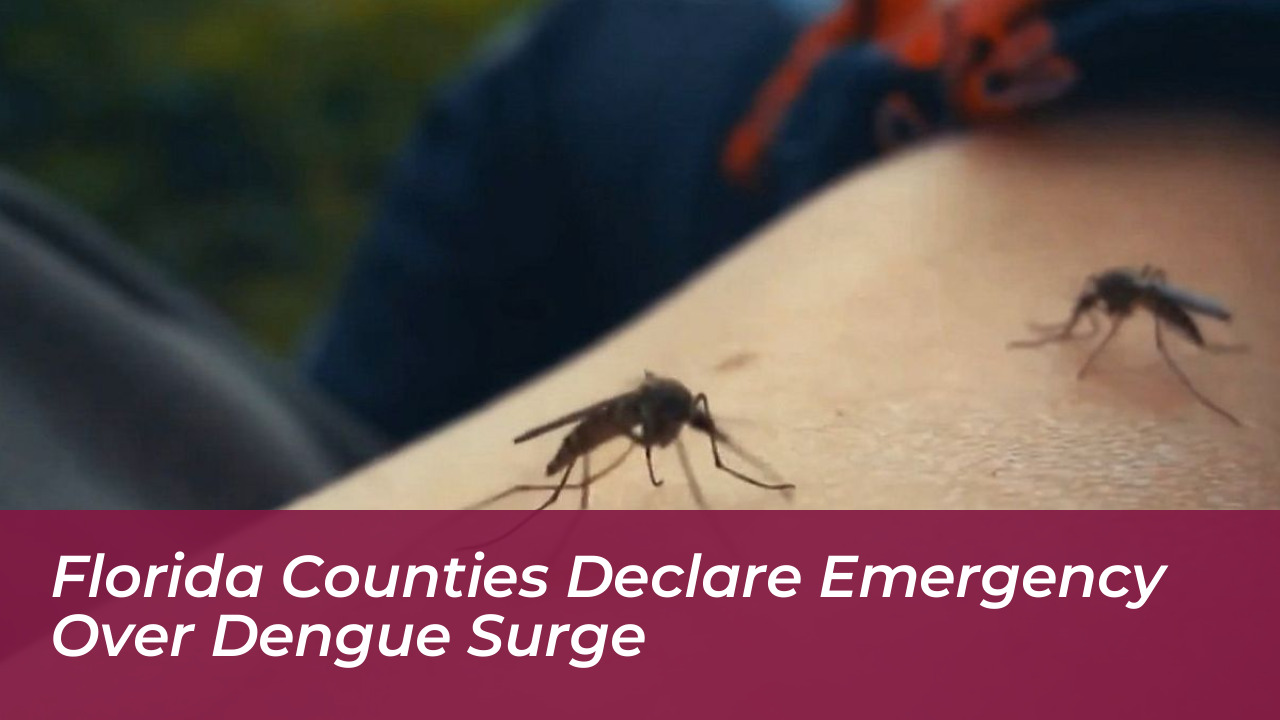
Florida counties declare states of emergency as dengue cases reach 190, signaling a critical public health moment across the state. Commissioners in Hillsborough, Pinellas, and Pasco counties enacted coordinated administrative declarations to combat a sharp surge in mosquito-borne dengue fever. This swift action bypasses standard bureaucratic hurdles, allowing local authorities to deploy emergency funds and scale up mosquito abatement operations rapidly. With 38 new locally acquired cases recorded in a single week, public health officials are racing to contain the outbreak before it expands further into neighboring communities.
- Introduction to the Florida Dengue Outbreak
- Emergency Declarations and Administrative Powers
- Epidemiology and Regional Distribution
- The Vectors: Understanding Aedes Mosquitoes
- Habitat and Flight Range Dynamics
- Biting Behavior and Virus Incubation
- Clinical Presentation and Public Health Risk
- Regional Mosquito Control Strategies
- Content Gaps: Urban Heat Islands and Irrigation Dynamics
- Micro-Climatic Urban Heat Islands
- Container Ecology and Automated Irrigation
- Advanced Vector Defense and Modern Solutions
- Biological Controls and Sterile Insect Techniques
- Smart Property Mapping and Community Surveillance
- Actionable Prevention Checklist for Residents
Introduction to the Florida Dengue Outbreak
The current epidemiological landscape reveals a concentrated cluster of vector-borne illness centered primarily around the Tampa Bay region. Hillsborough County remains the epicenter of the outbreak, housing the vast majority of the statewide total. State health officials recently confirmed a rare dengue-related fatality in South Tampa, marking the first such death in the region in nearly a century. This grim milestone underscores the severity of a virus that traditionally sees lower local transmission rates on the United States mainland.
Neighboring jurisdictions are taking proactive steps to prevent widespread transmission across county lines. Pinellas and Pasco counties issued local states of emergency as preventive safeguards, while Polk County confirmed its first human case of locally acquired dengue. Public health agencies emphasize that halting this viral spread requires aggressive regional collaboration, targeted aerial treatments, and active community participation to reduce breeding sites.
Emergency Declarations and Administrative Powers
Declaring a local state of emergency serves a distinct operational purpose during biological and vector threats. Standard municipal purchasing rules and procurement contracts often require lengthy bidding periods. Emergency orders suspend these procedural delays, giving county administrators the power to immediately purchase bulk pesticides, larvicides, and specialized trap equipment without waiting for standard approvals.
These emergency powers also establish the necessary financial mechanisms for state and federal reimbursement. Emergency management directors can reallocate personnel, authorize overtime, and coordinate multi-agency responses. , mosquito control districts gain the legal agility to access private properties and restricted drainage easements for targeted spraying when public health is at immediate risk.
Epidemiology and Regional Distribution
Hillsborough County continues to bear the brunt of the crisis, accounting for 170 of the 190 total cases reported since July. The rapid cluster development in urban neighborhoods points to localized environmental factors that favor vector proliferation. Health investigators trace transmission chains through detailed patient interviews and neighborhood epidemiological mapping.
Human mobility acts as a primary bridge for geographical transmission across county lines. Infected individuals frequently travel across municipal boundaries for work or leisure during their viremic phase before showing symptoms. This movement introduces the virus to new mosquito populations in adjacent counties, turning a localized neighborhood issue into a regional emergency.
The Vectors: Understanding Aedes Mosquitoes
Habitat and Flight Range Dynamics
Dengue transmission in Florida is driven primarily by two warm-weather mosquito species: Aedes aegypti and Aedes albopictus. Unlike floodwater mosquitoes that emerge in vast marshes after heavy rains, these species thrive directly in urban and suburban environments. They lay eggs in small, artificial water containers rather than large natural bodies of water.
Both species maintain a remarkably short flight range, rarely traveling more than 100 to 500 feet from their hatching site throughout their entire lifespan. Because the mosquitoes themselves do not fly long distances, human travel remains the primary engine behind the geographic spread of the virus from one neighborhood to another.
Biting Behavior and Virus Incubation
Aedes mosquitoes exhibit distinctly aggressive daytime and twilight biting habits. They are highly anthropophilic, meaning they strongly prefer feeding on human blood over animal hosts. This close association with human populations increases the likelihood of rapid viral exchange within residential zones.
When a female mosquito bites an infected person during the viremic phase, the virus enters the insect’s gut. After an internal incubation period, the virus reaches the salivary glands, allowing the mosquito to transmit the pathogen to every subsequent human host it feeds upon for the rest of its life.
Clinical Presentation and Public Health Risk
Diagnosing dengue presents a significant challenge because roughly 75 percent of infected individuals remain entirely asymptomatic. These silent carriers unknowingly circulate the virus as they move through daily routines. For the one in four individuals who do develop symptoms, clinical onset typically occurs within 3 to 15 days of an infective bite.
Common symptoms mimic severe influenza and include sudden high fevers, severe retro-orbital headaches behind the eyes, and intense muscle and joint pain. This extreme joint ache earned dengue the historical moniker breakbone fever. Other signs involve maculopapular rashes and mild hemorrhagic manifestations such as minor nosebleeds.
Severe dengue, historically known as dengue hemorrhagic fever, represents a dangerous medical emergency. It can lead to plasma leakage, fluid accumulation, respiratory distress, and organ impairment. Hospitalization is often required for intravenous fluid management and close hemodynamic monitoring.
Regional Mosquito Control Strategies
Vector management districts across Hillsborough, Pasco, and Pinellas are executing aggressive mitigation protocols. Crews have stepped up aerial and ground pesticide spraying across affected residential zones. In Hillsborough County, low-flying helicopters execute targeted treatments in neighborhoods like South Tampa, Seminole Heights, and Riverview.
Frequent afternoon rainfall complicates these chemical applications. Downpours wash away applied larvicides and adulticides shortly after dispersal, forcing districts into a continuous cycle of re-treating affected zones. Surveillance teams monitor automated traps, test sentinel chicken blood samples, and analyze viral load data to pinpoint where ultra-low-volume spraying will achieve maximum impact.
Content Gaps: Urban Heat Islands and Irrigation Dynamics
Micro-Climatic Urban Heat Islands
Standard media reports attribute the current surge purely to seasonal rainfall patterns. Urban planning research shows that concrete-heavy urban heat islands in Tampa and surrounding municipalities create ideal thermal envelopes for Aedes development cycles. Elevated ambient temperatures shorten the extrinsic incubation period of the dengue virus inside the vector.
This biological acceleration allows mosquitoes to become infectious much faster. Higher urban temperatures mean a mosquito can complete its internal viral replication cycle in fewer days, increasing the rate of transmission across multiple bite cycles within a compressed timeframe.
Container Ecology and Automated Irrigation
While public awareness campaigns urge citizens to dump standing water, they rarely address automated residential irrigation systems. Daily lawn sprinklers maintain perpetual moisture in small, overlooked receptacles such as plant saucers, discarded buckets, and corrugated drain pipes.
This constant hydration bypasses natural dry spells that would otherwise desiccate mosquito eggs. Automated watering schedules sustain localized breeding populations continuously, insulating backyard micro-habitats from regional weather variations.
Advanced Vector Defense and Modern Solutions
Biological Controls and Sterile Insect Techniques
Relying solely on chemical insecticides invites long-term resistance among mosquito populations. Forward-thinking vector control programs increasingly utilize biological controls, such as introducing predatory copepods into non-potable water features to consume mosquito larvae before they mature.
Another advanced technique involves deploying sterile male Aedes aegypti populations. When sterile males mate with wild females, no viable offspring are produced, driving down the total vector population density naturally over successive generations without heavy chemical loads.
Smart Property Mapping and Community Surveillance
Modern public health initiatives increasingly rely on decentralized mobile applications for crowdsourced standing water reporting. Residents can photograph and upload breeding site locations directly to municipal dashboards.
This real-time neighborhood tracking feeds spatial analytics platforms that optimize municipal spraying routes. By targeting high-density reporting zones directly, vector control teams maximize their operational efficiency and suppress localized outbreaks faster.
Actionable Prevention Checklist for Residents
- Conduct weekly property audits to empty, scrub, and overturn any containers holding stagnant water.
- Seal rain barrels and water storage tanks with fine mesh screens to block adult entry.
- Clear roof gutters regularly to prevent debris from trapping water and creating hidden breeding zones.
- Dispose of unused tires, old buckets, and unsealed plastic containers that collect rain.
- Change pet drinking bowls and birdbath water at least twice a week to interrupt the mosquito life cycle.