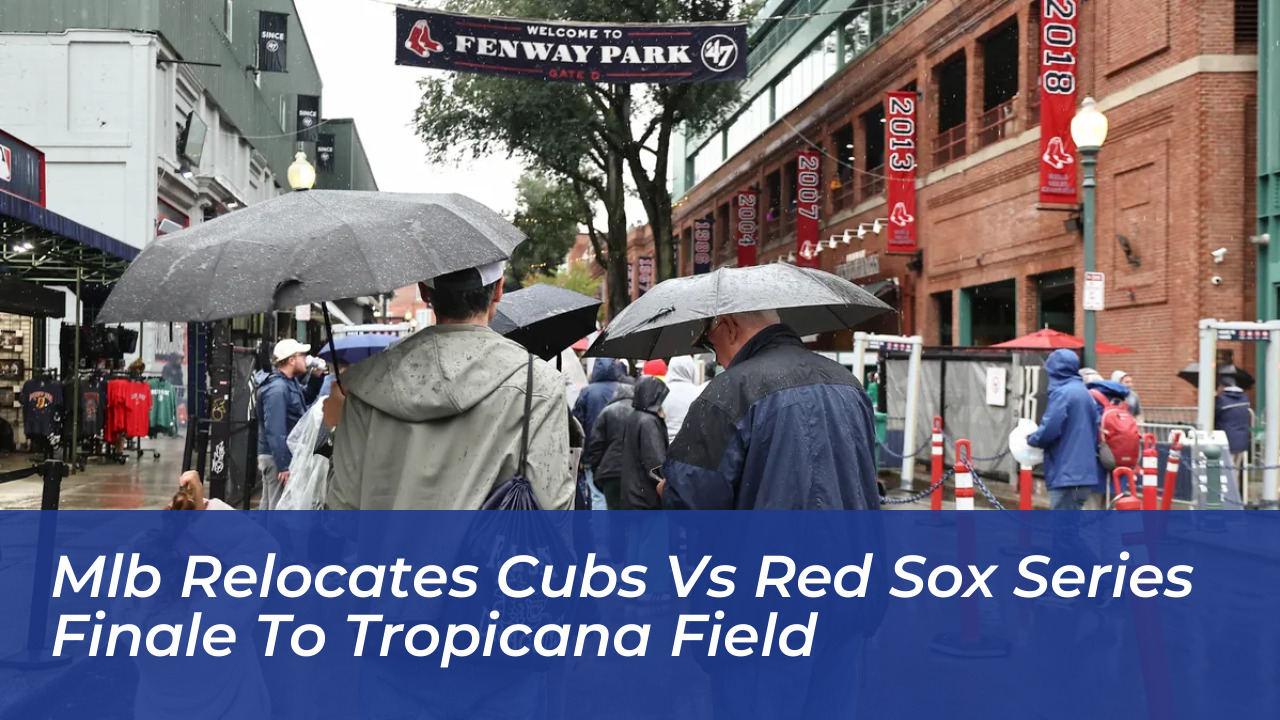
Major League Baseball made a rare operational pivot by shifting the regular-season series finale between the Chicago Cubs and Boston Red Sox to Tropicana Field in St. Petersburg, Florida. Severe weather forecasts threatening New England forced the league to abandon Fenway Park for Sunday afternoon. This emergency relocation safeguards the contest from a powerful incoming nor’easter packing multi-day heavy rain and high-velocity winds across the northeastern United States.
- Emergency Relocation Details and Schedule Adjustments
- The Threat of the New England Nor’easter
- Selecting Tropicana Field as a Neutral Site
- Rarity of In-Season Venue Shifts in Modern Baseball
- Standard Weather Protocols vs Extraordinary Measures
- Logistical Execution Behind the Florida Transition
- Comparative Analysis: Open-Air Ballparks vs Domed Stadiums
- Fenway Park Versus Tropicana Field
- The Modern Debate Over Weather Reliability
- Impact on Stakeholders, Fans, and Local Economies
- Ticket Holders and Regional Fanbases
- Economic Fallout for Boston Neighborhood Businesses
- Broadcasting, Player Preparation, and Future Contingencies
- Media Operations on Short Notice
- Player Routine Disruption and Mental Toughness
- Future Implications for League Schedule Flexibility
- Frequently Asked Questions
- Why did MLB move the Cubs and Red Sox game?
- How did ticket holders get handled for the relocated game?
- When was the last time MLB shifted a venue due to weather?
- Why was Tropicana Field chosen as the neutral site?
- Are climate-controlled backup venues becoming standard practice?
Emergency Relocation Details and Schedule Adjustments
The Threat of the New England Nor’easter
Severe weather forecasts threatening Massachusetts and the broader northeastern United States created an untenable playing environment for late September. High-velocity winds and multi-day heavy rainfall rendered Fenway Park completely unplayable and posed a direct hazard to anyone inside the open-air seating bowl.
League officials faced an immediate choice to abandon the historic venue to safeguard player safety and schedule integrity. Operating a professional game under severe meteorological threats invites unnecessary injury risks, prompting the swift decision to look for viable alternatives outside the impact zone.
Selecting Tropicana Field as a Neutral Site
Finding a major league facility on short notice requires precise logistical alignment across the league. The Tampa Bay Rays were playing an away series in Philadelphia against the Phillies, leaving their home stadium entirely vacant for the weekend.
Tropicana Field provided a weather-proof, fixed-dome environment that offered a completely reliable alternative for the series finale. Coordinated schedule shifts included a Friday doubleheader in Boston followed by an immediate transit of both team travel parties down to Florida.
Rarity of In-Season Venue Shifts in Modern Baseball
Standard Weather Protocols vs Extraordinary Measures
Major League Baseball typically handles routine rain delays through doubleheaders, next-day double-ups, and scheduled off-days within the existing calendar. Shifting a game across state lines due to regional weather remains an extraordinary measure reserved for extreme circumstances.
Excluding pandemic-era adjustments, permanent cross-market venue relocations remain exceptionally rare in modern baseball history. A direct historical comparison exists in the September 2017 scheduling shift caused by Hurricane Irma, which temporarily moved series games between the New York Yankees and Tampa Bay Rays to Citi Field in New York.
Logistical Execution Behind the Florida Transition
Moving two professional sports organizations with less than two days of notice requires immense coordination. Equipment trucks departed Boston immediately following Friday games, driving overnight to reach the west coast of Florida before Sunday morning.
Team travel directors, broadcast engineers, and stadium ground crews worked around the clock on a 48-hour notice. Stadium operations in St. Petersburg successfully met all official league standards for clubhouse facilities, equipment readiness, and field markings.
Comparative Analysis: Open-Air Ballparks vs Domed Stadiums
Fenway Park Versus Tropicana Field
| Feature | Fenway Park (Boston) | Tropicana Field (St. Petersburg) |
|---|---|---|
| Roof Type | Open-air | Fixed Domed Roof |
| Weather Vulnerability | High (Rain, Snow, Nor’easters) | Zero weather delays |
| Playing Surface | Natural Grass | Artificial Turf |
| Primary Tenant | Boston Red Sox | Tampa Bay Rays |
The Modern Debate Over Weather Reliability
This emergency relocation reignites the ongoing discussion regarding weather exposure in professional sports. Balancing the traditional charm of historic outdoor stadiums against operational weather risks remains a persistent challenge for sports executives.
The growing appeal of climate-controlled facilities becomes particularly evident during late-season playoff pushes. When division titles and wild card spots hang in the balance, a guaranteed game time provides immense value over rain delays and postponed doubleheaders.
Impact on Stakeholders, Fans, and Local Economies
Ticket Holders and Regional Fanbases
Sudden venue changes create immediate complications for supporters who planned months in advance to attend a game in Boston. Emergency ticketing protocols, refunds, and ticket exchanges were quickly established by clubs to assist fans displaced from Fenway Park.
Conversely, the change delivered an unexpected late-September bonus for Tampa Bay baseball enthusiasts. Local fans gained a rare opportunity to witness an iconic interleague matchup between two historic franchises without leaving their home region.

Economic Fallout for Boston Neighborhood Businesses
Shifting games out of Boston creates immediate revenue drops for local establishments. Restaurants, bars, and merchandise vendors surrounding Kenmore Square depend heavily on weekend series crowds to sustain their operations.
The sudden cancellation of Saturday’s fixture and the relocation of Sunday’s finale eliminated crucial foot traffic. Local business owners absorbed a noticeable financial blow during a weekend that should have brought peak autumn crowds to the neighborhood.
Broadcasting, Player Preparation, and Future Contingencies
Media Operations on Short Notice
Television and radio networks faced massive operational hurdles when the game location shifted overnight. Production crews, technical directors, and broadcast talent scrambled to adjust travel itineraries across the eastern seaboard.
Despite the geographic jump, advanced remote broadcasting infrastructure ensured seamless integration. Production teams maintained standard broadcast quality by interfacing directly with the stadium audio and visual networks at Tropicana Field.
Player Routine Disruption and Mental Toughness
Professional athletes rely on strict physical and mental routines to perform at peak levels. Transitioning abruptly from the chilly autumn air of Boston into a climate-controlled indoor stadium in Florida disrupts normal biological rhythms.
Coaching staffs managed player fatigue caused by unexpected flights, hotel changes, and altered sleep schedules. Maintaining focus under such volatile circumstances serves as a true test of professional preparedness.
Future Implications for League Schedule Flexibility
How successful emergency relocations unfold could shape future contingency protocols for Major League Baseball. League administrators now look closely at rapid response frameworks.
Designating domed stadiums as official emergency backup sites for climate-threatened series may become standard policy. Such measures protect the integrity of the 162-game schedule against increasingly unpredictable weather patterns.
Frequently Asked Questions
Why did MLB move the Cubs and Red Sox game?
Major League Baseball relocated the series finale to protect players and fans from a severe nor’easter bringing heavy rain and high winds to New England, as Fenway Park lacks a retractable roof.
How did ticket holders get handled for the relocated game?
The respective ballclubs and league officials established emergency ticketing protocols, offering refunds or specific access options for fans who purchased tickets for the Boston games.
When was the last time MLB shifted a venue due to weather?
Prior to this weekend, the last non-pandemic venue shift occurred in September 2017, when Hurricane Irma forced the New York Yankees and Tampa Bay Rays to play at Citi Field in New York.
Why was Tropicana Field chosen as the neutral site?
Tropicana Field was available because the Tampa Bay Rays were playing an away series in Philadelphia against the Phillies, and its fixed dome guaranteed an uninterrupted game.
Are climate-controlled backup venues becoming standard practice?
League officials actively review domed stadium availability to establish reliable contingency frameworks for future weather disruptions.