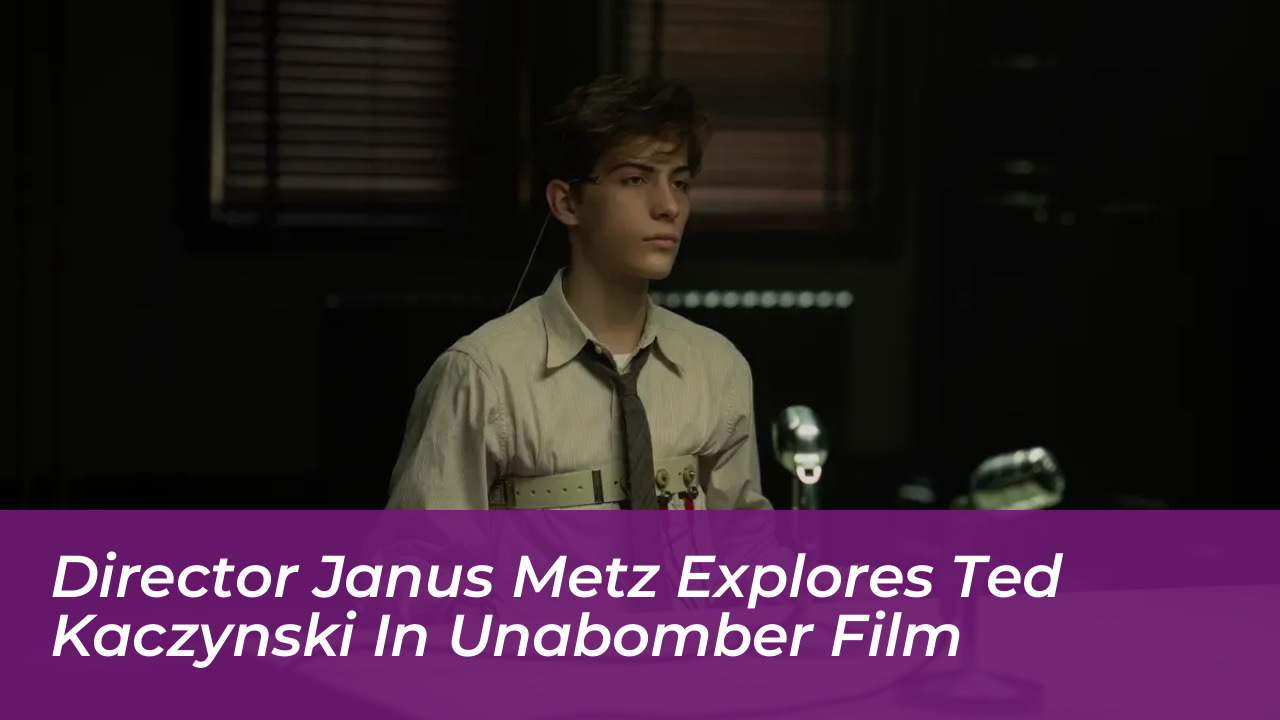
The Netflix feature film titled Unabomber shifts the cultural focus away from standard FBI procedurals to examine the formative years of Theodore Kaczynski. Directed by Janus Metz, known for Borg vs. McEnroe, the narrative delves directly into Kaczynski’s early life as an isolated academic prodigy and his controversial experiences at Harvard University. The cinematic approach does not seek to excuse the violent acts that left three people dead and 23 others injured between 1978 and 1995. Rather, Metz constructs a character-driven study of isolation, institutional betrayal, and the gradual descent into ideological extremism. With Jacob Tremblay stepping into the role of a young Kaczynski and Russell Crowe portraying Harvard professor Henry Murray, the film examines the psychological pressures of the late 1950s Ivy League environment.
- From Mathematical Prodigy to Isolated Extremist
- Early Academic Brilliance and Harvard Admission
- Advanced Studies and Career at Berkeley
- The Harvard Years and the Henry Murray Experiments
- Inside the Psychological Stress Tests
- Impact on Kaczynski’s Worldview
- Cast and Creative Vision Behind Netflix Unabomber
- Unpacking the Manifesto and the Reality of the Manhunt
- Publication of Industrial Society and Its Future
- The Real-Life Investigation by David Kaczynski
- Unique Historical Angle: Linguistic Forensics and Private Investigation
- Unique Historical Angle: The Intellectual Contradiction of Anti-Technology Dogma
- Reflecting on Radicalization in the Modern Era
- Frequently Asked Questions
- What is the focus of the Netflix film Unabomber directed by Janus Metz?
- Who stars in the Netflix Unabomber film?
- What were the Henry Murray experiments at Harvard?
- How was Ted Kaczynski eventually caught?
From Mathematical Prodigy to Isolated Extremist
Early Academic Brilliance and Harvard Admission
The trajectory of Ted Kaczynski remains one of the most confounding case studies in modern criminal history. Born in Chicago in 1942, Kaczynski displayed extraordinary mathematical aptitude from early childhood. He skipped multiple grades, mastering complex mathematical concepts long before his peers. This accelerated intellectual development separated him socially from children his own age, fostering a deep sense of detachment. He entered Harvard University as a mathematics prodigy at the remarkably young age of 16 in the late 1950s.
Life inside the ivy-covered walls of Harvard presented an intense cultural and intellectual shock for a teenager. Surrounded by brilliant minds and affluent classmates, Kaczynski struggled to find a peer group. His exceptional analytical skills remained his primary anchor while his social isolation deepened. The academic pressure of the institution combined with his personal alienation to shape a fragile psychological foundation.
Advanced Studies and Career at Berkeley
Following his undergraduate years, Kaczynski continued his academic ascent by earning a master’s degree and a doctorate in mathematics from the University of Michigan. His doctoral dissertation solved a notoriously complex mathematical problem in boundary function theory, praised by professors as a work of rare brilliance. Recognizing his potential, the University of California, Berkeley, appointed him as an assistant professor of mathematics at the age of 25, making him one of the youngest professors in the country.
Despite this professional triumph, Kaczynski felt increasingly alienated by the academic establishment and the changing social landscape of the late 1960s. He grew deeply disillusioned with modern mathematics and the broader trajectory of technological society. In 1969, he abruptly resigned from his position at Berkeley. He severed ties with the academic world and ultimately retreated to a remote, off-grid cabin near Lincoln, Montana, beginning a life of total solitude.
The Harvard Years and the Henry Murray Experiments
Inside the Psychological Stress Tests
A central pillar of the new Netflix film is the controversial psychological experimentation conducted on Kaczynski during his undergraduate years at Harvard. Russell Crowe stars as Henry Murray, a prominent psychologist who, alongside academic collaborator Christiana Morgan, subjected students to intense psychological stress tests. The film frames the Harvard experiments not as a singular origin point for domestic terrorism, but as a crucial fracture in a young man’s developing worldview.
Participants in Murray’s study were asked to write detailed essays outlining their personal philosophies, core values, and deepest aspirations. Researchers then subjected these beliefs to aggressive, belittling interrogations designed to induce high levels of emotional stress while being recorded on film. The methodology involved systematic humiliation, challenging the participants’ core identities under harsh lights and electrodes. The psychological toll of these sessions left lasting emotional scars on multiple students.
Impact on Kaczynski’s Worldview
While Kaczynski later downplayed the long-term impact of these sessions in prison correspondence, contemporary biographers and the new film suggest that the experience fueled a deep sense of humiliation, alienation, and resentment toward institutional authority. The feeling of being manipulated by authority figures under the guise of scientific progress reinforced his growing suspicion of institutional control. This formative betrayal serves as a narrative anchor for understanding his later rejection of technological society.
The cinematic exploration treats these experiments as a catalyst rather than a simple excuse. It highlights how institutional experiments on human subjects during the Cold War era often ignored psychological collateral damage. Kaczynski’s internal world fractured further during these years, planting the seeds of an uncompromising hostility toward the architects of modern industrial progress.
Cast and Creative Vision Behind Netflix Unabomber
Director Janus Metz assembled a prominent cast to bring this complex historical narrative to the screen. The production balances historical documentation with cinematic interpretation to fill the gaps in the public record. Jacob Tremblay portrays the young, socially awkward prodigy navigating Harvard, while Russell Crowe embodies the charismatic and controversial professor Henry Murray. Shailene Woodley takes on the role of Joanne Miller, a fictionalized investigative agent, and Annabelle Wallis plays Christiana Morgan, Murray’s academic collaborator.
Shooting primarily in Montreal, where McGill University doubled for the historic Ivy League campus, the production team recreated the collegiate atmosphere of the late 1950s. The visual tone shifts deliberately between the polished red-brick academic buildings of Cambridge and the claustrophobic, snow-covered isolation of the Montana wilderness. This visual contrast mirrors the internal journey of the protagonist as he moves from civilized intellectual spaces into the raw wilderness.
Unpacking the Manifesto and the Reality of the Manhunt
Publication of Industrial Society and Its Future
In 1995, the Unabomber case reached a turning point when Kaczynski demanded the publication of his 35,000-word treatise, Industrial Society and Its Future. The New York Times and The Washington Post published the text under the guidance of federal authorities, who hoped a reader might recognize the writing style. The strategy succeeded, though the real-life sequence of events differed significantly from standard Hollywood depictions.
The manifesto attacked industrialization, technology, and modern leftism, arguing that the system destroys human freedom and psychological health. Federal hopes centered on the idea that public readership would expose the author through distinct phrasing or familiar viewpoints. While the federal task force anticipated tips from academics or former colleagues, the actual breakthrough originated from a much closer source.
The Real-Life Investigation by David Kaczynski
David Kaczynski, Ted’s younger brother, and his wife, Linda Patrik, grew suspicious after reading the published manifesto. Recognizing recurring phrases and philosophical arguments found in childhood letters, David faced an agonizing moral dilemma. Rather than going straight to federal law enforcement, David hired a private investigative team and a forensic linguist to compare the manifesto against decades of personal correspondence.
Only after confirming a high probability of authorship did the family turn the evidence over to the FBI via legal counsel. Federal agents subsequently arrested Kaczynski at his Montana cabin on April 3, 1996. Investigators recovered active bomb-making equipment, operational typewriters, and tens of thousands of pages of handwritten journals detailing his grievances, cementing the end of a two-decade manhunt.
Unique Historical Angle: Linguistic Forensics and Private Investigation
Commercial filmmaking regularly compresses complex investigations into singular heroic arcs. However, examining primary source records reveals an entirely separate dimension of the Unabomber case that mainstream adaptations frequently omit: the birth of modern forensic linguistics in a private law office. When David Kaczynski suspected his brother, he did not simply hand over a stack of papers to the federal government. He retained attorney Tony Bisceglie, who assembled an independent task force consisting of a private investigator, a clinical psychologist, and a linguistic analyst.
This private team spent three months analyzing syntactic structures, idiosyncratic punctuation, and rare vocabulary choices before ever notifying the FBI. This civilian operation established a legal and methodological precedent for using stylistic text analysis in criminal profiling. By bypassing traditional bureaucratic channels during the initial investigative phase, the private team shielded the suspect’s identity while constructing an airtight evidentiary bridge. Exploring this technical partnership highlights how civilian intelligence gathering outpaced federal assets during the critical months of 1995.
Unique Historical Angle: The Intellectual Contradiction of Anti-Technology Dogma
A striking paradox defines the life of Theodore Kaczynski. The man who condemned industrial civilization and mechanical progress relied heavily on industrial byproducts to execute his campaign. Living in a remote cabin without modern utilities, Kaczynski utilized metal scraps, batteries, wires, and chemicals scavenged from local dumps to build sophisticated explosive devices. His advanced mathematical and scientific training enabled him to construct complex mechanical systems while simultaneously denouncing the very scientific establishment that produced them.
This behavioral contradiction forms a core psychological puzzle explored in modern analyses of the case. Kaczynski acted as a skilled industrial mechanic while preaching the total dismantling of the industrial system. He used modern tools, postal systems, and manufactured materials to wage war against modernity. The psychological irony of an anti-industry critic depending on industrial waste highlights the deep cognitive dissonance inherent in extreme ideological crusades.
Reflecting on Radicalization in the Modern Era
Director Janus Metz intends the film to serve as a cautionary tale for contemporary audiences navigating an increasingly digital and isolated world. Parallels between historical isolation and modern digital radicalization echo through the cinematic narrative. Kaczynski retreated into physical isolation, cutting off human connection until his grievances consumed his entire worldview. In the modern era, online echo chambers and virtual isolation often create similar pathways to extremism.
The film challenges viewers to recognize the warning signs of alienation before it hardens into destructive ideology. By focusing on the human elements of institutional pressure, mental vulnerability, and societal detachment, the narrative transcends a simple crime drama. It offers a sober reminder that understanding the origins of radicalization remains essential for preventing future tragedies in an increasingly complex world.
Frequently Asked Questions
What is the focus of the Netflix film Unabomber directed by Janus Metz?
The film shifts away from standard FBI procedurals to focus on Ted Kaczynski’s early psychological development, academic brilliance, time at Harvard, and the impact of institutional stress tests on his worldview.
Who stars in the Netflix Unabomber film?
The cast features Jacob Tremblay as young Ted Kaczynski, Russell Crowe as Professor Henry Murray, Shailene Woodley as an investigative agent, and Annabelle Wallis as Christiana Morgan.
What were the Henry Murray experiments at Harvard?
Conducted during the late 1950s, these psychological stress tests required students to write personal philosophies and defend them against aggressive, belittling interrogations designed to induce emotional distress.
How was Ted Kaczynski eventually caught?
After Kaczynski demanded the publication of his manifesto in 1995, his brother David Kaczynski and sister-in-law Linda Patrik recognized his writing style, hired private forensic linguists, and subsequently notified the FBI.