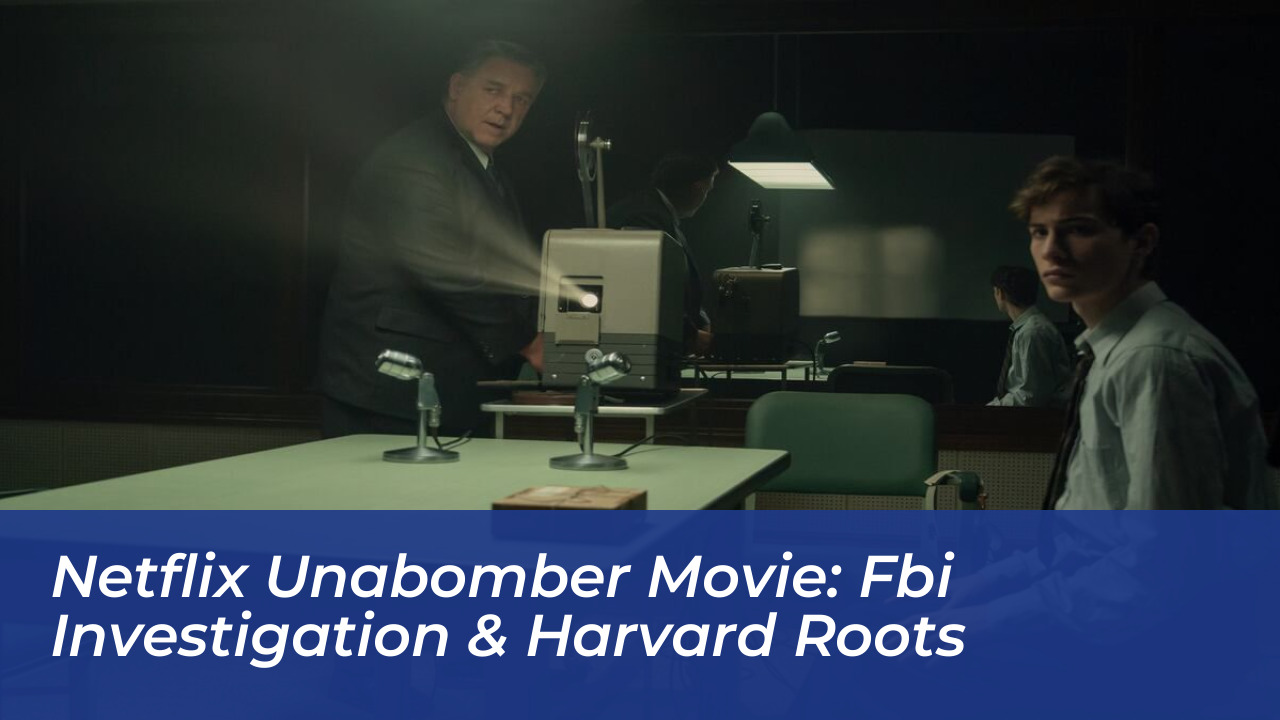
Netflix expands its catalog of biographical crime dramas with the September 25, 2026 release of Unabomber. Directed by Janus Metz, the thriller examines the complex historical intersection between the longest-running manhunt in federal history and the formative years of Ted Kaczynski. Written by Sam Chalsen and Nelson Greaves, the feature structures its narrative around a dual timeline. It contrasts the frantic 1995 federal investigation in San Francisco with Kaczynski’s early academic journey as a 16-year-old mathematics prodigy at Harvard University in 1958.
- The Dual Timeline Narrative Structure
- Contrasting Eras in Cinematic Storytelling
- The 1995 Manhunt and Linguistic Breakthrough
- Forensic Linguistics in Action
- The 1958 Harvard Experiments
- Institutional Pressure and Vulnerability
- Cast and Character Breakdown
- Jacob Tremblay as Ted Kaczynski
- Russell Crowe as Henry Murray
- Shailene Woodley as Joanne Miller
- Annabelle Wallis as Christiana Morgan
- Behind the Scenes: Production and Creative Vision
- Historical Fact Versus Cinematic License
- Timeline Comparison of Unabomber
- Frequently Asked Questions
- When was Unabomber released on Netflix?
- Who directed the Netflix movie Unabomber?
- Does the movie cover the entire life of Ted Kaczynski?
- Are the psychological experiments at Harvard historically accurate?
- What role does forensic linguistics play in the film?
The Dual Timeline Narrative Structure
The film breaks away from conventional linear biographies by running two parallel tracks. One timeline follows federal agent Joanne Miller in 1995 as she races against time to stop a decade-spanning mail-bombing campaign. The other tracks Kaczynski’s teenage years in the ivy-covered quadrangles of Harvard. This structural choice aims to show how youthful isolation and institutional pressure fused into a destructive ideology.
By jumping between these two distinct eras, the narrative creates a thematic bridge. It connects the quiet psychological strain of mid-century academia with the high-octane pressure of modern forensic investigation. The pacing keeps audiences engaged while drawing direct lines from the subject’s youth to his later actions.
Contrasting Eras in Cinematic Storytelling
- Balancing the high-octane tension of 1990s forensic investigation with the quiet, intellectual alienation of mid-century academia.
- Highlighting the thematic bridge between academic institutional experiments and societal distrust of technology.
Cinematic storytelling requires precise structural pacing. Filmmakers often leverage contrasting environments to highlight inner turmoil. The visual palette shifts deliberately between decades. This aesthetic choice deepens audience immersion.
The 1995 Manhunt and Linguistic Breakthrough
By 1995, Kaczynski had executed 15 bombings that left two people dead and 23 injured. Major newspapers faced immense public pressure when they published his anti-technology manifesto, Industrial Society and Its Future. The film highlights the painstaking police work required to crack the case. The turning point arrives when agent Joanne Miller analyzes the linguistic patterns of the manifesto. She matches these insights with a tip from David Kaczynski, who recognizes stylistic similarities to letters written by his brother.
Investigators spent years chasing dead ends before linguistic analysis provided a breakthrough. The film showcases the tedious hours agents spent combing through documents, building a psychological profile based entirely on word choice and phrasing. This analytical approach ultimately forced open a case that had baffled federal agencies for decades.
Forensic Linguistics in Action
- The meticulous process of analyzing phrasing, vocabulary, and ideological markers within the manifesto.
- The crucial familial intervention by David Kaczynski that altered the trajectory of the federal manhunt.
Federal agencies faced unprecedented public scrutiny during this investigation. Media pressure mounted daily as thousands of tips flooded field offices. Investigators relied heavily on profile analysis and linguistic forensics to isolate genuine leads.
The 1958 Harvard Experiments
Shifting back four decades, the film explores Kaczynski’s time as an undergraduate prodigy. Arriving at Harvard at just 16 years old, Kaczynski struggled to connect with his peers. During this vulnerable period, he participated in psychological studies run by Professor Henry Murray. These experiments involved intense verbal degradation while subjects were hooked up to monitoring equipment. The film posits that these controversial sessions served as a primary catalyst for Kaczynski’s deep-seated hatred of modern technology and academia.
The campus scenes carry a cold, unsettling atmosphere that mirrors Kaczynski’s internal state. Isolated from normal social development, the young student absorbed intense pressure from elite institutional frameworks. The movie uses these psychological trials to explain the root causes of a deeply troubled mind.
Institutional Pressure and Vulnerability
- Examining the social isolation of a teenage prodigy within an elite university environment.
- The ethical implications of the psychological studies conducted on undergraduate students during the late 1950s.
Academic institutions wield immense psychological influence over impressionable students. Researchers during this era frequently pushed ethical boundaries in the name of behavioral science. These historical practices continue to generate intense debate among modern psychologists and ethicists.
Cast and Character Breakdown
A high-profile ensemble brings the historical figures to life, blending rising young talent with seasoned cinematic veterans.
Jacob Tremblay as Ted Kaczynski
Tremblay portrays the young math prodigy, capturing his intellectual isolation and gradual descent into radicalization.
Russell Crowe as Henry Murray
Crowe plays the influential Harvard psychology professor whose controversial research methods form the ideological battleground of the campus scenes.
Shailene Woodley as Joanne Miller
Woodley takes on the role of the fictionalized lead FBI investigator driving the 1995 San Francisco manhunt.
Annabelle Wallis as Christiana Morgan
Wallis portrays Professor Murray’s academic partner and co-director at the Harvard Psychological Clinic.
Character development relies heavily on nuanced performances to bridge historical gaps. Actors spent months studying archival footage and historical texts. This preparation ensures authentic representations of complex real-world figures.
Behind the Scenes: Production and Creative Vision
Director Janus Metz brought the project to life after previous successes like Borg vs McEnroe and All the Old Knives. Screenwriters Sam Chalsen and Nelson Greaves discovered the Harvard experiment angle through a radio broadcast. Because both writers attended Harvard, the discovery of this dark historical chapter drove them to draft the screenplay. Sophie Cassidy produced the film for 2.0 Entertainment in association with MRC, ensuring a polished aesthetic that contrasts mid-century academic coldness with 1990s law enforcement grit.
The production design team worked carefully to recreate both eras with authentic detail. From the wood-paneled offices of 1950s Cambridge to the cluttered federal desks of 1990s San Francisco, every set piece reinforces the psychological weight of the story.
Cinematography plays a vital role in establishing distinct temporal atmospheres. Lighting techniques vary significantly between the two eras. Cold, muted tones define the academic scenes, while high-contrast gritty textures dominate the federal investigation sequences.
Historical Fact Versus Cinematic License
While the film uses the Harvard psychological experiments as the main catalyst for Kaczynski’s worldview, real-world historians note that Kaczynski downplayed the direct impact of Murray’s studies in his own journals. However, scholars agree that his time at Harvard marked a period of profound alienation. The friction between institutional authority and an isolated intellect remains a core theme of the feature.
Dramatization requires narrative focus, and the filmmakers chose to spotlight the Harvard experiments to give audiences a tangible anchor for Kaczynski’s radical shifts. Viewers should keep in mind that historical biopics often condense complex decades of life experience into sharp, thematic collisions.
Balancing historical accuracy with dramatic storytelling challenges every biographical filmmaker. Creative liberties often streamline complex events for cinematic clarity. Historians continue to debate the precise triggers that shaped Kaczynski’s destructive path.
Timeline Comparison of Unabomber
| Timeline Metric | 1958 Harvard Era | 1995 FBI Investigation |
|---|---|---|
| Primary Focus | Intellectual isolation and psychological experiments | Forensic linguistics and manhunt operations |
| Key Figures | Ted Kaczynski, Henry Murray, Christiana Morgan | Joanne Miller, David Kaczynski |
| Primary Setting | Harvard University campus, Cambridge, Massachusetts | San Francisco field office and Montana cabin |
| Tone | Mid-century academic tension and cold paranoia | High-stakes procedural urgency |
Frequently Asked Questions
When was Unabomber released on Netflix?
Netflix released the film globally on September 25, 2026.
Who directed the Netflix movie Unabomber?
Janus Metz directed the film, working from a screenplay written by Sam Chalsen and Nelson Greaves.
Does the movie cover the entire life of Ted Kaczynski?
No. Instead of a birth-to-death survey, the film focuses exclusively on two distinct periods: his time as a 16-year-old student at Harvard in 1958 and the FBI investigation leading to his capture in 1995.
Are the psychological experiments at Harvard historically accurate?
Yes. Kaczynski did participate in psychological studies conducted by Henry Murray while at Harvard, though debate remains among historians regarding the exact degree to which those experiments influenced his later terrorist actions.
What role does forensic linguistics play in the film?
Linguistic analysis provides the breakthrough moment for investigators trying to match the published manifesto to Kaczynski’s personal writing style.