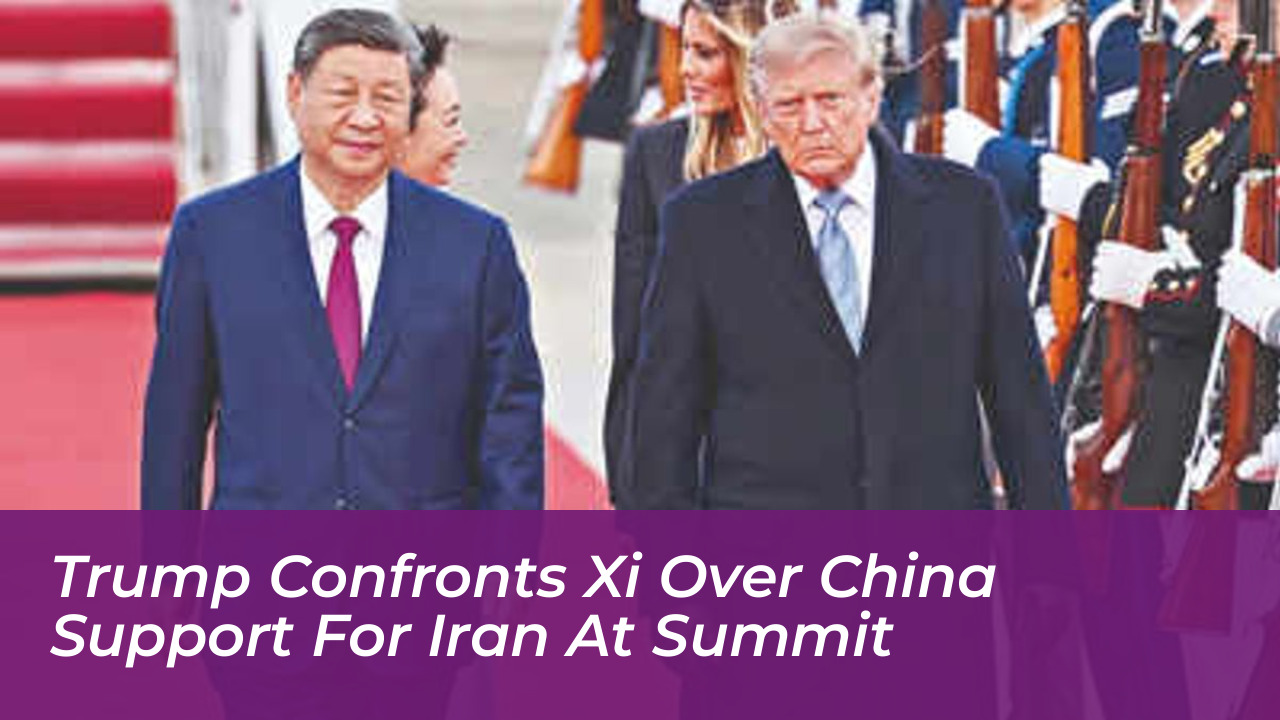
During Chinese President Xi Jinping’s state visit to Washington, U.S. President Donald Trump delivered an explicit warning regarding Beijing’s economic and military entanglement with Tehran. According to U.S. Ambassador to China David Perdue, President Trump told Xi directly that any form of Chinese assistance to Iran remains completely unacceptable. This diplomatic confrontation underscores rising tensions over geopolitical proxy flashpoints, energy security in the Strait of Hormuz, and military logistics fueling instability in the Middle East. The three-day state visit, initiated by Trump’s formal invitation, aimed to establish a floor under relations between the world’s two largest economic powers. Yet behind the military pageantry, red carpets, and B-2 stealth bomber flyovers at Joint Base Andrews, substantive closed-door negotiations exposed deep divisions regarding the global order.
- Inside the Washington Summit: The Diplomatic Standoff
- High-Stakes Preparations and Red Lines
- Pragmatism Versus Deep Divisions
- The Intelligence Battleground: Satellite Imagery and Military Support
- Bipartisan Pressure and Congressional Warnings
- State Department Sanctions and Dual-Use Friction
- Economic Leverage and the Energy Crisis in the Strait of Hormuz
- Maritime Choke Points and Oil Imports
- Financial Enforcement and Strategic Hedging
- Broader Geopolitical Dynamics on the Agenda
- Trade Truces and Artificial Intelligence Protocols
- Taiwan Strait and Rare Earth Supply Chains
- Assessing the Strategic Fallout of the Summit
- The Limits of Transactional Diplomacy
- Frequently Asked Questions
- Why did President Trump confront Xi Jinping regarding Iran during the Washington summit?
- What specific support has China allegedly provided to Iran?
- How did Beijing respond to allegations of supporting Iran?
- What role does the Strait of Hormuz play in U.S.-China tensions over Iran?
- Were there any major agreements reached regarding Iran during the summit?
Inside the Washington Summit: The Diplomatic Standoff
High-Stakes Preparations and Red Lines
President Trump and Chinese President Xi Jinping convened for a 90-minute closed-door meeting at the White House to address flashpoints spanning the Middle East, Ukraine, and the Korean Peninsula. Ambassador Perdue noted in media interviews that the Trump administration communicated weeks prior to the summit that direct or indirect assistance to Iran crosses a definitive redline. This warning encompasses military equipment, critical parts, financial lifelines, and intelligence sharing.
Despite the stark warnings, the two leaders attempted to project an image of pragmatism. Both administrations recognize the catastrophic economic fallout should bilateral stability collapse completely. However, the diplomatic balancing act remains fragile. While Beijing attempts to position itself as a stabilizing counterweight to American unilateralism, Washington faces mounting domestic pressure from lawmakers demanding strict enforcement of secondary sanctions.
Pragmatism Versus Deep Divisions
American lawmakers continue to demand aggressive oversight of financial networks that sustain the Iranian war machine. Entities facilitating petroleum trade or providing logistical support are now primary targets for U.S. regulators. Congress expects the executive branch to utilize every tool available to sever the financial lifelines connecting Beijing and Tehran.
At the same time, Chinese trade representatives are navigating severe domestic economic pressures. Maintaining steady export channels to Western markets is paramount for Beijing. The challenge lies in balancing this commercial necessity against their long-term strategic investments in West Asia and anti-Western partnerships.
The Intelligence Battleground: Satellite Imagery and Military Support
Bipartisan Pressure and Congressional Warnings
The urgency behind Trump’s confrontation with Xi stems from recent intelligence assessments detailing Beijing’s material support for Iranian military operations. Bipartisan pressure intensified ahead of the summit following public disclosures regarding commercial and state-linked Chinese entities sharing wartime satellite imagery with Tehran. A high-profile congressional letter spearheaded by lawmakers highlighted a September intelligence assessment indicating that Chinese satellite data supported an Iranian strike on an airbase in Jordan that resulted in U.S. casualties.
Lawmakers classified Beijing’s military cooperation as a severe threat to American servicemembers. Representative John Moolenaar, along with other congressional leaders, labeled this technological enablement as a direct challenge to national security. The State Department previously sanctioned multiple China-based entities for providing orbital reconnaissance data that actively guided strikes against U.S. positions in the region.
State Department Sanctions and Dual-Use Friction
Washington has steadily expanded its enforcement mechanisms, targeting specific technological supply chains. Beijing consistently issues formal denials regarding state-owned enterprises intentionally aiding actions against American forces. Officials in China claim these transactions involve civilian or commercial entities operating independently of government directives.
However, Western intelligence agencies argue that the line between commercial entities and state oversight in China is remarkably thin. Dual-use technologies exported under the guise of commercial agreements often find their way into military supply chains, complicating efforts by Western diplomats to enforce strict containment policies.
Economic Leverage and the Energy Crisis in the Strait of Hormuz
Maritime Choke Points and Oil Imports
The geopolitical confrontation over Iran intersects directly with global energy markets and maritime choke points. The ongoing U.S. naval blockade on Iranian ports within the Strait of Hormuz has severely disrupted petroleum shipments. This maritime restriction chokes off an estimated 12 percent of China’s total oil imports, creating acute energy vulnerabilities for the world’s second-largest economy.
As China remains Iran’s largest trading partner and primary crude oil customer, Beijing faces significant pressure from Washington to leverage this economic dominance. U.S. strategy involves pressing Chinese leadership to isolate Tehran from global financial markets and force a return to diplomatic negotiations.
Financial Enforcement and Strategic Hedging
Treasury Secretary Scott Bessent engaged Chinese counterparts during the summit regarding financial sanctions compliance and enforcement mechanisms. While Chinese financial authorities expressed a willingness to discuss trade stability during preliminary talks, achieving concrete alignment on isolating Iran remains elusive. Beijing views its partnership with Iran as a strategic hedge against Western dominance, securing a steady stream of discounted crude oil.
Despite these economic ties, the limits of financial alignment are clear. Beijing prefers a role as a diplomatic mediator rather than an active enforcer of American foreign policy objectives. This fundamental divergence prevents any meaningful consensus on regional security frameworks.
Broader Geopolitical Dynamics on the Agenda
Trade Truces and Artificial Intelligence Protocols
The confrontation over Iran unfolded alongside negotiations on broader strategic files. Negotiators discussed extending the existing trade truce past its expiration date, granting both nations additional time to formulate a comprehensive commercial agreement amidst ongoing tariff structures. , both delegations explored the establishment of an artificial intelligence notification mechanism designed to serve as a crisis hotline for national security incidents.
Taiwan Strait and Rare Earth Supply Chains
President Xi urged Washington to handle the Taiwan issue prudently against pending arms packages and congressional posturing. In response, the White House maintained its traditional stance of strategic ambiguity. Meanwhile, Beijing’s dominance over critical mineral mining and refining served as a potent counterweight to ongoing U.S. semiconductor export controls.
Assessing the Strategic Fallout of the Summit
The Limits of Transactional Diplomacy
Trump’s direct confrontation with Xi Jinping highlights the limits of transactional diplomacy when confronted with entrenched security crises. While the Washington summit successfully prevented an immediate escalation of trade hostilities and maintained vital channels of communication, it yielded no breakthroughs regarding Beijing’s alignment with Tehran.
As the U.S. maintains its maximum pressure campaign against Iran, enforcement mechanisms targeting Chinese entities will likely intensify. The summit ultimately demonstrated that while both economic superpowers prefer managed competition over open conflict, bridging fundamental divergences on regional security remains an uphill battle.
Frequently Asked Questions
Why did President Trump confront Xi Jinping regarding Iran during the Washington summit?
President Trump confronted Xi because U.S. intelligence assessments revealed that Chinese entities provided wartime satellite imagery and logistical support used in Iranian military operations against American forces in the Middle East.
What specific support has China allegedly provided to Iran?
U.S. officials and congressional reports point to the transfer of dual-use technology, intelligence sharing, rare industrial parts, and commercial satellite imagery that enabled precise targeting for Iranian regional strikes.
How did Beijing respond to allegations of supporting Iran?
The Chinese government formally denies that state-owned enterprises or official policies support military actions against American forces, maintaining that trade relations are strictly commercial and civilian in nature.
What role does the Strait of Hormuz play in U.S.-China tensions over Iran?
The Strait of Hormuz is a vital maritime oil route. U.S. naval blockades disrupt petroleum shipments that make up a significant portion of China’s total oil imports, creating energy vulnerabilities and friction over economic enforcement.
Were there any major agreements reached regarding Iran during the summit?
No major strategic agreements were reached regarding Iran. While the summit produced progress on trade truce extensions and artificial intelligence protocols, Beijing and Washington remained deeply divided on regional security and sanctions enforcement.