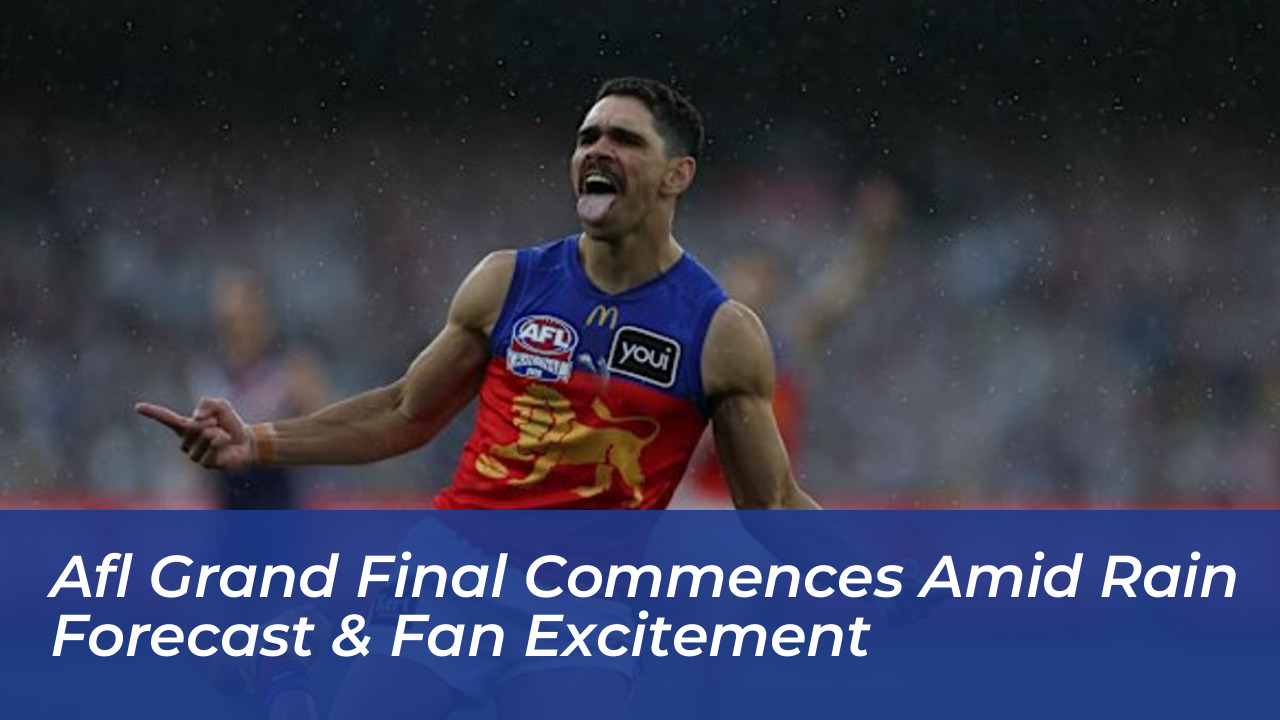
The Melbourne Cricket Ground sets the stage for a dramatic AFL Grand Final between Fremantle and the Brisbane Lions, featuring roaring crowds, falling rain, and high-energy pre-game entertainment from Australian pop icon Kylie Minogue. Fans across the nation tuned in as the traditional season finale kicked off under uniquely challenging meteorological conditions, turning a standard championship match into a test of pure endurance and tactical flexibility.
- Unpacking the Cold Front: From Spring Warmth to Winter Conditions
- Temperature Drop and Rainfall Projections
- Comparison with Historical Rain-Affected Grand Finals
- Logistical Shift: Preserving the Melbourne Cricket Ground Surface
- Relocation of the Under-17 Curtain-Raiser
- MCG Turf Management and Drainage Capabilities
- Tactical Breakdown: How Heavy Rain Alters Match Strategy
- Fremantle Defensive Grid and Stoppage Preference
- Brisbane Uncontested Marking Chains Under Pressure
- Team Adaptability in Wet Conditions
- Spectator Experience and Entertainment Adaptations
- Kylie Minogue Headlines Pre-Game Spectacle
- Fan Preparation and Stadium Guidelines
- Frequently Asked Questions
- How does heavy rain impact AFL match strategy?
- What temperature drop was recorded at the MCG?
- Why was the under-17 curtain-raiser relocated?
- How did fans prepare for the wet weather conditions?
Unpacking the Cold Front: From Spring Warmth to Winter Conditions
An abrupt weather shift transforms match conditions from warm spring sunshine into heavy downpours and biting southerly winds. Meteorological reports confirm a sharp cold front moving through Victoria on match day, originating from a low pressure trough that carried moisture directly across the continent. This sudden change caught many travelers and match goers off guard, requiring immediate adjustments as conditions deteriorated rapidly.
Atmospheric instability combined with coastal moisture feeds to create persistent rain bands over the metropolitan area. Local forecasters monitored the system for days before upgrading warnings as the front accelerated. Players warming up on the arena noticed the sudden drop in air quality and wind speed instantly.

Forecasters recorded up to 10 millimeters of rainfall through Saturday morning and early afternoon, creating a slippery playing surface. Temperatures plunged significantly from Friday’s peak of 25 degrees Celsius during the traditional Grand Final parade down to a daytime maximum of 16 degrees Celsius. Ambient temperatures dropped further to roughly 13 degrees Celsius during active play, driven down by severe wind chill that tested player resilience.
Humidity levels soared past eighty percent, making the air feel much heavier than standard autumn fixtures. Trainers adjusted hydration strategies to focus on warmth and energy retention rather than cooling. Players wore specialized thermal undergarments beneath their standard team guernseys to combat muscle stiffness during breaks.
Temperature Drop and Rainfall Projections
- Meteorological data reveals a sharp cold front tracking across Victoria.
- Temperatures plunge from Friday’s 25 degrees Celsius Grand Final parade peak to a daytime maximum of 16 degrees Celsius.
- Wind chill drops ambient field-level temperatures to roughly 13 degrees Celsius during active play.
- Forecasters record up to 10 millimeters of rainfall through Saturday morning and early afternoon.
Comparison with Historical Rain-Affected Grand Finals
- Rain remains an infrequent disruption during the final match of the Australian Rules football season.
- The last comparable wet-weather decider occurred in 2009, resulting in a low-scoring, physical battle amid icy winds and an 11-degree temperature drop.
- Modern stadium organizers utilize advanced weather-resistant staging instead of traditional pitch-level platforms to protect audio-visual presentations.
Logistical Shift: Preserving the Melbourne Cricket Ground Surface
League administrators implement proactive measures to protect the turf and maintain player footing throughout the championship match. Officials recognized early that protecting the root structure of the grass would dictate the quality of play as precipitation intensified throughout the afternoon. Groundskeepers worked tirelessly behind the scenes to ensure the drainage systems operated at peak capacity.
Moving preliminary events away from the main arena proved vital for turf preservation. The venue features sophisticated sub-surface drainage systems to evacuate heavy water volumes, but excessive foot traffic remains the primary enemy of wet turf. Eliminating preliminary fixtures prevents excessive churning and protects grass roots during slippery, high-contact sequences.
Ground staff applied specialized sand amendments earlier in the week to absorb surface moisture and improve traction. Heavy rollers compressed the top layer to prevent chunks of turf from tearing away during aggressive tackles. These preventative measures successfully prevented large mud patches from forming in the central corridor.
Relocation of the Under-17 Curtain-Raiser
- Officials move the national youth showcase match to Whitten Oval in Footscray.
- The relocation prevents early surface degradation and ensures a pristine pitch for the main event.
MCG Turf Management and Drainage Capabilities
- The venue features sophisticated sub-surface drainage systems to evacuate heavy water volumes.
- Eliminating preliminary fixtures prevents excessive churning and protects grass roots during slippery, high-contact sequences.
Tactical Breakdown: How Heavy Rain Alters Match Strategy
Coaching staff from both clubs adjust their game plans to account for a wet leather ball and slick turf conditions. Wet weather alters tactical execution, favoring teams built on defensive pressure and inside contest work. Clean handling becomes nearly impossible after the first quarter, forcing players to rely on instinctive ground-level skills rather than precise aerial marking.
Ruckmen must alter their tapping strategies to direct the ball downward into congested packs rather than to outside runners. Midfielders swap long, floating kicks for low, penetrating bullets that slide along the turf. Forwards learn to anticipate unpredictable bounces off the wet grass.
Fremantle relies on a strong defensive matrix designed to lock the ball in the forward half. Slick conditions favor grinding stoppages and tackle-heavy contest work, perfectly matching their seasonal profile. Conversely, Brisbane builds its highest scoring sequences through fast, fluid ball movement and uncontested marking chains, which becomes severely restricted by the greasy ball and driving rain.
Coaches emphasize immediate defensive positioning at every stoppage to prevent clean clearances. Forward lines push higher up the ground to create an extra layer of defensive pressure. Every possession becomes a high-stakes battle for territorial dominance across the wing.
Fremantle Defensive Grid and Stoppage Preference
- Fremantle relies on a strong defensive matrix designed to lock the ball in the forward half.
- Slick conditions favor grinding stoppages and tackle-heavy contest work.
Brisbane Uncontested Marking Chains Under Pressure
- Brisbane traditionally builds scoring chains through fast, fluid ball movement.
- Wet weather forces a pivot toward direct surge football and long kicks to deep target zones.
Team Adaptability in Wet Conditions
Weather disruptions force immediate tactical revisions from coaching staff sitting on the interchange bench. The table below outlines key structural adjustments required for wet ground conditions:
| Strategic Element | Fremantle Match Profile | Brisbane Lions Match Profile |
|---|---|---|
| Primary Playstyle | Stoppage dominance and defensive pressure | Uncontested marking and rapid ball movement |
| Wet Weather Impact | High alignment with natural grinding style | Requires adaptation to surge-and-advance tactics |
| Key Performance Metric | Tackles inside 50 and ground-ball gets | Metres gained and forward-entry conversion |
| Handling Strategy | First-time gathering and short handball fires | Direct long kicking to deep target zones |
Team runners deliver constant updates regarding slippery zones near the boundary lines. Interchange rotations increase in frequency to maintain high intensity in the wet. Players swap boots multiple times to find the optimal stud length for traction.
Spectator Experience and Entertainment Adaptations
Fans and organizers adapt quickly to adverse weather without dampening the atmosphere of the season finale. Pop icon Kylie Minogue delivered a high-energy pre-game show on a central, custom-built stage. Technicians implemented waterproof covers and specialized wiring systems to protect equipment against continuous rainfall, ensuring the performance energized the crowd.
Supporters adjusted quickly to the cold turn in weather. Fans traded t-shirts and caps for heavy rain jackets, insulated layers, and team-branded ponchos. Venue management enforced standard stadium safety guidelines, urging fans to refrain from raising umbrellas in seating bays to ensure clear viewing lines for all spectators.
Concession stands experienced record sales for hot beverages and protective ponchos before the opening bounce. Stadium staff distributed emergency rain ponchos at major entry gates to assist unprepared patrons. Despite the gloomy skies, crowd noise reached deafening levels as the first quarter commenced.
Kylie Minogue Headlines Pre-Game Spectacle
- Pop superstar Kylie Minogue delivers a vibrant pre-game show on a custom-built central stage.
- Specialized waterproof wiring and protective covers ensure uninterrupted performance quality despite continuous rain.
Fan Preparation and Stadium Guidelines
- Supporters swap standard match-day attire for heavy rain jackets, insulated layers, and team ponchos.
- Venue management enforces safety policies, restricting open umbrellas in seating bays to maintain clear viewing lines.
“Spring weather in Melbourne can shift rapidly within 24 hours. Adapting ball-handling techniques and footwear to a wet surface remains a central factor in deciding who lifts the premiership cup.”
Frequently Asked Questions
How does heavy rain impact AFL match strategy?
Rain makes the ball slippery, reducing clean handling and aerial marking. Teams must rely on ground-level contests, short handballs, and defensive pressure.
What temperature drop was recorded at the MCG?
Temperatures dropped from Friday’s parade peak of 25 degrees Celsius down to 16 degrees Celsius, with wind chill lowering field-level warmth to 13 degrees.
Why was the under-17 curtain-raiser relocated?
Officials moved the youth match to protect the root structure of the MCG turf from excessive foot traffic before the main event.
How did fans prepare for the wet weather conditions?
Supporters wore heavy rain jackets, insulated layers, and team ponchos while avoiding open umbrellas in seating bays.