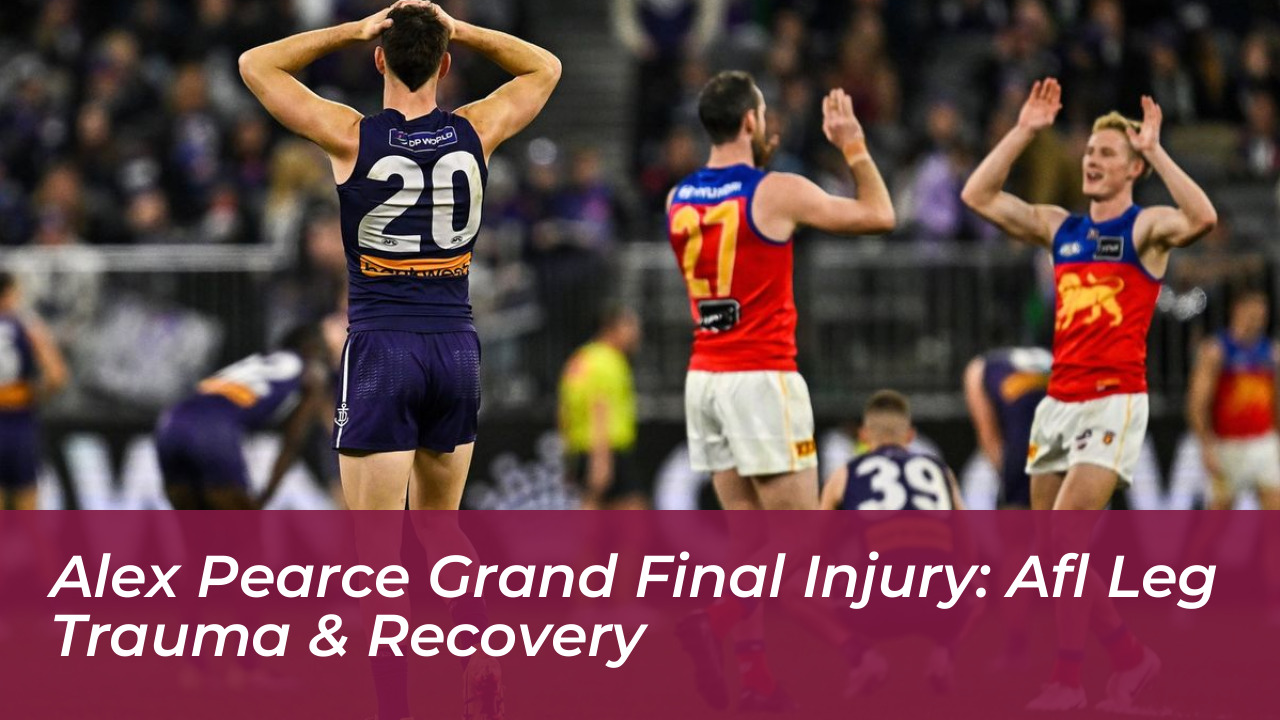
During a high-stakes AFL match, Fremantle Dockers captain Alex Pearce suffered a severe lower-leg injury that reshaped the defensive structure of his team. The key defender went down during a fierce contest, forcing medical staff to assist him off the turf. The sudden loss of their defensive anchor left Fremantle struggling to reorganize their backline under immense pressure, while raising serious questions about Pearce’s recovery timeline for upcoming fixtures.
- The Pivotal Incident: How the Lower-Leg Injury Unfolded
- On-Field Medical Evaluation and Sideline Assessment
- Official Fremantle Ruling and On-Field Tactical Impact
- Anatomy and Biomechanics of AFL Lower-Leg Injuries
- The Simmonds Squeeze Test and Tendon Integrity
- Rehabilitation Protocols and Expected Recovery Timelines
- Tactical Leadership Void and Coaching Adjustments
- Comparative Analysis: Major Injury Incidents
- Modern Sports Science and Injury Prevention Frameworks
- Frequently Asked Questions About Alex Pearce’s Injury
- What is the expected return timeline for an Achilles injury?
- How does a surface slip cause an Achilles tendon rupture?
- Can teams use a medical substitute when a player is injured in a match?
The Pivotal Incident: How the Lower-Leg Injury Unfolded
The decisive moment occurred during a fast-paced defensive sequence, with Fremantle battling to maintain their structural integrity against a surging attack. Alex Pearce was matched up directly in a high-speed chase for a loose ball inside the defensive 50. As both athletes contested for position, Pearce attempted a rapid change of direction to secure possession and clear the danger zone.
During this explosive movement, Pearce lost traction on the turf surface. The sudden slip created an awkward combination of torsional stress and extreme linear forces across his right lower extremity. Instead of absorbing the movement naturally, his lower leg buckled under the weight of his momentum, causing the defender to instantly drop to the grass in obvious distress.
Play continued briefly around the loose ball, but the officiating umpires quickly stopped the match as Pearce remained grounded, clutching his right lower leg. The emotional energy inside the stadium shifted instantly. Teammates rushed to check on their captain while the umpire summoned medical personnel to the field, marking a challenging turn of events in a critical fixture.
On-Field Medical Evaluation and Sideline Assessment
Fremantle medical staff reached the fallen skipper within seconds of the stoppage. Initial physical evaluations conducted directly on the turf indicated clear functional impairment. Pearce was completely unable to bear weight through his right heel, signaling significant disruption to the kinetic chain of his lower leg.
Recognizing the severity of the trauma, trainers supported Pearce on either side, carefully assisting him off the ground toward the interchange bench. He could not put any pressure on his right foot as he hobbled across the boundary line, highlighting the acute nature of the damage sustained during the collision.
Once situated on the bench, sports physicians immediately removed his right football boot and sock to expose the injured area. Clinical examinations focused heavily on the Achilles tendon region, where trainers identified severe localized tenderness and early structural laxity. Medical staff quickly applied cryotherapy ice wraps around the Achilles region to limit acute tissue swelling and minimize inflammatory responses while preparing for off-site imaging.
Official Fremantle Ruling and On-Field Tactical Impact
Following the preliminary bench diagnostics, the Fremantle medical team issued an immediate and definitive ruling. Alex Pearce was officially ruled out for the remainder of the match. The formal announcement put an end to any hopes of a courageous return, forcing the coaching staff to restructure their game plan on the fly.
The loss of Pearce delivered a substantial tactical blow to Fremantle’s defensive line. As the primary intercept marker and chief organizer of the back six, his absence left a gaping hole in the Dockers’ aerial defense. His ability to read the flight of the ball and direct positional shifts had been central to Fremantle’s defensive consistency all season.
The opposition forward line quickly recognized the structural vulnerability. Without Pearce on the field to spoil long entries, opposing forwards gained cleaner aerial access, capitalizing on the temporary disorganization within the Dockers backline. Fremantle’s remaining defenders scrambled to adapt, but the emotional and physical disruption created permanent mismatches.
Anatomy and Biomechanics of AFL Lower-Leg Injuries
Australian rules football places extraordinary strain on the lower extremities due to the endless combination of high-speed sprinting, rapid deceleration, and explosive vertical leaps. During a typical match, players subject their lower limbs to repeated mechanical stress. The Achilles tendon, which connects the gastrocnemius and soleus calf muscles to the calcaneus bone, bears the brunt of these dynamic loads.
Biomechanical studies demonstrate that explosive plant-and-pivot movements on natural grass can generate tensile loads on the Achilles tendon equal to eight to twelve times an athlete’s total body weight. When traction gives way unexpectedly, the sudden release and rapid re-engagement of torque can exceed the ultimate tensile strength of the tendon fibers, leading to acute strain, partial tears, or catastrophic rupture.
The Simmonds Squeeze Test and Tendon Integrity
To evaluate tendon continuity immediately after an acute injury, field clinicians rely on rapid diagnostic physical assessments like the Simmonds squeeze test, often called the Thompson test. The medical practitioner squeezes the calf muscle while the patient rests in a prone or kneeling position. In a healthy tissue structure, this compression causes automatic plantar flexion of the foot. A lack of foot movement strongly indicates a full-thickness tear of the Achilles tendon structure.
In addition to manual tests, medical personnel evaluate the palpable gap along the tendon pathway. When complete ruptures occur, a visible depression usually forms a few centimeters above the heel insertion point, accompanied by an immediate loss of resting muscle tension.
Rehabilitation Protocols and Expected Recovery Timelines
Recovering from an acute, high-grade lower-leg or Achilles tendon injury requires a disciplined, long-term rehabilitation plan split across distinct recovery phases. Because elite Australian rules footballers require maximum explosive power, surgical repair is standard practice to re-approximate the torn tendon ends and re-establish optimal resting length.
Phase 1 begins immediately post-surgery, focusing on strict immobilization in a protective rigid boot, combined with aggressive swelling management. During the first two to four weeks, non-weight-bearing protocols allow primary scar tissue formation at the surgical repair site. Early controlled passive motion exercises are introduced gradually under strict physical therapy oversight to prevent excessive scar adhesion.
Phase 2 centers on progressive mechanical loading and calf muscle restoration. Between weeks six and twelve, light weight-bearing exercises begin, accompanied by slow resistance protocols. Therapists utilize force plates and clinical balance tools to restore neuromuscular control, rebuild muscular volume in the gastrocnemius, and gradually increase the tensile capacity of the healing tendon collagen.
Phase 3 shifts toward athletic functional restoration, covering a period from six months up to a full year. Athletes execute multidirectional agility drills, high-speed straight-line running, and landing mechanics retraining. Full return-to-play clearance typically demands a nine-to-twelve-month recovery window, requiring athletes to demonstrate equal bilateral calf strength, symmetrical power output, and complete psychological readiness before returning to elite contact sport.
Tactical Leadership Void and Coaching Adjustments
Losing a senior captain during a high-pressure match forces a coaching group to execute high-stakes tactical shifts under intense psychological stress. Alex Pearce served as the vocal core of Fremantle’s backline, regularly directing coverage shifts, signaling double-team support, and managing key match-ups against opposition power forwards.
Without Pearce directing play, assistant coaches must immediately reassign primary defensive responsibilities to remaining key defenders. Young players are thrust into high-stress one-on-one contests against elite opposition targets, often without the benefit of organized double-team support from their skipper.
Beyond immediate match adjustments, a major injury to a starting captain reshapes long-term roster management. Team management must balance salary cap considerations and squad depth, identifying emerging talent capable of filling the structural void across an extended nine-to-twelve-month absence.
Comparative Analysis: Major Injury Incidents
High-profile injuries during crucial matches are among the most dramatic moments in sports history. The intense physical pressure of elite competition frequently pushes athletic bodies past their mechanical limits, leading to game-altering structural losses.
The following table illustrates significant historical injury setbacks occurring during important matches, highlighting the tactical shifts and ultimate team outcomes resulting from these key losses:
| Player / Team | Match Stage | Injury Mechanism & Site | Structural Tactical Impact | Final Match Outcome |
|---|---|---|---|---|
| Alex Pearce (Fremantle) | 3rd Quarter | Slip during pivot / Right Achilles area | Loss of primary interceptor and defensive caller | Defensive structural collapse in late quarters |
| Robert DiPierdomenico (Hawthorn) | 1st Quarter | Heavy body contact / Punctured lung & ribs | Player remained on field; severe physical limitation | Hawthorn held on for historic victory |
| Matthew Primus (Port Adelaide) | Mid-Season / Fixture Missed | Awkward landing / Anterior Cruciate Ligament | Loss of main ruckman; backup forced into starting role | Port Adelaide won 2004 Premiership |
| Jonathon Brown (Brisbane) | 2nd Quarter | Facial collision / Severe cranial trauma | Key target removed; forward entry structure disrupted | Brisbane lost offensive momentum |
Modern Sports Science and Injury Prevention Frameworks
To reduce the occurrence of severe lower-limb trauma, modern AFL clubs rely heavily on advanced sports science technologies. Wearable GPS tracking devices monitor real-time player workloads during training and matches, alerting strength and conditioning coaches when high-velocity running metrics spike into dangerous fatigue zones.
Pitch traction management has also become a critical area of focus for elite sports science departments. Prior to matches at major venues, staff measure grass density, moisture levels, and surface hardness. Players choose specific boot stud configurations based on these biomechanical traction tests to minimize dangerous slipping risks during rapid changes of direction.
, elite strength programs incorporate specialized eccentric calf training and isometric loading exercises to build tendon stiffness. By training lower-leg tendons to absorb sudden shock loads, sports science departments aim to create greater mechanical resilience against dynamic, non-contact injuries on match day.
Frequently Asked Questions About Alex Pearce’s Injury
What is the expected return timeline for an Achilles injury?
Rehabilitation following a major Achilles tendon repair usually ranges between nine and twelve months for elite professional athletes. This extensive timeframe allows the tendon to regain structural strength, rebuild muscular calf volume, and complete high-speed running protocols safely.
How does a surface slip cause an Achilles tendon rupture?
A sudden slip places unexpected dynamic loads on the lower leg muscles while they are rapidly contracting. This combination of eccentric lengthening and peak muscle contraction generates dynamic forces that exceed the tensile limits of the tendon collagen, causing structural failure.
Can teams use a medical substitute when a player is injured in a match?
Yes, under current AFL regulations, teams can activate a designated tactical or medical substitute once club medical personnel officially confirm that an active player has sustained an injury that renders them unfit to continue participating in the match.