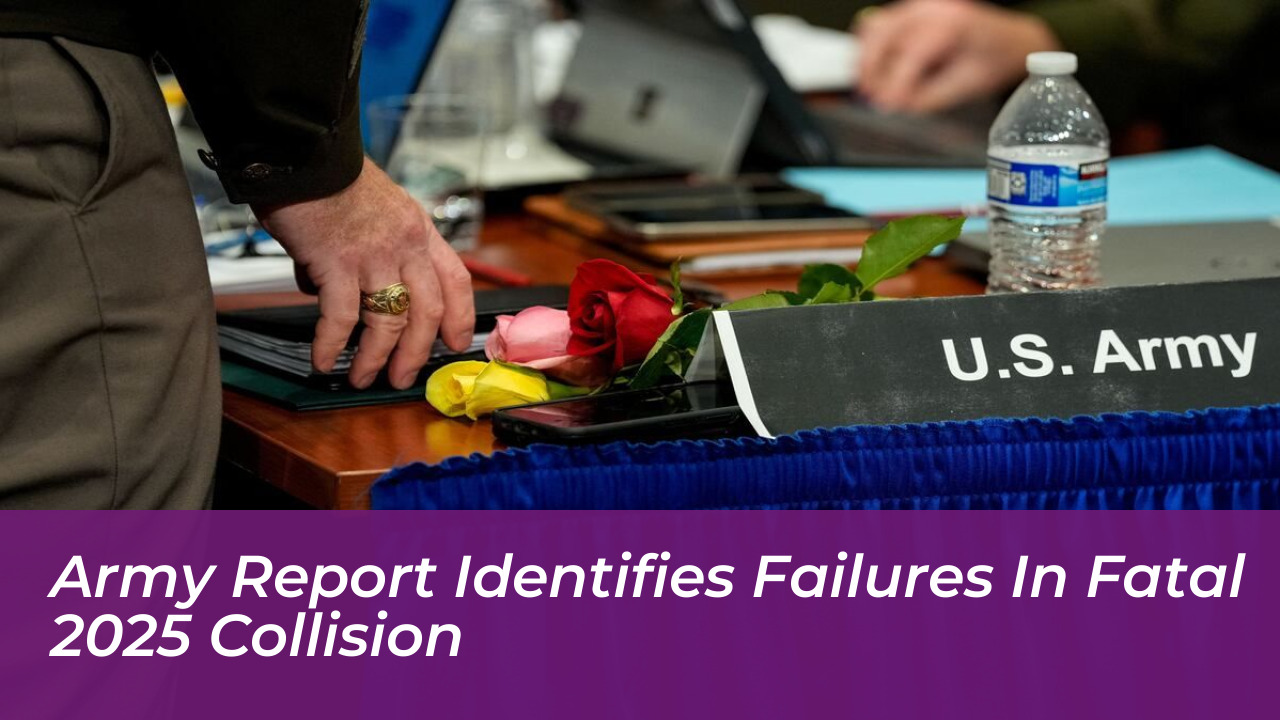


A comprehensive U.S. Army investigative report has revealed that equipment malfunctions, inadequate training, and serious gaps in safety oversight contributed to the January 2025 midair collision near Ronald Reagan Washington National Airport. The tragic accident, which involved an American Airlines regional jet and an Army Black Hawk helicopter over the Potomac River, resulted in 67 fatalities, making it the deadliest U.S. aviation disaster in over two decades.
The previously undisclosed report, completed in May and reviewed by Reuters and the Associated Press, identified a series of systemic breakdowns across multiple layers of conflict management. Investigators concluded that the single most salient factor in the crash was two failed radio transmissions, which prevented the helicopter crew from receiving critical traffic details from air traffic control.
Key Findings and Systemic Failures
According to the document authored by a military lieutenant general, the accident was not the result of a single error, but rather an accumulation of technical and operational failures. The report highlighted several major contributing issues:
- Radio and Communication Failures: Two broken radio transmissions meant the Black Hawk crew did not receive vital updates regarding American Airlines Flight 5342 as it circled to land.
- Technical and Equipment Deficiencies: Investigators found technical problems with the Black Hawk fleet, including missing Traffic Alert and Collision Avoidance systems on many battalion helicopters-including the aircraft involved in the crash.
- Altimeter Inaccuracies and ADS-B Out: The helicopter failed to transmit key safety location data (ADS-B Out) due to improper maintenance, and the aircraft was operating with known altimeter inaccuracies that provided faulty altitude readings.
- Night-Vision Goggle Limitations: Military pilots were wearing night-vision equipment that significantly restricted their field of view, making it extremely difficult to spot the commercial jet amid the bright lights of the metropolitan area.
- Training and Flight Hour Gaps: The report noted a pattern of helicopter crews failing to meet semiannual minimum flight hours, alongside a lack of robust training for military pilots operating near major commercial hubs like Washington and Baltimore.
The Role of Air Traffic Control and the FAA
While acknowledging the military’s internal shortcomings, the report also scrutinized civilian oversight. Investigators faulted Federal Aviation Administration (FAA) air traffic controllers for using non-standard terminology and providing incomplete traffic advisories. The report noted that the air traffic controller in the tower could have prevented the tragedy by giving the helicopter precise positioning details and warning the commercial jet of the approaching military aircraft.
The National Transportation Safety Board (NTSB) conducted a broader civilian investigation and previously concluded that FAA failures were largely responsible for the disaster. In an October 1 letter to the Army, NTSB Chair Jennifer Homendy noted that while the Army has made significant progress in addressing safety recommendations-such as inspecting the transponders of all 3,600 Army helicopters by July 2025-its aviation safety system historically failed to consistently detect, interpret, and act on latent hazards.
Calls for Broad Safety Reforms and Congressional Action
In response to the findings, the Army stated that it has implemented stronger training and surveillance checks, completed new helicopter safety inspections, and improved altitude awareness testing. Additionally, the military is actively pursuing an FAA data-sharing agreement to help identify potential midair collision risks.
The Army has also expanded its safety reviews beyond the Washington, D.C., region to examine helicopter flight operations in other major metropolitan areas, including Los Angeles and the Seattle-Tacoma region, as well as international posts in South Korea, Japan, and Germany.
Families of the victims, including relatives of First Officer Sam Lilley and passengers traveling from Wichita, Kansas, argue that the report underscores the urgent need for legislative action. They continue to pressure Congress to pass comprehensive aviation safety reforms that mandate collision-avoidance technology across all aircraft operating in shared airspace.
“It’s a simple concept anyone can understand: aircraft should be able to see each other in the sky. The technology is proven. All that’s required is the political will to do the right thing,” the Families of Flight 5342 group stated.
Both the House and Senate have passed differing aviation safety bills in the wake of the disaster, and lawmakers are currently working to reconcile a final compromise package for a congressional vote.