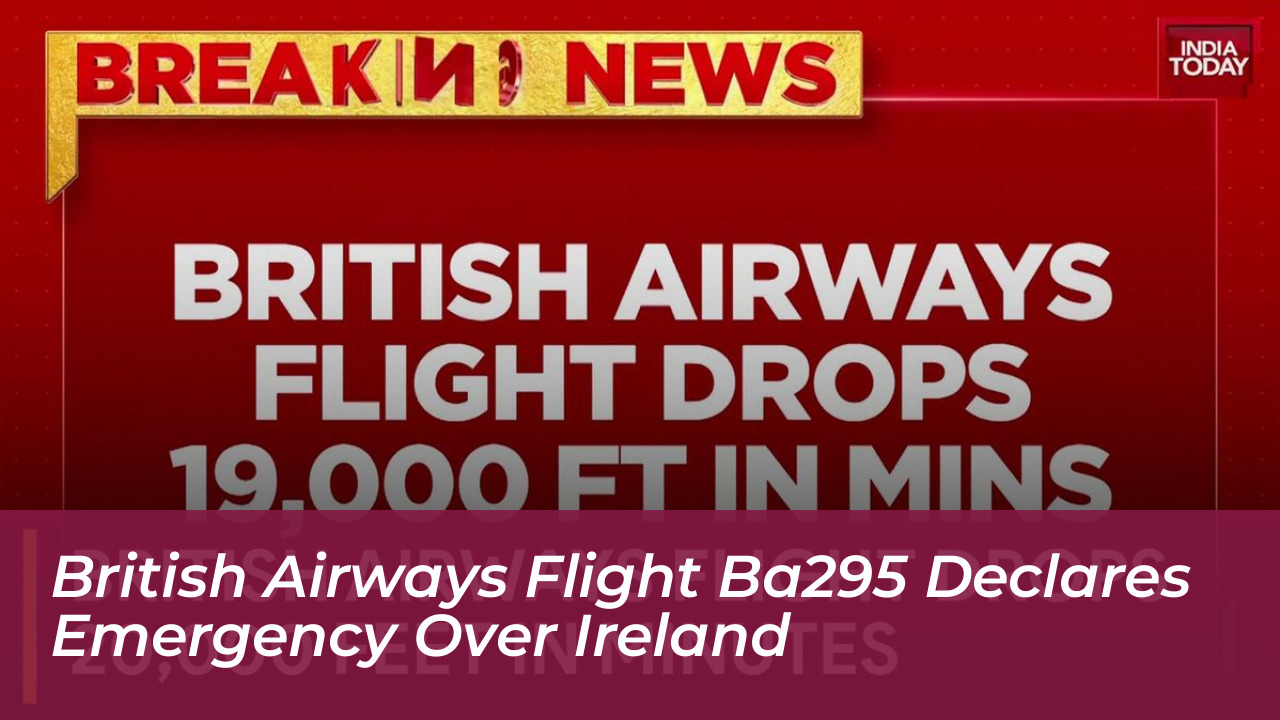



A Chicago-bound British Airways flight was forced to divert back to London on October 5, 2026. The plane issued a squawk 7700 emergency code and made a steep altitude drop while flying over Irish airspace.
Flight BA295, operated by a Boeing 777-200ER with the registration G-VIIA, departed smoothly from London Heathrow Airport Terminal 5 at approximately 11:50 a.m. local time. The widebody aircraft was scheduled to complete an eight-hour and forty-minute transatlantic journey to Chicago O’Hare International Airport.
Flight tracking data from platforms like Flightradar24 showed that about one hour into the trip, after leveling off at 37,000 feet, the flight crew faced an undisclosed technical issue. The aircraft then started a rapid, controlled descent. It dropped nearly 28,000 feet within minutes to stabilize at a lower altitude before turning back toward the United Kingdom.
Emergency Protocol and Safe Return
Using the squawk 7700 transponder code immediately alerted air traffic controllers in the United Kingdom and Ireland of an onboard emergency. This standard aviation protocol gives the aircraft priority handling during its emergency diversion.
Ground teams at London Heathrow prepared for the safe return of the Boeing 777. The aircraft landed back at its departure hub safely. Emergency response vehicles met the plane as a standard precaution. British Airways engineering teams inspected the aircraft right away to find the exact cause of the mid-air emergency.
Squawk 7700 and Rapid Descents
In commercial aviation, a “squawk” is a four-digit code assigned to an aircraft’s transponder by air traffic control. While routine codes track flight paths, specific emergency codes have universal meanings:

- Squawk 7500: Reserved for unlawful interference or hijacking.
- Squawk 7600: Indicates a complete or partial loss of radio communication.
- Squawk 7700: Declares a general emergency, alerting all radar facilities and air traffic controllers to provide immediate assistance.
Pilots execute rapid descents from high cruising altitudes to quickly reach a level where cabin pressure and oxygen levels are stable. This happens during pressurization failures, or to navigate away from severe weather and mechanical problems.
Passenger Impact and Airline Response
Airlines follow strict safety rules after unexpected diversions. British Airways ground staff helped the passengers of Flight BA295 after they returned to London Heathrow. The airline rebooked the travelers onto alternative flights so they could reach Chicago O’Hare International Airport safely.
British Airways released a brief statement confirming the flight returned to London out of an abundance of caution due to a technical issue. The airline emphasized that the safety of its customers and crew remains its highest priority.