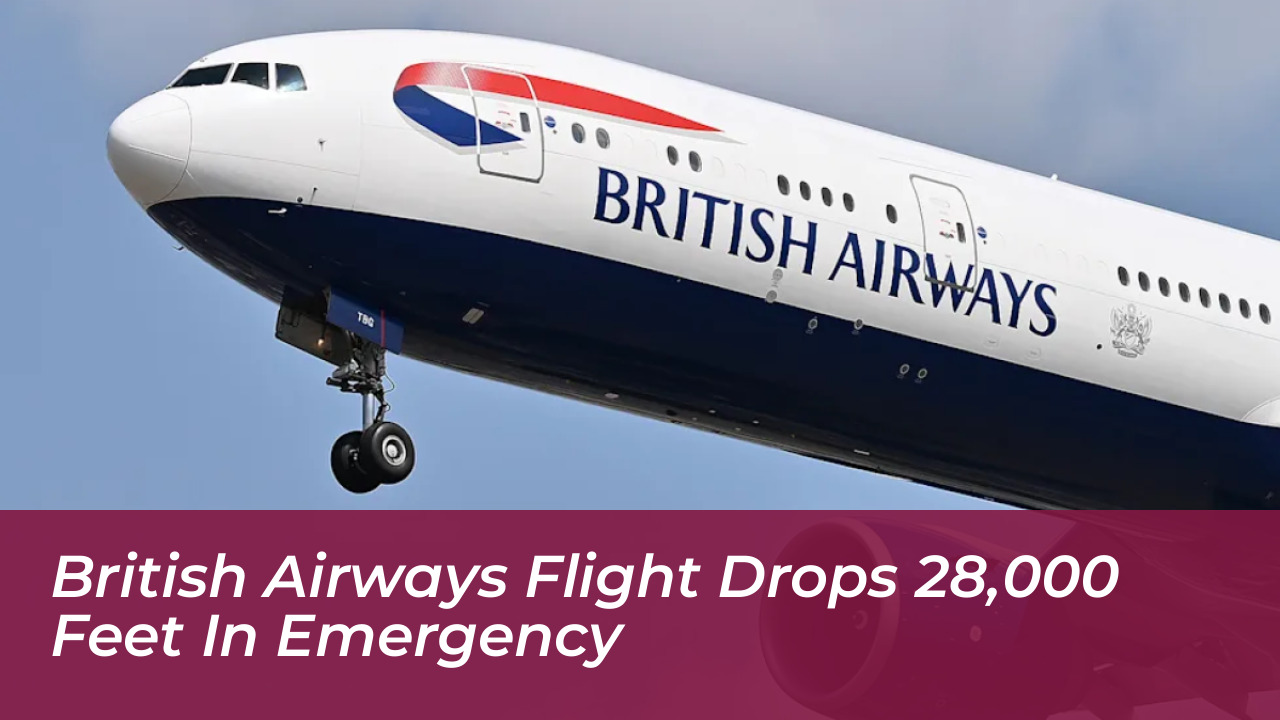



A Chicago-bound British Airways Boeing 777 carrying passengers from London dropped 28,000 feet in just seven minutes after suffering a rapid loss of cabin pressure on Monday, October 5, 2026. Flight 295, which departed London Heathrow Airport around noon local time, declared an emergency over Ireland, turned around, and spent four hours burning off jet fuel over the Bristol Channel before landing safely back at Heathrow at 5:00 p.m.
Flight tracking data from FlightAware confirmed the jet began its steep descent just 30 minutes after taking off at 12:15 p.m. local time. The sudden drop forced passengers to wear emergency oxygen masks for roughly half an hour until the aircraft descended to 9,000 feet, where atmospheric pressure is safe enough to breathe without assistance.
Emergency Procedures and Flight Timeline
British Airways Flight 295 had ascended to its cruising altitude of 37,000 feet after leaving London Heathrow Airport at 12:15 p.m. local time. Approximately 30 minutes into the journey, while flying over Ireland, the aircraft encountered a sudden technical issue resulting in a loss of cabin pressure.
The flight crew immediately initiated a rapid descent, dropping the aircraft 28,000 feet down to 9,000 feet in only seven minutes. Pilots issued a 7700 emergency squawk-the international general emergency code-to air traffic control and made an immediate U-turn back toward England.
Passengers reported that oxygen masks deployed from the cabin ceiling shortly before the rapid descent began. While some initial uncertainty swept through the cabin, travelers noted that the descent itself felt controlled and that the pilots executed a steady procedure.
Burning Fuel and Safe Landing at Heathrow
Because the Boeing 777-200ER had just taken off for a long-haul transatlantic flight to Chicago’s O’Hare International Airport, its fuel tanks were completely full. Landing the heavy aircraft immediately would have exceeded safe landing weight limits.
To mitigate this, the flight crew navigated the aircraft into a holding pattern over the Bristol Channel between Pembrokeshire and North Devon. The plane spent roughly four hours zigzagging and burning off excess jet fuel. Flight tracking services monitored the looping path before the aircraft successfully lined up for a normal landing back at London Heathrow Airport at 5:00 p.m. local time.

“The aircraft landed safely after our highly trained pilots returned to Heathrow following a technical issue. Customers disembarked the aircraft normally and our teams are working to get their travel plans back on track as quickly as possible,” British Airways stated in an official release.
Cabin Pressure Loss
Aviation experts note that sudden losses of cabin pressurization can stem from various structural or mechanical faults. Common causes include:
- Fuselage or window seal cracks
- Degraded cabin door seal leaks
- Malfunctions in electronic pressure control systems
- Pneumatic valve or outflow valve failures
When cabin pressure drops at high altitudes, the thin air lacks sufficient oxygen for human respiration, risking hypoxia. Modern commercial aircraft are equipped with automated drop-down oxygen masks that provide breathable air while pilots rapidly descend below 10,000 feet, where supplemental oxygen is no longer required.
Aircraft and Passenger Impact
The aircraft involved in the incident, a Boeing 777-200ER, is part of British Airways’ widebody fleet. Ground teams at Heathrow met the flight upon landing, and passengers disembarked normally through airport jetways. British Airways coordinated hotel accommodations and rebooked affected travelers onto alternative flights departing the following day.
The incident follows a string of airspace and technical challenges within the United Kingdom’s aviation sector, drawing additional scrutiny to equipment reliability across regional and international carriers.