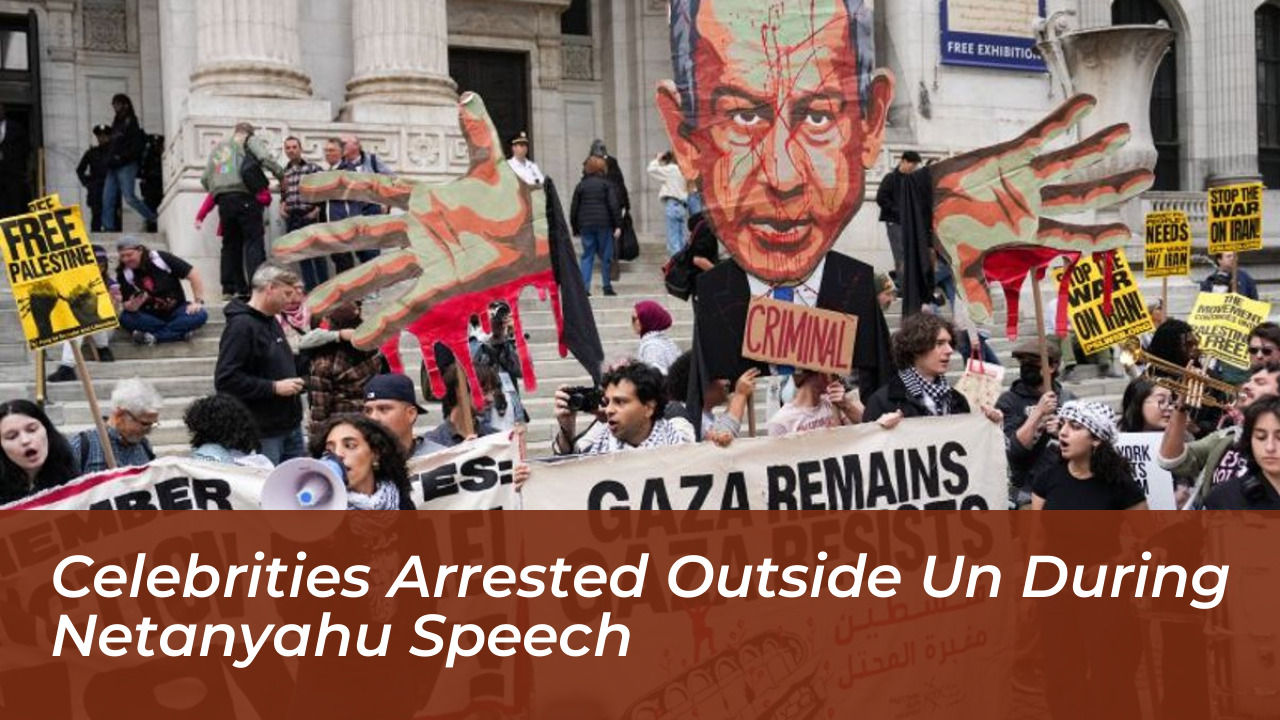
More than 100 activists, municipal leaders, and Hollywood actors were arrested outside UN during Netanyahu speech in New York City as tensions boiled over during the United Nations General Assembly. Demonstrators blocked First Avenue to protest United States military funding to Israel, leading to direct civil disobedience actions right along the international diplomacy perimeter. The coordinated protest caused widespread transit disruptions throughout Midtown Manhattan while triggering parallel walkouts inside the UN General Assembly hall.
- Mass Civil Disobedience Outside the United Nations Headquarters
- Dispersal Orders and First Avenue Blockade Tactics
- Mass Processing Protocols and Disruption of Diplomatic Routes
- High-Profile Actors and Activists Detained in Street Action
- Prominent Figures Taken into Police Custody
- Noted Public Figures Supporting the Demonstration Groundwork
- Local New York Political Leaders Taken into Custody
- Municipal and State Elected Officials Cuffed Along First Avenue
- Statements from Congressional Candidates and Regional Advocates
- Organizational Architecture: Jewish Voice for Peace Mobilization
- Coordination and Synchronized Visual Messaging
- Academic and Community Perspectives on International Platforms
- Secondary Expansion: Palestine Youth Movement Demonstrations
- Afternoon March Across Midtown Manhattan
- Transit Interruptions Near Grand Central Terminal
- Diplomatic Resistance Inside the General Assembly Hall
- Delegation Walkouts During Netanyahu’s Address
- Palestinian Authority Address via Remote Video Link
- Legal Jurisdictions, Municipal Limits, and Political Fallout
- International Criminal Court Arrest Warrants vs. Local Police Limits
- Domestic Political Tension Ahead of Elections
- Frequently Asked Questions
Mass Civil Disobedience Outside the United Nations Headquarters
The early morning demonstration turned into one of the largest civil disobedience actions outside the United Nations compound in recent years. Law enforcement officials confirmed that NYPD officers arrested 104 individuals who sat directly in the middle of First Avenue. By occupying the main roadway, the group effectively shut down vehicular access near the heavily fortified security perimeter established for visiting international heads of state.
Dispersal Orders and First Avenue Blockade Tactics
Police officers attempted to clear the thoroughfare by issuing multiple formal warnings over high-powered loudspeaker systems. The directives informed the crowd that sitting in the street violated city traffic ordinances and that failure to clear the area would result in immediate arrest. Demonstrators refused to move, locking arms and continuing to chant anti-war slogans as Prime Minister Benjamin Netanyahu prepared to take the rostrum inside the General Assembly.
When the protesters maintained their positions on the pavement, specialized NYPD units systematically surrounded the seated crowd. Officers established a tight physical perimeter to isolate the core group from surrounding onlookers and press personnel. Law enforcement then began moving through the ranks of seated activists to make individual arrests without major violent altercations.
Mass Processing Protocols and Disruption of Diplomatic Routes
Police applied plastic zip-ties to detain individuals who blocked the main diplomatic transit routes. Officers methodically lifted each seated demonstrator from the asphalt, secured their hands, and led them away from the intersection. The process required a heavy logistical presence, temporarily halting official vehicle motorcades attempting to enter the diplomatic complex.
NYPD personnel escorted detainees individually into parked, high-capacity police buses and mass-transit transport vans stationed along 42nd Street and First Avenue. Police drove the arrestees to local precinct facilities for formal booking and identification checks. Authorities issued desk appearance tickets and court summonses primarily for disorderly conduct and obstructing vehicular traffic before releasing participants later in the day.
High-Profile Actors and Activists Detained in Street Action
The street action attracted noticeable support from high-profile figures within the entertainment industry and public advocacy sectors. Celebrities stood side by side with grassroots activists, using their platform to draw international media attention to the civil disobedience campaign unfolding on the streets of New York.
Prominent Figures Taken into Police Custody
Among those taken into custody was 79-year-old Oscar-winning actor Susan Sarandon. Wearing a white shirt displaying the phrase “Fund people not bombs,” Sarandon sat with the frontline group in the center of First Avenue. NYPD officers placed her in plastic flex-cuffs and escorted her to a waiting transport vehicle without incident.
Emmy-winning actor and comedian Hannah Einbinder, 31, was also arrested during the street blockade. Video recorded at the scene showed officers guiding Einbinder away as she shouted slogans calling for an immediate end to foreign military assistance. Prior to her arrest, Einbinder spoke publicly about her perspective as a Jewish woman, emphasizing the need to separate Jewish cultural identity from state-sponsored military operations.
Former military intelligence whistleblower and civil liberties activist Chelsea Manning joined the frontline sit-in as well. Manning sat alongside grassroot organizers near the main security gates before being cuffed and led away by police processing teams.
Noted Public Figures Supporting the Demonstration Groundwork
Other well-known public figures joined the surrounding crowd to monitor police actions and show solidarity with those taking part in the sit-in. Actors Cynthia Nixon and Elliot Page were observed along the sidewalk perimeters, observing the police setup and documenting the mass arrests as law enforcement cleared the street.
Comedian Caleb Heron also participated among the grassroots supporters gathered outside the barricaded zones. These public figures helped draw additional media coverage to the blockade, amplifying the message of the demonstration across digital platforms while the arrests were underway.
| Name | Public Role / Title | Action Taken Outside UN |
|---|---|---|
| Susan Sarandon | Oscar-winning Actor | Arrested on First Avenue wearing “Fund people not bombs” shirt |
| Hannah Einbinder | Emmy-winning Actor / Comedian | Detained during sit-in; spoke out against military aid funding |
| Chelsea Manning | Whistleblower / Activist | Arrested with frontline group blocking diplomatic access gates |
| Chi Ossé | NYC Council Member | Arrested for sitting on First Avenue roadway |
| Emily Gallagher | NYS Assemblymember | Cuffed after blocking transit routes near UN compound |
Local New York Political Leaders Taken into Custody
The protest was notable for the direct involvement of municipal and state elected officials who chose to participate in illegal street blockades. Rather than observing from the sidelines, several politicians sat on the asphalt to halt the flow of diplomatic traffic leading into the United Nations complex.
Municipal and State Elected Officials Cuffed Along First Avenue
New York City Council Members Chi Ossé, Alexa Avilés, and Jennifer Gutiérrez were all cuffed by NYPD officers along First Avenue. The local lawmakers sat side by side with community members, refusing orders from law enforcement to step onto the sidewalk. Their arrest highlighted growing political rifts within the city regarding foreign policy and military spending allocations.
New York State Assemblymember Emily Gallagher was similarly detained after taking a seat on the road near the primary diplomatic gates. Gallagher joined city council members in using direct physical action to block traffic. Meanwhile, Council Members Tiffany Cabán, Sandy Nurse, and Shahana Hanif remained present near the police perimeter, publicly voicing their support for the activists and condemning the high number of arrests.
Statements from Congressional Candidates and Regional Advocates
Darializa Avila Chevalier, a key member of the Democratic Socialists of America and candidate for New York’s 13th Congressional District, was among those processed by police. Following her release from custody, Chevalier issued a statement emphasizing that local leaders must take direct action against foreign military financing.
The primary political rationale behind the civil disobedience focused on demanding an immediate end to United States military assistance to Israel. Advocates argued that federal tax funds directed toward foreign military operations should instead address pressing domestic needs, including public housing, healthcare, and infrastructure improvements across New York City.
Organizational Architecture: Jewish Voice for Peace Mobilization
The morning disruption was organized and coordinated by progressive advocacy organizations that specialized in strategic non-violent civil disobedience. The campaign required weeks of planning to synchronize street movements with the precise timing of the UN General Assembly schedule.
Coordination and Synchronized Visual Messaging
Advocacy group Jewish Voice for Peace took the lead in organizing the morning sit-in. The group mobilized approximately 200 core participants specifically trained for high-visibility direct action. Organizers timed the operation to match the exact moment world leaders and media networks focused their attention on the UN General Assembly hall.
To maximize visual impact, organizers instructed all core participants to wear uniform white t-shirts printed with bold anti-war messaging. This synchronized dress code created clear visual cohesion for news photographs and television broadcasts, helping viewers immediately identify the central message behind the street blockade.
Academic and Community Perspectives on International Platforms
Participants included university faculty members and local community organizers. Manijeh Moradian, a 50-year-old professor of Iranian and Jewish heritage, spoke out about the civic motivations behind the action. She stated that tax-paying citizens have a basic duty to voice opposition when global institutions host world leaders responsible for ongoing military actions.
Organizers stressed that international diplomatic summits held on American soil provide a unique opportunity for local populations to exert political pressure. By disrupting standard transit routes, the group aimed to break through diplomatic routine and force high-level officials to confront domestic opposition to current foreign policy decisions.
Secondary Expansion: Palestine Youth Movement Demonstrations
As the morning sit-in concluded with mass arrests near the UN, a second series of large-scale demonstrations broke out across Midtown Manhattan during the afternoon. Thousands of additional marchers gathered across major transit hubs to continue public actions throughout the day.
Afternoon March Across Midtown Manhattan
The afternoon mobilization was spearheaded by the Palestine Youth Movement, drawing an estimated crowd of over 2,000 marchers. The group assembled at Bryant Park before heading east toward the East River. Demonstrators set up multi-point protest lines, occupying the public steps of the New York Public Library and blocking major cross-town avenues along their route.
The movement created an interconnected network of protest zones throughout the city center. Large groups carried banners, flags, and megaphones, maintaining a constant presence on the streets long after police cleared the initial blockade outside the United Nations headquarters.
Transit Interruptions Near Grand Central Terminal
The dense crowds caused severe commuter disruptions surrounding Grand Central Terminal during the afternoon rush hours. NYPD traffic officers were forced to divert vehicles away from 42nd Street as marchers occupied key lanes and intersection crossings across Midtown.
To control crowd movement, the NYPD deployed specialized crowd control units equipped with heavy metal barricades. Officers set up physical barriers to keep the primary march routes separated from smaller groups of counter-demonstrators waving Israeli flags, preventing direct physical confrontations between opposing sides.
Diplomatic Resistance Inside the General Assembly Hall
The street disruptions outside the United Nations mirrored diplomatic resistance occurring directly inside the General Assembly hall during Prime Minister Netanyahu’s address to world delegates.
Delegation Walkouts During Netanyahu’s Address
As Prime Minister Netanyahu walked up to the podium to deliver his scheduled address, dozens of foreign diplomats stood up from their desks and exited the chamber in a coordinated walkout. The sudden exit left wide sections of seats completely empty, providing a dramatic visual display of international disagreement with Israeli policy actions.
To counter the visible walkout inside the chamber, supporters seated in the public gallery began chanting loudly in Hebrew as Netanyahu began his speech. The Prime Minister used his time at the podium to defend ongoing military operations, directly criticizing the diplomats who walked out and reiterating his administration’s geopolitical stance.
Palestinian Authority Address via Remote Video Link
Because the United States government denied entry visas to the official Palestinian delegation for a second consecutive year, Palestinian Authority President Mahmoud Abbas was unable to attend the summit in person. Instead, his address was broadcast into the General Assembly hall via a pre-recorded video link sent from Ramallah.
The visa denials and subsequent remote address underscored the ongoing diplomatic hurdles surrounding the conflict. The video broadcast highlighted the contrasting treatment of foreign leaders at the summit and fed into the broader political debates taking place outside on the streets of Manhattan.
Legal Jurisdictions, Municipal Limits, and Political Fallout
The events outside and inside the United Nations brought long-standing questions surrounding international legal enforcement and local police authority back into public focus.
International Criminal Court Arrest Warrants vs. Local Police Limits
Despite public calls from some protesters demanding the arrest of foreign leaders subject to International Criminal Court (ICC) warrants, the NYPD holds no legal authority to execute international warrants. Municipal police forces in the United States operate strictly under state and federal legal frameworks, meaning they cannot enforce mandates issued by international judicial bodies like the ICC.
, the United States is not a signatory to the Rome Statute, which established the International Criminal Court. Because US municipal law enforcement agencies do not recognize ICC jurisdiction, NYPD officers were limited strictly to enforcing local traffic laws, public order ordinances, and local criminal codes along First Avenue.
Domestic Political Tension Ahead of Elections
The mass arrests and coordinated street blockades reflect growing political polarization within domestic American politics. Progressive groups, municipal officials, and grassroots organizations are increasingly willing to use direct action to pressure national leadership on foreign policy decisions.
At the same time, the diplomatic walkouts inside the UN hall and persistent protests outside illustrate the heightened political isolation facing Israeli leadership. The combined domestic and international pressure campaigns highlight the deep political friction surrounding current Middle Eastern policy decisions, establishing a clear precedent for future diplomatic gatherings.
Frequently Asked Questions
How many people were arrested outside the UN during Netanyahu’s speech?
NYPD officers arrested 104 demonstrators who sat in the middle of First Avenue to block traffic outside the United Nations security perimeter.
Which celebrities were cuffed during the demonstration?
Oscar-winning actor Susan Sarandon, Emmy-winning actor Hannah Einbinder, and activist Chelsea Manning were among the prominent public figures taken into police custody.
Why can’t local police arrest visiting leaders who have ICC warrants?
The NYPD operates strictly under municipal, state, and federal laws. Because the United States is not bound by the Rome Statute of the International Criminal Court, local law enforcement agencies lack legal authority to execute ICC warrants against foreign heads of state.