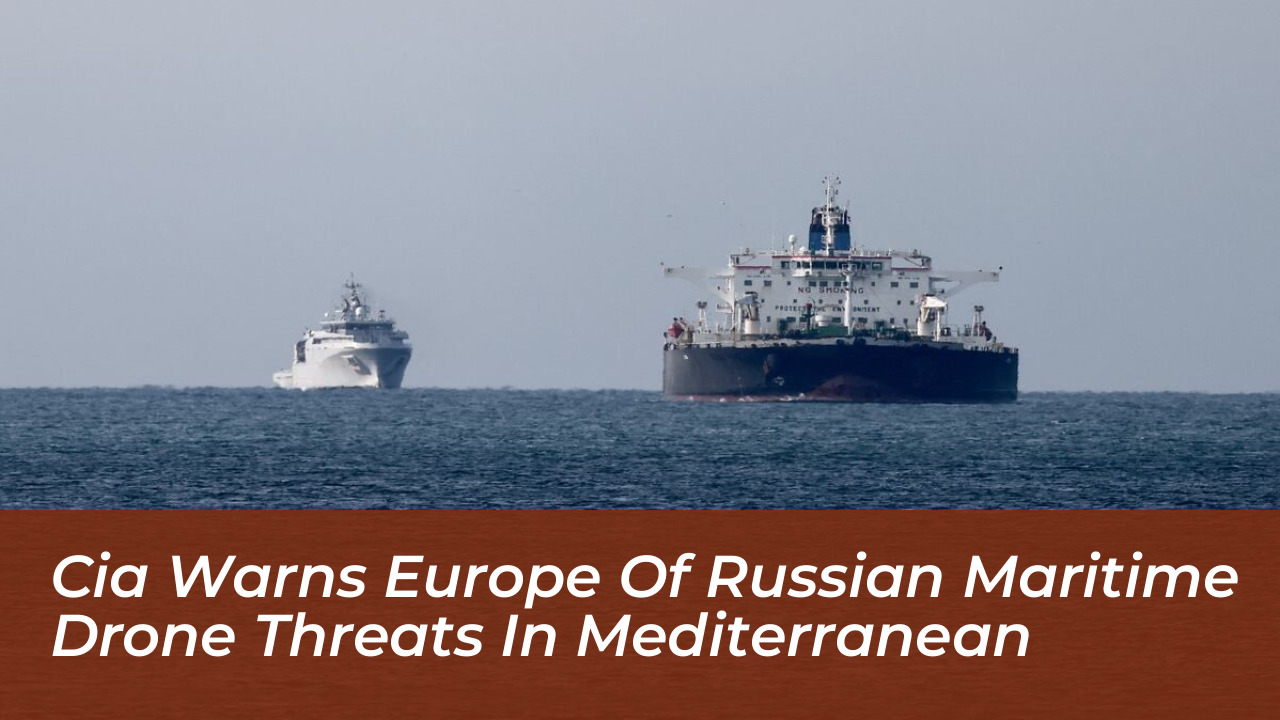
The CIA has issued a severe intelligence warning to European allies, revealing a covert Russian plot to launch long-range unmanned aerial vehicles from commercial merchant ships in the Mediterranean Sea. This alarming development highlights a dangerous expansion of asymmetric hybrid warfare, shifting potential threats from eastern airspace breaches to vulnerable southern maritime corridors.
- Understanding the CIA Intelligence Warning on Mediterranean Maritime Drones
- The Intelligence Briefing Shared with European Allies
- The Covert Strategy: Merchant Ships as Launch Platforms
- Anatomy of the Gerbera Drone: Specifications and Threat Capabilities
- Design and Performance Metrics of the Gerbera
- Payload Impact on Critical European Infrastructure
- Escalation of Hybrid Warfare Across European Borders
- Recent Airspace Breaches and Sabotage Incidents
- Systematic Testing of European Defense Readiness
- Strategic Implications and European Countermeasures
- Political and Military Responses in Southern Europe
- Emergency Defense Protocols and Counter-Drone Drills
- Comparative Analysis of Maritime Drone Threats and Defenses
- Securing the Mediterranean Basin Against Hybrid Attacks
- Unified Maritime Surveillance Frameworks
- Neutralizing Covert Deployment Vectors
Understanding the CIA Intelligence Warning on Mediterranean Maritime Drones
The Intelligence Briefing Shared with European Allies
Recent diplomatic exchanges and investigative reports from the Spanish daily El Mundo brought this maritime threat to light. Following a high-level diplomatic visit in late August, American intelligence agencies briefed their European counterparts about Moscow preparing a new vector for hybrid warfare. Instead of relying solely on traditional land-based missile sites or eastern flank airspace violations, the focus has shifted toward the sprawling waters of the Mediterranean Sea.
This southern maritime theater presents a complex security puzzle. The vast expanse of open water, combined with heavy commercial shipping traffic, offers an ideal environment for covert military maneuvers. Intelligence analysts note that hostile actors view the Mediterranean as an underutilized operational space where conventional naval radar networks struggle to maintain continuous, detailed oversight of every single vessel.
The Covert Strategy: Merchant Ships as Launch Platforms
The core of the reported strategy involves utilizing disguised commercial vessels operating in international waters. These ships can blend seamlessly with the thousands of cargo carriers transiting the Mediterranean every day. Inside standard shipping containers welded to the decks of these shadow fleet vessels, operators conceal long-range unmanned aerial vehicles, keeping them entirely hidden from satellite observation and routine naval patrols.

When the merchant vessel reaches a designated launch corridor off the coast of Southern Europe, hydraulic or pneumatic systems integrated into the containers catapult the drones toward their target vectors. Detecting these launch platforms beforehand is exceptionally difficult. The sheer volume of legitimate maritime traffic creates a massive screening challenge for naval surveillance teams trying to separate innocent cargo carriers from hostile actors.
Anatomy of the Gerbera Drone: Specifications and Threat Capabilities
Design and Performance Metrics of the Gerbera
The primary weapon system identified in the CIA assessment is the Gerbera unmanned aerial vehicle. Engineers designed this aircraft specifically for low-cost production and high-volume deployment. Its compact 2.5-meter wingspan allows operators to pack multiple units inside a standard freight container without raising suspicion during routine port inspections.
Weighing only 18 kilograms in total, the Gerbera features a lightweight composite frame that facilitates manual handling and rapid mechanical reloading on a ship deck. Despite its small size, the aircraft boasts an operational range reaching up to 600 kilometers, depending on atmospheric conditions. With a cruising speed of 160 kilometers per hour, the drone can cross from international waters to Mediterranean coastal targets in roughly one to two hours.
Payload Impact on Critical European Infrastructure
The Gerbera carries a payload of four to five kilograms of high explosives. While this is modest compared to strategic cruise missiles, military analysts emphasize that the warhead is optimized for precision kinetic strikes against vulnerable civilian and industrial targets. These payloads carry enough force to puncture fuel depots, ignite major fires at petrochemical plants, and disrupt operations at civilian airports.
A coordinated swarm of these container-launched drones could paralyze critical infrastructure nodes across Western European NATO member states. Because the airframes are inexpensive to manufacture, an attacker can deploy them in high numbers to overwhelm local air defense batteries through sheer saturation.
Escalation of Hybrid Warfare Across European Borders
Recent Airspace Breaches and Sabotage Incidents
This maritime threat assessment arrives amid a broader escalation of sabotage and hybrid warfare incidents across the European continent. Intelligence agencies have cataloged multiple breaches of NATO airspace along the eastern flank, including an unprecedented event where 19 Russian drones entered Polish airspace simultaneously. These continuous provocations demonstrate a systematic effort by Moscow to test the response times and radar capabilities of NATO nations.
Similar incidents have occurred near critical transport hubs. A civilian aircraft recently collided with an explosive-laden drone at Germany’s Leipzig airport. In the north, a Swedish naval vessel successfully jammed an unidentified drone launched from a Russian intelligence ship in the Öresund Strait, proving that maritime-based drone operations are already active in European waters.
Systematic Testing of European Defense Readiness
Military commanders view these localized events as deliberate probes designed to map out blind spots in European air defense networks. By launching small-signature drones from unexpected directions, hostile planners can measure how quickly coastal radar operators detect the threat and how efficiently local security forces mobilize their counter-drone assets.
The reliance on shadow fleet vessels adds another layer of complexity. These aging tankers and cargo ships often switch off their transponders, changing ownership frequently to evade international sanctions. Using them as covert drone platforms transforms commercial shipping into a persistent, floating security risk.
Strategic Implications and European Countermeasures
Political and Military Responses in Southern Europe
In response to the mid-September intelligence briefing, political and military leaders across Europe are accelerating emergency defense protocols. French President Emmanuel Macron convened an immediate Defense Council session followed by high-level consultations at the Élysée Palace. The discussions focused heavily on reviewing national airspace security and upgrading coastal radar coverage across France, Italy, and Spain.
Emergency Defense Protocols and Counter-Drone Drills
Non-landlocked and neutral nations are also upgrading their defensive postures. The Austrian military recently initiated extensive counter-drone exercises involving hundreds of active-duty soldiers. These drills utilized Mistral ground-to-air missile batteries, rapid-fire 35-millimeter cannons, and advanced electronic jamming equipment to simulate real-world interception scenarios.
These specialized training exercises focus specifically on detecting low-flying, small-signature aerial threats that easily evade traditional long-range radar systems designed for larger fighter jets or ballistic missiles. Ground units are learning to rely on acoustic sensors and mobile optical tracking systems to spot low-altitude drones before they reach populated areas.
Comparative Analysis of Maritime Drone Threats and Defenses
| Threat Dimension | Conventional Defense Challenge | Proposed Mitigation Strategy |
|---|---|---|
| Containerized Maritime Launch | Inability to distinguish merchant vessels carrying hidden drones from legal cargo ships. | Enhanced maritime boarding protocols, satellite tracking of shadow fleets, and thermal imaging at sea. |
| Low-Radar Signature | Gerbera drones feature small composite frames that blend into ground clutter. | Deployment of short-range acoustic sensors, mobile air defense units, and tactical electronic jamming. |
| Asymmetric Infrastructure Strikes | Vulnerability of open civilian airports, power grids, and petrochemical plants. | Hardening of perimeter defenses, physical netting, and localized counter-UAV kinetic interceptors. |
Securing the Mediterranean Basin Against Hybrid Attacks
Unified Maritime Surveillance Frameworks
As European governments digest the implications of the CIA intelligence report, defense ministers are calling for a unified maritime surveillance framework across the entire Mediterranean basin. Integrating commercial shipping registries with real-time military radar tracking remains the most viable path to monitor suspicious cargo movements.
Naval patrols must adopt more aggressive inspection protocols for vessels operating outside standard commercial lanes. By combining satellite data analytics with thermal imaging and active boarding operations, allied navies can intercept shadow fleet ships before they reach launch positions near European shores.
Neutralizing Covert Deployment Vectors
Preventing hostile kinetic actions before deployment from international shipping lanes requires unprecedented international cooperation. European naval security must evolve rapidly to meet the realities of asymmetric hybrid warfare. Securing the Mediterranean against containerized drone threats is no longer a distant hypothetical scenario, but an urgent operational priority for NATO’s southern command.