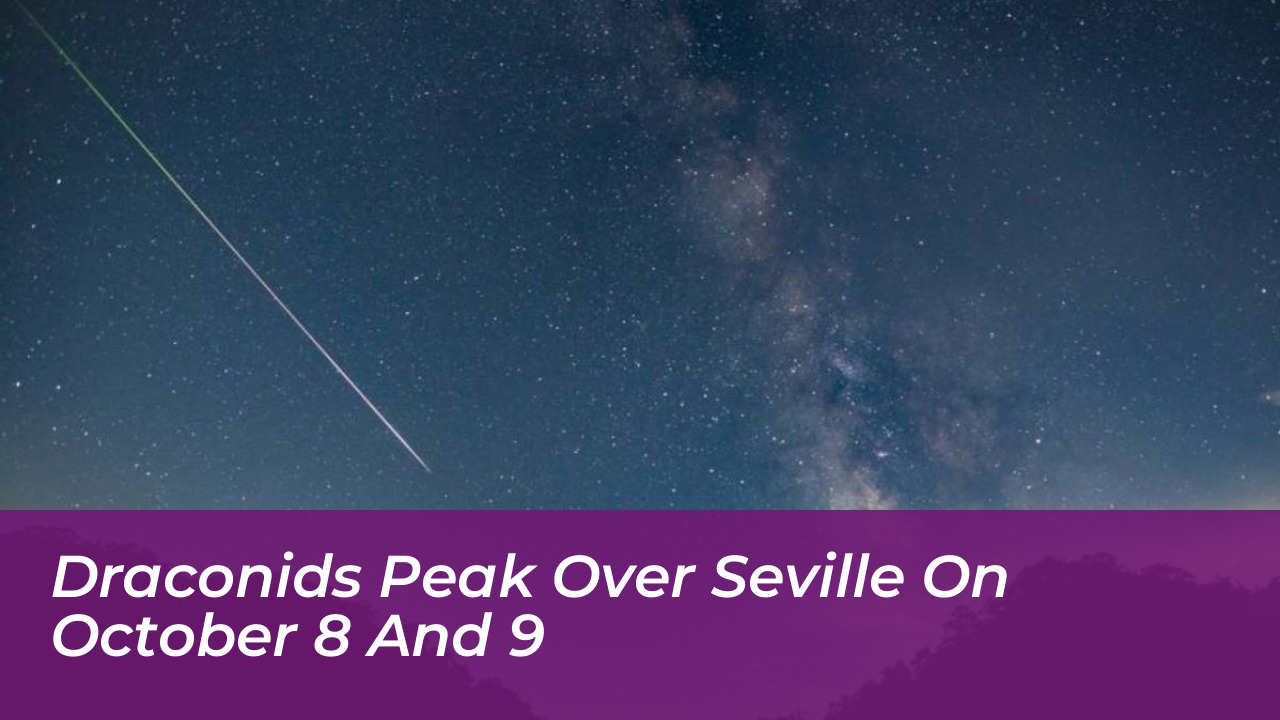


Skywatchers in Seville will have a prime opportunity to observe the Draconid meteor shower as it reaches its peak activity during the evening hours of Thursday, October 8, through the early morning of Friday, October 9, 2026. While the annual display is expected to be modest, highly favorable dark-sky conditions will provide an ideal backdrop for astronomy enthusiasts across the region.
Draconid Meteor Shower Visibility Window and Peak Times
The Draconids remain active in a visibility window from October 6 through October 10. For observers on the Spanish mainland, the peak is scheduled to hit at 3:00 a.m. CEST (01:00 UTC) on October 9. Unlike many major meteor showers that require staying up until the early pre-dawn hours, the Draconids are best viewed shortly after nightfall.
The shower’s radiant point in the constellation Draco sits highest in the sky as evening darkness falls and gradually declines throughout the night. Viewers in Seville should head outdoors shortly after dusk, around 20:30 local time, when the radiant is most favorably positioned.
Viewing Conditions and Expected Rates
Astronomical forecasts indicate that the 2026 display will produce a modest rate of approximately 5 meteors per hour. These meteors travel at a relatively slow velocity of roughly 20 kilometers per second. Because the Draconid debris enters Earth’s atmosphere at a shallow angle, the resulting shooting stars often appear as graceful, long-lasting streaks rather than quick flashes.
Observing conditions in Seville will benefit significantly from favorable lunar phases. As the new moon approaches on October 10, the moon will remain hidden until sunrise during the peak nights, leaving the sky dark enough to spot even faint meteors.
Parent Comet and Unpredictable Activity
The Draconids occur when Earth passes through the orbital debris trail left by Comet 21P/Giacobini-Zinner. This periodic object orbits the Sun every 6.6 years and reached its closest approach to the Sun, known as perihelion, in March 2025. While historical returns have occasionally sparked intense outbursts-such as legendary storms in 1933 and 1946, or enhanced activity in 2011 and 2018-no unusual surges have been reliably forecast for 2026.
Tips for Observing the Draconids in Seville
- Find a dark location away from heavy city light pollution, such as rural outskirts or open parks with an unobstructed view of the sky.
- Allow 20 to 30 minutes for your eyes to fully adapt to the dark evening conditions.
- Look away from the radiant point in Draco; meteors observed further away from the radiant exhibit longer, more visible tails.
- Dress warmly for the October evening air and bring a reclining lawn chair for a comfortable viewing experience.