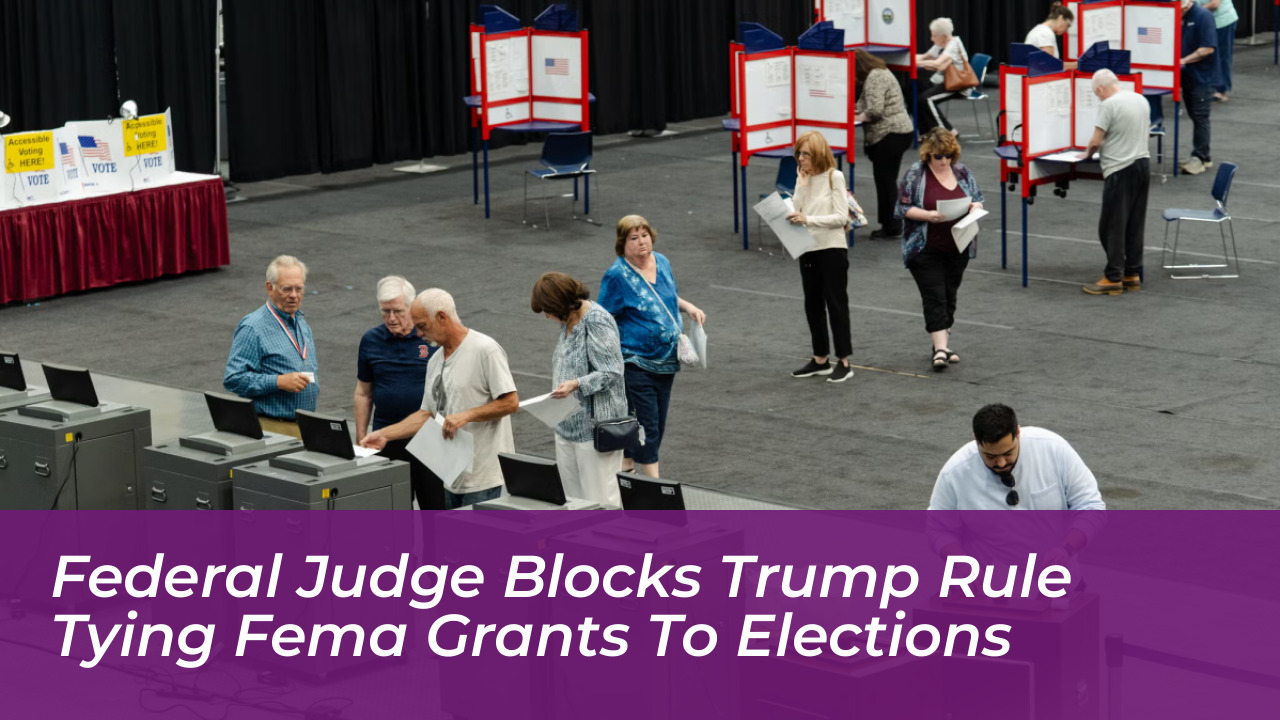
A federal judge in Washington, D.C., struck down a Trump administration directive on September 28, 2026, that tied 20 percent of emergency preparedness grants to state election policy changes. U.S. District Court Judge Amir H. Ali ruled that the Federal Emergency Management Agency (FEMA) exceeded its legal authority by withholding crucial counterterrorism funds over routine voting procedures.
Under the rules issued earlier in June by the Department of Homeland Security, FEMA required local jurisdictions to examine transitioning to hand-marked paper ballots, conduct post-election manual audits, and verify voter citizenship in registration databases. Noncompliant states and municipalities faced losing up to 20 percent of their share from $1 billion in annual grants, which fund local terrorism drills and urban anti-terror preparedness.
Lawsuit Challenged FEMA Authority
Local governments in Texas, Tennessee, and the city of Columbus, Ohio, filed a lawsuit in August against FEMA and its parent agency, the Department of Homeland Security, to block the policy. The plaintiffs argued that the funding conditions infringed on state authority, endangered essential public safety funding, and threatened voter eligibility.
Judge Ali sided with the local governments. He found that Congress authorized FEMA to distribute the grants to further counterterrorism objectives. The agency could not use federal funding prospects to pressure states into carrying out preferred election reforms at their own expense.
Key Details of the Vacated FEMA Rules
- Funding at Risk: A 20 percent holdback affecting over $200 million in annual Homeland Security Grant Program funds.
- Mandated Changes: Requirements for hand-marked paper ballots, five percent post-election manual audits, and voter roll reconciliations.
- Citizenship Checks: Verification requirements using the federal SAVE system for registered voters, polling place workers, and system operators.
- Financial Burden: Estimated costs included millions for printing equipment in jurisdictions like Dallas County and Travis County in Texas.
Distinction Between Security and Election Rules
In his ruling, Judge Ali drew a legal distinction between protecting elections from actual physical and cyber threats versus dictating routine administrative voting procedures. The court acknowledged that FEMA possesses the authority to fund measures designed to protect election infrastructure from physical attacks, distributed denial-of-service (DDoS) cyber threats, and physical security improvements.
However, the judge concluded that requirements concerning ballot forms, voter rolls, post-election audits, and the eligibility of specific voters and poll workers went far beyond what Congress authorized for the counterterrorism grant program.
Impact of the Court Decision
The Monday ruling vacated the controversial conditions just two days before FEMA was expected to issue its 2026 Homeland Security Grant Program awards. The court’s decision leaves FEMA’s broader, multi-million dollar grant program intact. It entirely strikes down the election-administration requirements, the accompanying 20 percent funding holdback, and the agency’s August 10 compliance guidance.
The decision marks a significant legal setback for the Trump administration’s broader push to increase federal oversight and authority over state-run election administration ahead of the midterm congressional elections.