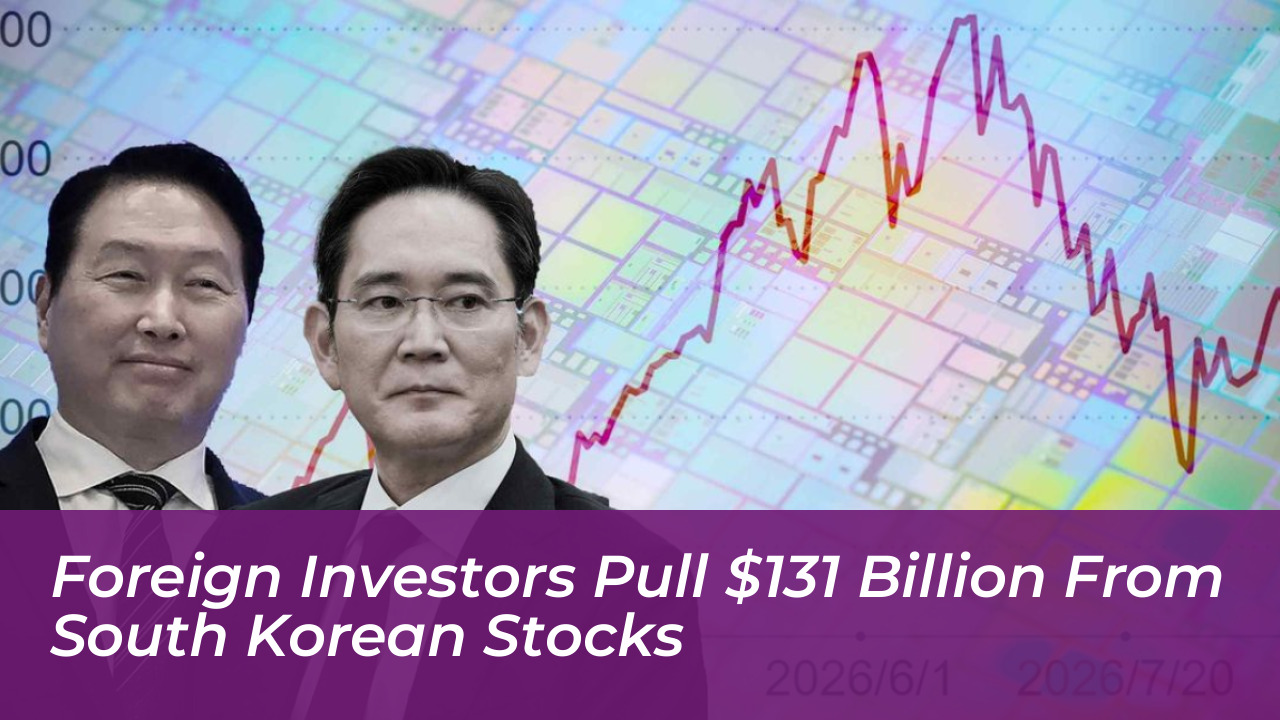

South Korea’s stock market is facing a sharp reversal as foreign investors withdraw massive amounts of capital and enthusiasm for artificial intelligence investments weakens. Trading activity has plunged across the country’s $4.3 trillion equity market, while the benchmark Kospi has fallen 22% in the second half of 2026, according to Bloomberg data.
Foreign investors have pulled $131 billion from South Korean equities this year, marking the largest outflow among major Asian markets. The steep withdrawals follow a strong first-half rally that initially made the Kospi the world’s best-performing major equity benchmark, driven heavily by surging global demand for artificial intelligence memory chips.
Impact on Semiconductor Heavyweights
Trading turnover has dropped 70% from its late-May peak, reflecting diminished market participation as investors reassess the outlook for domestic semiconductor companies. Samsung Electronics and SK Hynix, which together account for more than half of the Kospi’s total weighting, remain central to concerns about the sustainability of the AI-driven market rally.
Concerns over future chip demand became apparent when Samsung shares declined despite the company reporting a nearly ninefold increase in quarterly operating profit. Market support from corporate share buybacks is also weakening. Samsung and SK Hynix are approaching the completion of combined buyback programs worth 55 trillion won, equivalent to roughly $41 billion.
Retail Participation and Leverage Unwind
Local retail investor participation has similarly declined following a broader market selloff. Outstanding margin loans have fallen to approximately 33 trillion won from a June peak of 38.6 trillion won. Meanwhile, brokerage deposits have dropped to around 100 trillion won from nearly 140 trillion won, highlighting a significant liquidity crunch in the domestic market.
Investors are increasingly favoring regional alternatives such as Taiwan, whose technology sector offers broader exposure to the AI supply chain. Taiwan’s Taiex index has gained 70% this year, outperforming the Kospi by approximately 23 percentage points in the previous quarter.
Market Outlook and Resilience
Despite the recent downturn and heavy capital outflows, South Korea remains among the stronger-performing markets overall for the year, supported by earlier gains and expectations of continued AI infrastructure investment. Analysts note that while the memory sector is undergoing a necessary multiple and flow reset, underlying order books for advanced memory chips like High Bandwidth Memory (HBM) remain robust through 2027.
Frequently Asked Questions
Why has the KOSPI index declined despite strong profit reports from Samsung and SK Hynix?
The decline is driven by shifts in buyer structure and liquidity rather than corporate profitability. Because Samsung Electronics and SK Hynix account for over half of the KOSPI’s weighting, foreign selling and the unwinding of leverage have created a temporary buying vacuum, causing the index to fall even as company profits remain exceptionally strong.
What is the main reason for the massive outflow of foreign capital from South Korea?
The primary driver is concentrated selling pressure on the two largest market heavyweights, Samsung and SK Hynix. In September alone, these two corporations accounted for 76.6% of total net foreign selling. Additionally, the appreciation of the Korean Won during this period eroded USD-denominated returns for foreign holders.
How have corporate share buybacks affected the KOSPI index?
Share buybacks executed by Samsung and SK Hynix served as the primary source of buying support, absorbing substantial selling pressure. However, this support is temporary as Samsung’s major buyback program concluded in early October and SK Hynix’s program neared completion, leaving a vacuum in market liquidity.
How has retail investor behavior shifted in South Korea?
South Korean individual investors shifted from being net buyers of KOSPI stocks in the first half of the year to becoming net sellers in the third quarter. Concurrently, many retail investors increased their net purchases of U.S. equities, signaling a temporary rotation of capital away from the domestic market.
What key factors will determine future volatility in the South Korean stock market?
Future volatility will hinge on whether new institutional buyers, such as domestic pension funds, step in to fill the liquidity void left by receding foreign capital and corporate buybacks. Sustained HBM demand, memory pricing trends, and macroeconomic indicators like U.S. inflation data will also heavily influence foreign risk appetite.