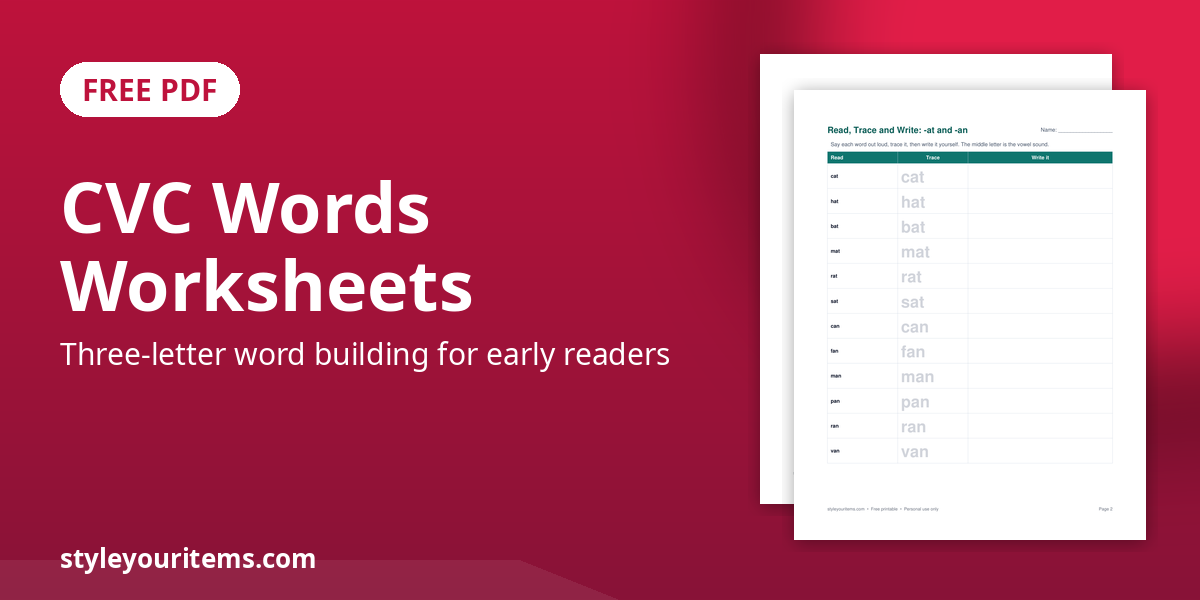
A child who knows the letters still cannot read until the letters start joining up. The first join is the CVC word: three letters, consonant, vowel, consonant, like cat, dog and sun. One small word, one clear sound pattern, and suddenly reading stops being a memory test and starts being a skill. These free printable CVC words worksheets are built for that exact step, the bridge from knowing letters to reading words.
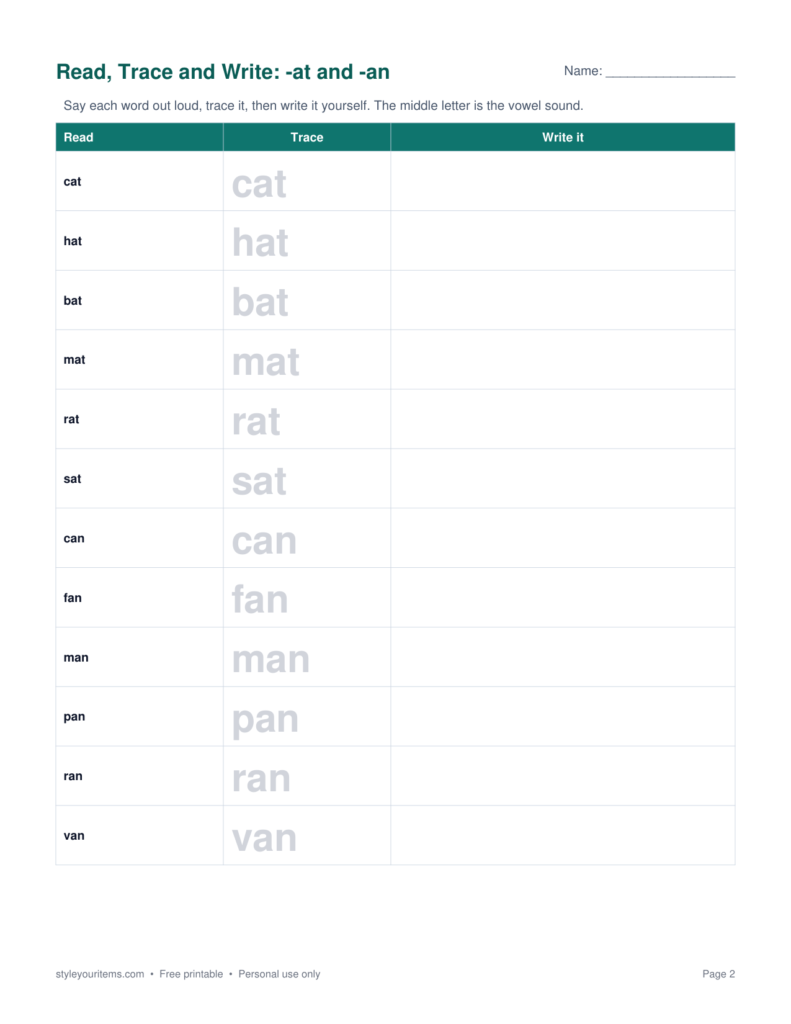
The PDF has six pages: a cover page, four activity pages, and an answer key. The activities work through eight word families, -at, -an, -ap, -it, -in, -og, -ot and -et, so a child meets the same pattern many times in different words. Page two is read, trace and write for the -at and -an families. Page three is fill in the missing middle letter. Page four matches words to short written clues. Page five asks the child to find a three-letter word inside a sentence and then write a sentence of their own. There is no sign-up and no email needed, and the file prints on Letter or A4. If your child is still learning the letters themselves, start with the alphabet tracing worksheets first, then come back to this pack.
What your child practises on these four pages
- Word families, not random words. Learning cat, hat, bat, mat, rat and sat together teaches the pattern, not six separate spellings. Once the -at family clicks, the -an family is the same game with a new ending.
- The middle vowel sound. The vowel is the hardest letter in a CVC word because it changes the most: cat and cut look alike to a beginner. The missing-letter page makes the child listen for that middle sound and choose it, which is the skill that matters most at this stage.
- Tracing, then writing from memory. Page two shows each word in large trace letters before asking the child to write it alone. Tracing builds the hand movement; the empty write column tests whether the spelling stuck.
- Reading for meaning, not just sounding out. The matching page gives a short written clue, like “It says meow”, and the child has to find the word that fits. That is real reading: sound plus meaning, together. Note that the clues are written words, not pictures, so for a child who cannot read the clues yet, read them aloud and let the child do the matching.
- Finding words inside sentences. Page five puts CVC words inside full sentences, because words on a list are easier than words in the wild. Circling a three-letter word in “The cat sat on the mat” is the first step towards reading a whole book page.
How to use the pack in one week
- Day one: read, trace and write. Print page two. Say each word out loud together, stretch the sounds slowly (c-a-t), trace it, then cover the trace column and write it alone. Twelve words, about ten minutes. Praise the trying, not just the correct spellings.
- Day two: fill in the missing letter. Print page three. Sixteen words are each missing their middle letter, and the word family at the end of the row is the clue. If your child is stuck, say the word slowly and ask which sound is in the middle.
- Day three: match the word to its clue. Print page four. Read each clue aloud if needed, then let the child find the matching word in the word bank and write its number. Ten clues, and every answer is a word from the families in this pack.
- Day four: find the word, then write a sentence. Print page five. Read the six sentences together, circle a three-letter word in each one (some sentences have more than one, and any one is right), then help your child write one sentence of their own using a CVC word from the pack.
- Day five: check the answers and repeat the tricky family. Use the answer key on the last page together, not as a test. If the -og family caused trouble, play with it again: dog, log, fog, hog, jog, bog, said out loud while bouncing a ball, one word per bounce.
A worked example: the -at family
| Word | Missing letter | Clue |
|---|---|---|
| cat | c _ t | It says meow. |
| hat | h _ t | You wear it on your head. |
| bat | b _ t | It flies at night. |
| mat | m _ t | You sleep on it. (Also: you wipe your feet on it.) |
| rat | r _ t | A small animal with a long tail. |
| sat | s _ t | What you did on the chair. |
Every word in the table follows the same rule: change the first letter, keep -at, and you get a new word. That is the whole trick of word families, and it is why six words can teach more than sixty random ones. Once the -at family is easy, the pack moves on to -an, -ap, -it, -in, -og, -ot and -et, and the same game repeats. Children who can read these families are ready for the next step, which is the first fifty sight words: the, of, and, to, and the other small words that do not follow the pattern but appear on every page. A reading log is a nice way to record the first books they finish once these words click.
Questions people ask before they print it
What age is this pack for?
Mostly ages four to six: Reception and Year 1 in the UK, kindergarten and first grade in the US. A five-year-old who knows letter sounds is the perfect reader for it. Younger children can still enjoy tracing the big letters on page two.
Does my child need to know all the letters first?
They need the letter sounds, not the letter names, and mostly the sounds of the letters in these eight families. If a letter is still shaky, the alphabet tracing worksheets will firm it up in a few days, and then this pack will make much more sense.
Are there pictures to match?
No. The clues on page four are short written sentences, like “It says meow” and “You wear it on your head”. That is deliberate: matching a word to a picture is a guessing game, while matching a word to a written clue is reading. For a child who cannot read the clues yet, read them aloud and let the child do the matching and the writing.
How is this different from the rhyming worksheets?
The rhyming words worksheets teach the ear to hear that cat and hat sound alike. This pack teaches the eye and the hand to build those words letter by letter. Rhyming comes first for most children, then CVC building, then sight words. You can find the whole sequence in the Kids, School and Learning collection.