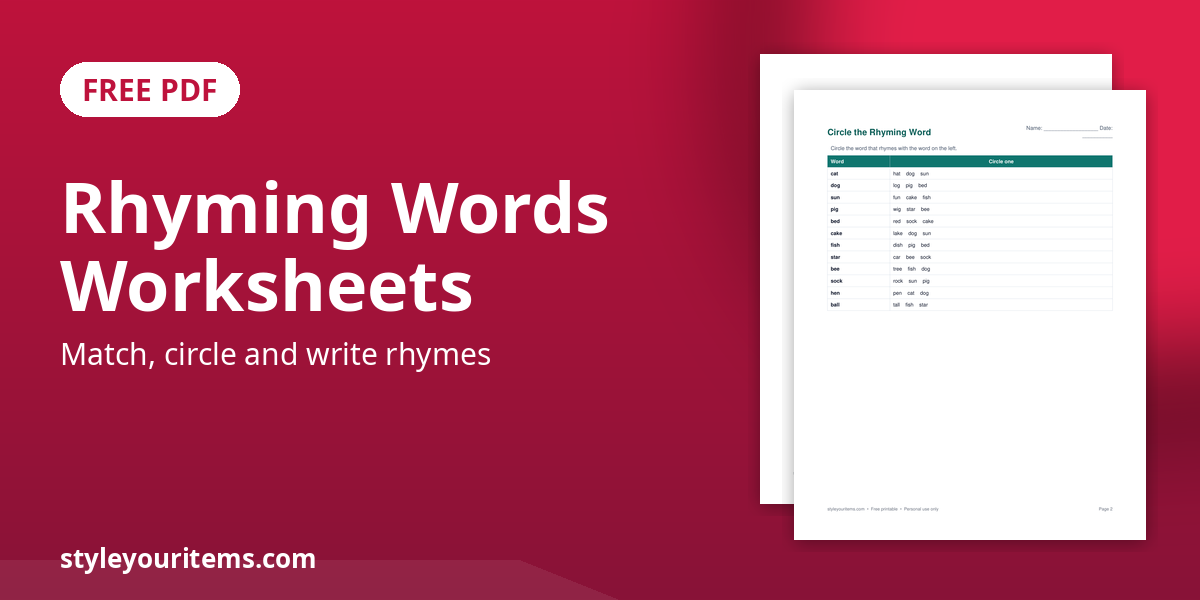
Rhyming is the first time a child hears that words have a sound shape, not just a meaning. Cat and hat sound alike in a way that cat and dog do not, and once a child can hear that, reading gets easier, because the same ear that hears the rhyme is the ear that will hear the sounds inside a new word. This free printable rhyming words worksheet gives that ear something to practise on, with four different activities that all use the same simple words, so the child practises the sound, not the spelling.
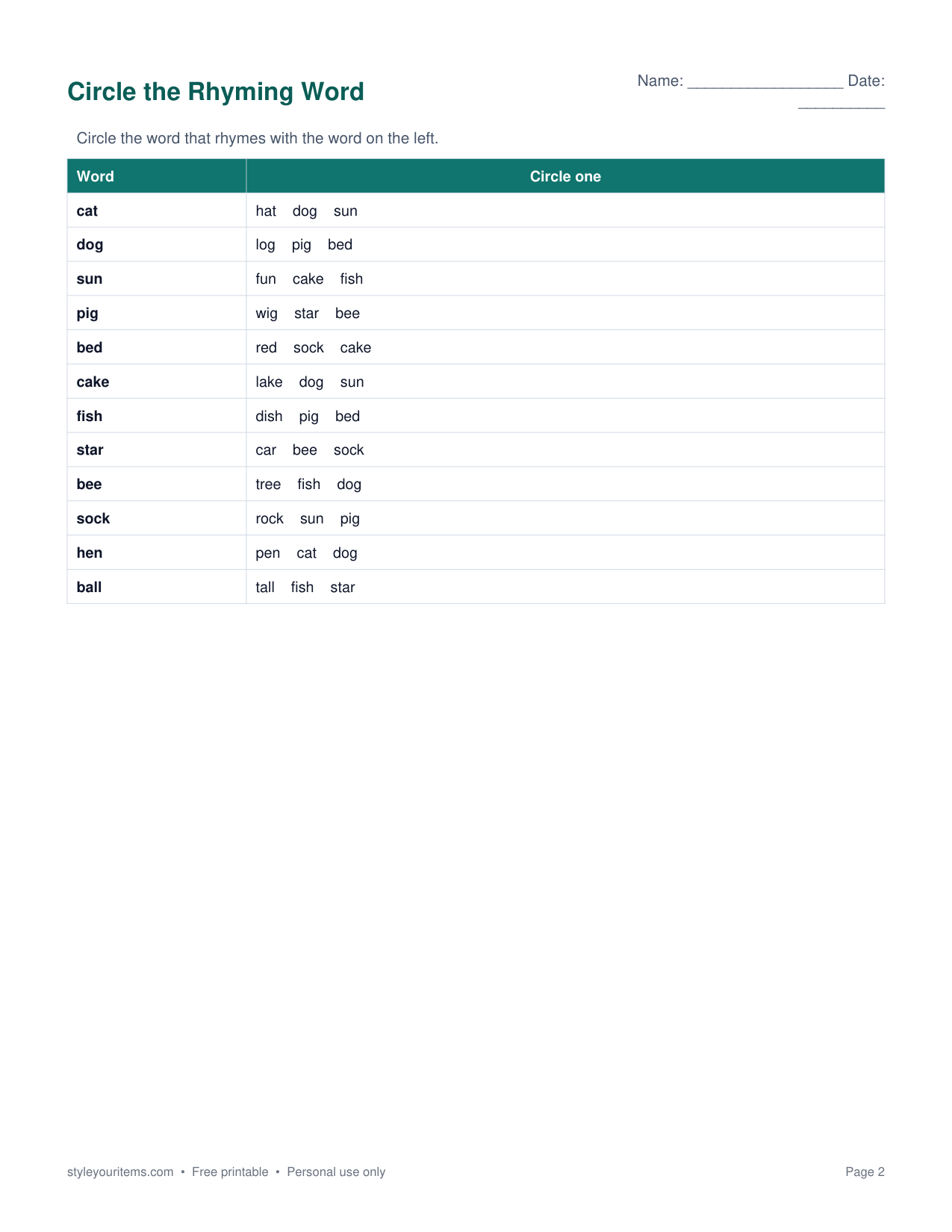
The PDF has six pages: a cover, four activity pages, and an answer key. Page one asks the child to circle the word that rhymes, page two matches rhyming pairs with a drawn line, page three asks for a rhyming word of their own, and page four is odd one out, where the word that does not rhyme has to be found. All four activities use short, everyday words like cat, dog, sun and cake, so a child who cannot read fluently yet can still join in if an adult reads the words aloud. Our sight words worksheets are the natural next step, once rhyming feels easy.
What your child practises
- Hearing the ending sound. Every activity turns on the last sound of the word: cat and hat share it, cat and sun do not. Hearing that difference is the skill, and the pages give it twelve rounds of practice at a time.
- Matching, not memorising. The match-the-pairs page has ten words on each side, and the answer is found by listening, not by remembering a list. A child who can match cat to hat has understood the pattern, not learned a pair.
- Making a rhyme of their own. The write-a-rhyming-word page asks for a new word, not a ticked box. Any real word that rhymes counts, and a silly answer that rhymes is a correct answer, which is exactly how a child learns that language is fun.
- Spotting the one that does not fit. Odd one out is the hardest page, because it asks the child to hold four words in their head and find the stranger. It is also the best check that the skill is real, because guessing does not work on it.
- Checking their own work. The answer key on the last page lets a child check the circle and match pages alone. Checking is part of learning, and a child who checks their own page is practising twice.
The words are chosen to be heard before they are read, which is why the same twelve words return across the pages. A child who meets cat on page one, matches it on page two, writes a rhyme for it on page three, and finds the odd one out on page four has heard that sound four times in four different ways. Our alphabet tracing worksheets use the same idea for letters, and they pair well with this set for a quiet afternoon.
How to use the worksheets
- Print the six pages on Letter or A4. One print is one full set, and a child can do it in one sitting or one page a day.
- Start on the circle page and read the words aloud together. Say the first word slowly, then the three choices, and let the child point to the one that sounds the same at the end. Do the first two rounds together, then let them carry on alone.
- On the matching page, read the left column first, then the right column, then let the child draw the lines. If a line crosses three others, that is fine. Crossed lines are a sign they are thinking, not a mistake.
- On the write-a-rhyming-word page, accept any real word that rhymes, even a funny one. If the child is stuck, give them the first sound and let them finish it: “It rhymes with cat and starts with h…”
- Save the odd one out page for last, and do it aloud. Four words, said slowly, and the child points to the one that sounds different. If they get it wrong, say all four again, slower, and let them hear it a second time.
- Finish with the answer key, together. Let the child check their own circle and match pages and circle the ones they got right. Praise the checking as much as the answers.
Ten minutes a day is enough, and the same set can be printed again next week with fresh eyes. Our telling time worksheets are built the same way, one skill, four activities, an answer key, and you will find them all in the Kids, School and Learning collection.
Frequently asked questions
What age are these worksheets for?
They are made for ages 4 to 7, roughly preschool to first grade. A four-year-old can do them with an adult reading aloud, and a seven-year-old can do them alone and check their own answers.
Do the worksheets use pictures?
No, they use words only. The activities are built around hearing the rhyme in spoken words, so an adult reading the words aloud is part of the activity, and the child practises listening as much as reading.
What if my child cannot read the words yet?
Read them aloud and let the child point, circle, or draw the line. The skill being practised is hearing rhymes, and that skill comes before reading, not after it. Our addition worksheets work the same way for numbers, if you want a second set for the same age.
Can I print the pages more than once?
Yes. The PDF is free for personal use, so print the whole set as often as you like, or print one page again when a child wants another go at it. A second try at the odd one out page, a week later, is often where the skill clicks.