
With Americans spending roughly 90% of their daily lives indoors, poor indoor air quality quickly becomes a primary trigger for respiratory irritation, allergies, and persistent sneezing. Among the most common household nuisances is dust-a relentless gray film that reappears on tables, bookshelves, and baseboards shortly after being wiped away. A standard air purifier equipped with a true HEPA filter captures 99.97% of dust and airborne particles down to 0.3 microns, directly cutting the volume of debris circulating through living spaces. While these devices clean circulating air, they do not automatically clear debris already settled on furniture. Understanding the distinction between floating pollutants and settled debris is essential for anyone trying to manage chronic dust issues effectively.
The Mechanics of Filtration: What Actually Happens to Indoor Dust
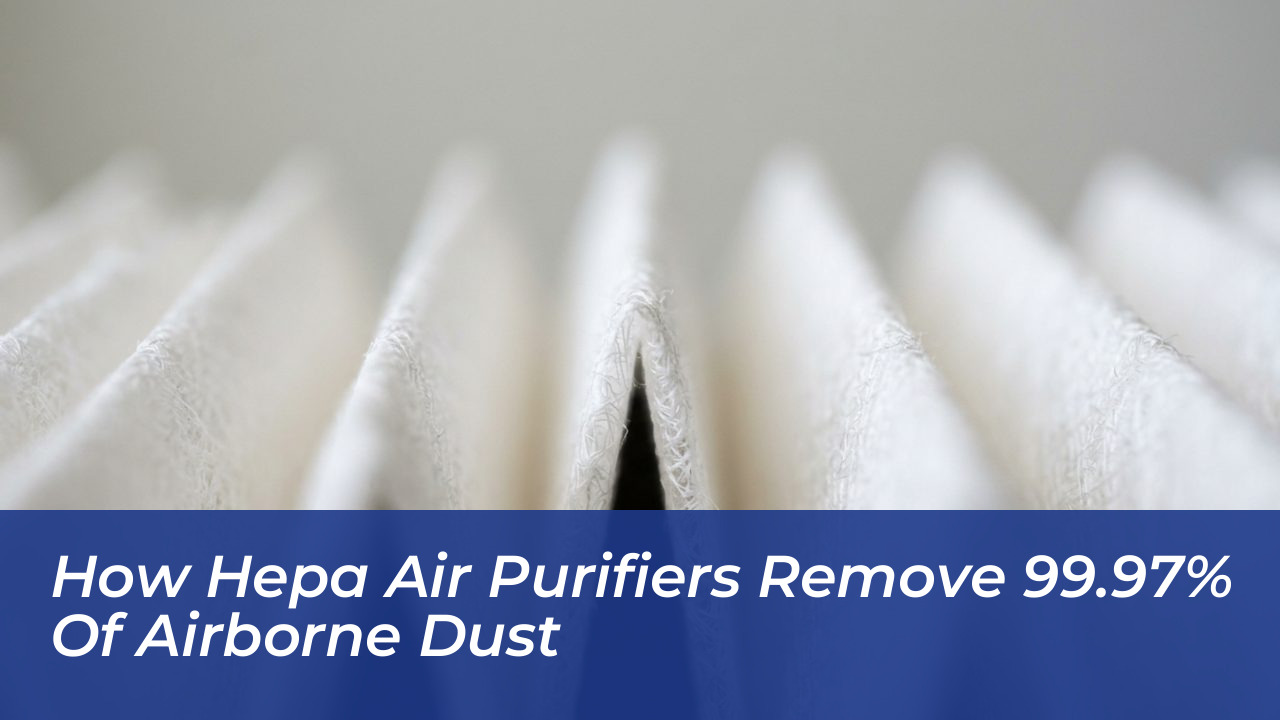
Air cleaners operate via a straightforward mechanical intake system. The unit pulls ambient air from the surrounding space, forces it through dense fibrous layers, traps particulate matter, and pushes clean air back into the room. According to the U.S. Environmental Protection Agency (EPA), high-efficiency particulate air (HEPA) filters achieve their strict standard by trapping microscopic irritants including pet dander, mold spores, pollen, and bacteria.
An air purifier does not simply catch dust the way a net catches fish. Instead, the mechanics depend heavily on particle size, and household dust covers an enormous size range-from ultrafine combustion particles up to visible lint and hair. Most particulate matter suspended in the air sits between 1 and 10 microns in diameter. A true HEPA filter uses three distinct physical mechanisms to capture these pollutants:
- Interception: Particles larger than about 1 micron cannot navigate around the dense glass fibers and collide directly with them, sticking firmly via Van der Waals forces.
- Impaction: Heavier particles (roughly 0.5 microns and up) carry enough momentum that when airflow curves around a filter fiber, the particle continues straight and embeds itself squarely in the material.
- Diffusion: Particles smaller than 0.1 microns move erratically due to Brownian motion, zig-zagging so unpredictably that they constantly collide with the filter fibers rather than flowing through cleanly.
The most penetrating particle size-the hardest for any filter to catch-is exactly 0.3 microns. This is precisely why the HEPA standard tests filtration efficiency at that exact measurement. A true HEPA filter must capture at least 99.97% of particles at this size, and traps larger or smaller particles with even higher efficiency.
Supplemental Filtration Stages
Beyond standard particulate media, modern units often incorporate supplemental stages to address gas-phase pollutants and biological threats:
- Activated Carbon: Specifically targets and absorbs household odors, volatile organic compounds (VOCs), and chemical fumes.
- UV-C Light: Neutralizes biological pathogens such as viruses and bacteria as they pass by the internal lamp.
- True HEPA Media: Traps physical debris down to 0.3 microns with high mechanical efficiency.
The Settled Dust Myth: Managing Expectations
A widespread misconception is that installing an air cleaner eliminates the need to wipe down furniture or vacuum carpets. The physical limitation lies in airflow dynamics: an appliance cannot suction heavy, settled dust off a coffee table across the room. Air cleaners trap particles suspended in the air before they land.
Once dust settles on carpets, upholstery, or shelving, manual removal remains necessary. Settled dust can redistribute throughout a room when disturbed by walking or sitting, and accumulated dust attracts dust mites, which can cause asthma and allergy symptoms to flare. However, running a unit continuously dramatically slows down how fast new dust gathers on flat surfaces, reducing overall dusting frequency.
Filter Performance Comparison
Not all filters perform equally against household dust. Selecting the right media dictates how effectively your air purifier cleans indoor rooms:
- True HEPA Filter: Captures 99.97% of dust, pollen, mold spores, and pet dander down to 0.3 microns. Essential for allergy and asthma sufferers.
- HEPA-Type or “HEPA-Style” Filters: Marketing terms for filters that do not meet official certification standards, often achieving only 85% to 95% efficiency at 0.3 microns.
- Activated Carbon Pre-Filters: Captures large dust bunnies, pet hair, and lint above 10 microns while neutralizing gaseous odors.
Timeline for Noticeable Results
Visible and sensory changes do not take weeks to appear. Most homeowners begin observing improved air quality within 30 minutes to two hours of starting a properly sized unit. The exact speed depends heavily on room volume, fan settings, and initial contamination levels. For a correctly sized unit matching the room’s Clean Air Delivery Rate (CADR), expect a dramatic drop in airborne fine dust particles shortly after powering on the device.
Placement and Maintenance for Maximum Impact
Machine location dictates overall efficiency. Shoving a machine into a tight corner or flush against a wall blocks intake vents and creates dead zones where air stagnates. To maximize circulation, position the device in a central area of the room with open clearance on all sides.
- Maintain continuous airflow: Manufacturers recommend running the machine several hours daily or continuously on a quiet, low setting for large rooms to keep particulate counts low.
- Inspect filter media: Check intake pre-filters regularly every 2 to 4 weeks and replace core HEPA filters according to manufacturer guidelines (typically every 6 to 12 months).
- Support HVAC performance: Replace home HVAC filters on schedule (using MERV 11 or higher) and arrange routine system inspections to handle whole-home dust.
- Implement physical barriers: Keep exterior windows shut during high-pollen seasons and wipe down pet coats after outdoor walks.
Frequently Asked Questions
Do air purifiers help with dust allergies?
Yes. Air purifiers running True HEPA filters capture dust mite allergen particles, pet dander, and pollen that circulate in the air. Allergy sufferers see the most consistent relief when running a properly sized HEPA purifier continuously in their bedroom, where they spend 7 to 9 hours per night. However, pairing the unit with allergen-proof mattress covers and regular vacuuming produces far better results than the purifier alone.
How long does it take an air purifier to remove dust from a room?
For a correctly sized unit matching the room’s CADR, expect a 70% to 80% reduction in airborne fine dust particles within 30 minutes of running on medium or high settings. Larger rooms or undersized units can take 1 to 2 hours to achieve similar particle count drops.
Do air purifiers reduce dust on furniture and surfaces?
Indirectly, yes. They do not clean what has already settled, but by continuously removing airborne particles, they slow the rate at which new dust accumulates on surfaces. You will find yourself wiping down furniture roughly 40% less frequently to maintain the same level of cleanliness.
What is the best HEPA air purifier for removing dust?
Top-rated models for dust removal include the Coway AP-1512HH Mighty for medium rooms up to 360 square feet, the Levoit Core 300 for small bedrooms, and the Blueair Blue Pure 211+ for large open-plan spaces exceeding 450 square feet. All feature verified True HEPA filtration capturing 99.97% of 0.3-micron particles.
Do air purifiers remove dust mites?
Partially. Dust mites themselves are large (200 to 300 microns) and live deep within carpets, mattresses, and upholstered furniture rather than floating in the air. An air purifier captures the lightweight allergen particles and fecal pellets (10 to 40 microns) shed by mites when they become airborne during bed-making or vacuuming.