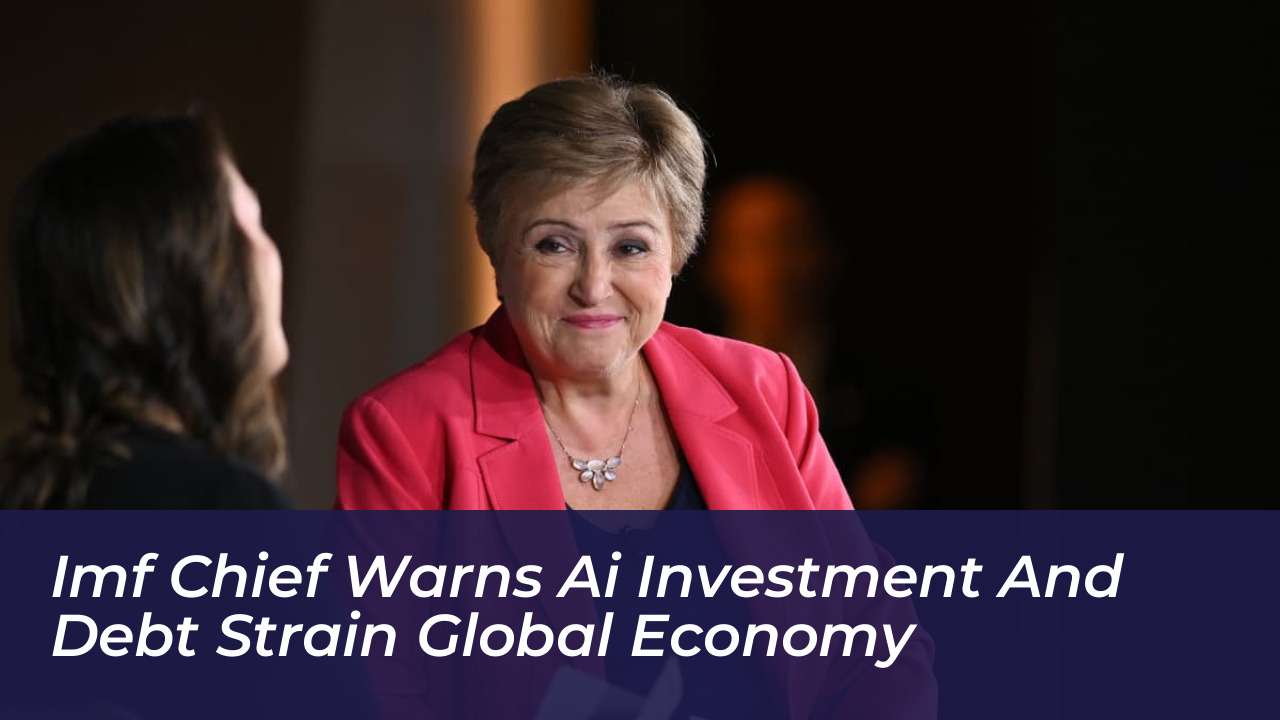


Accelerating artificial intelligence investment and skyrocketing global debt are placing significant pressure on global growth, International Monetary Fund (IMF) Managing Director Kristalina Georgieva stated during an address in Singapore on Wednesday. Speaking ahead of the annual IMF and World Bank meetings, Georgieva explained that the global economy faces compounding pressures from ongoing energy supply disruptions and massive demand for AI infrastructure.
“Love it, hate it, or fear it, AI is here,” said Georgieva, outlining how the technology is rapidly becoming a decisive driver of relative economic fortunes worldwide.
The Dual Pressures Facing the Global Economy
According to the IMF, the world economy is currently being pulled in two distinct directions: a negative energy supply shock stemming from conflict in the Middle East, and a positive demand shock driven by the global artificial intelligence investment boom. The combined effect of these forces remains highly uneven across different regions.
Worldwide capital expenditure on AI hardware and technology products currently accounts for over 10 percent of global goods trade. Georgieva noted that this spending matches or exceeds historical capital deployments seen during the construction of railroads, national power grids, and telecommunications networks.
While proper implementation of artificial intelligence could add up to half a percentage point to annual world growth-effectively adding an economy the size of ASEAN over a decade-the benefits risk remaining heavily concentrated. Economies less integrated into the global AI supply chain face widening economic inequality.
Inflationary Pressures and Record Public Debt
The massive AI building boom is inherently inflationary, compounding existing cost-of-living pressures driven by energy constraints, food shocks, trade tariffs, and rising defense spending. Oil prices remaining above $100 per barrel have further squeezed energy and refining capacity, pushing long-term bond yields in major economies to their highest levels in decades.
Simultaneously, global public debt is tracking toward levels unseen since World War II, expected to soon exceed 100% of global gross domestic product (GDP). Advanced economies are among the worst offenders. With higher global interest rates putting an end to the era of cheap borrowing, governments can no longer rely on economic growth alone to shrink their debt burdens without undertaking painful fiscal consolidation.
Financial Stability Risks in the AI Sector
Georgieva also highlighted structural vulnerabilities within the tech sector itself. Strong corporate earnings are currently driving share prices and broad wealth effects, but heavy borrowing by AI hyperscalers and vast global holdings of U.S. equities introduce systemic risks.
“Should earnings fall short, however, hyperscaler leverage and large and growing global holdings of U.S. equities could turn a disappointment into a far-reaching shock,” Georgieva warned. Citing Amara’s Law, she noted that the period of maximum risk lies squarely in the transition between today’s aggressive building boom and the eventual realization of long-term productivity benefits.
The IMF has urged global policymakers convening in Bangkok to avoid further delays in policy action, advocating for strengthened regulatory supervision, prudent monetary policy biases, and credible medium-term fiscal plans to secure long-term financial stability.
Frequently Asked Questions
What did the IMF chief warn about regarding AI and the global economy?
IMF Managing Director Kristalina Georgieva warned that while artificial intelligence investments are driving economic growth, they are also fueling inflation, increasing energy demand, and creating financial stability risks if corporate earnings disappoint hyperscaler expectations.
How large is the current global investment in artificial intelligence?
Global capital expenditure on AI hardware and technology products accounts for more than 10 percent of world goods trade, matching or exceeding historical investments made in railroads, power grids, and telecommunications infrastructure.
What is the status of global public debt according to the IMF?
Global public debt is nearing its highest level since World War II and is on track to exceed 100% of global GDP, with advanced economies carrying the heaviest debt burdens.
How is the Middle East conflict impacting global growth?
The ongoing conflict in the Middle East has caused negative energy supply shocks, keeping oil prices above $100 per barrel and driving up retail diesel and energy costs globally.
What policy actions is the IMF recommending to world leaders?
The IMF is urging policymakers to enact credible medium-term fiscal consolidation plans, maintain prudently hawkish monetary policies to curb inflation, and implement robust regulatory oversight for emerging technologies like AI.