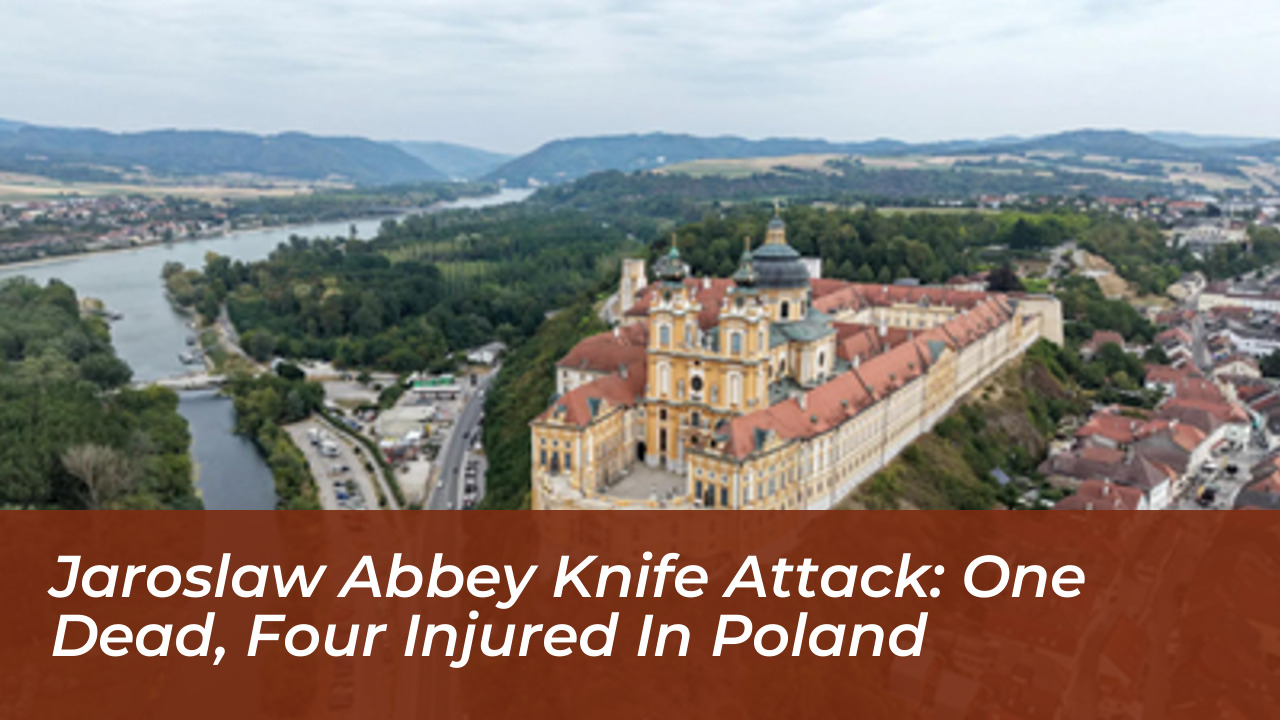
A brutal knife attack on the grounds of the Benedictine Abbey in Jaroslaw, southern Poland, left one clergyman dead and four other individuals injured. The violent episode unfolded on a Thursday morning, shocking the local community and drawing immediate condemnation from national leaders. Law enforcement officers detained a 31-year-old Ukrainian citizen at the scene as the primary suspect. Sister Barbara Dendor, speaking to the state broadcaster TVP Info, confirmed the death of Father Stanisław and noted that the knife attack at Jaroslaw Benedictine Abbey devastated the local religious community.
- Tragic Knife Attack at Jaroslaw Benedictine Abbey
- Timeline and Sequence of the Assault
- Victims and Casualties of the Tragedy
- Official Government Responses in Poland
- International Reactions and Diplomatic Stance
- Broader Social Context and Bilateral Relations
- Ongoing Police Investigation and Motive Analysis
- Security Implications for Polish Religious Sites
- Frequently Asked Questions
- What happened at the Jaroslaw Benedictine Abbey?
- Who is the suspect in custody?
- How have Polish and Ukrainian authorities responded?
- Are security measures changing at Polish religious sites?
The immediate impact of the violence reverberated across Poland, sparking public shock and deep concern among citizens and religious organizations alike. Rapid deployment of law enforcement and emergency medical services helped secure the perimeter and treat the wounded before the situation escalated further. Police officers apprehended the 31-year-old primary suspect directly at the scene, ensuring he could not cause additional harm to residents, pilgrims, or tourists visiting the historic monastery grounds.
National emergency response teams mobilized quickly to establish operational control over the affected sectors. Regional authorities activated multi-agency protocols to handle the crisis effectively under pressure.
Tragic Knife Attack at Jaroslaw Benedictine Abbey
Reconstruction of how the violence unfolded reveals a chaotic sequence starting from an initial confrontation outside the abbey to a violent rampage inside the complex. Local media reports indicate that the assault began when the perpetrator confronted a priest inside a nearby cafe before moving purposefully onto monastery grounds.
Eyewitnesses, including visitors and young people participating in activities at a nearby center, described the assailant as a disturbed individual who targeted people without immediate provocation. Law enforcement units arrived rapidly following emergency calls from abbey staff, securing the perimeter, administering emergency first aid, and preserving forensic evidence to reconstruct the exact timeline of the crime.
Forensic experts recovered multiple physical items of interest from the surrounding pathways. Investigators mapped out the entire physical trajectory of the suspect to establish hard evidence.
Timeline and Sequence of the Assault
The victims and casualties of the tragedy suffered severe physical trauma during the unexpected assault. Father Stanisław succumbed to his stab wounds despite immediate medical intervention by emergency responders. Meanwhile, Father Marek sustained life-threatening injuries and received intensive hospital care in critical condition.
Emergency medical services transported the three remaining injured victims to regional medical facilities for urgent treatment. To address the severe psychological toll, authorities deployed specialized crisis counselors and support teams to assist traumatized witnesses, abbey residents, and young people who witnessed the horrific violence unfold.
Hospital staff administered advanced surgical interventions to stabilize the surviving victims. Mental health professionals established mobile support units directly outside the regional medical centers.
Victims and Casualties of the Tragedy
Top Polish officials expressed profound shock and grief following the tragedy, demanding accountability and offering support to the affected community. President Karol Nawrocki stated that the assault shook the nation and called for a firm and uncompromising state response to such senseless acts of violence.
Prime Minister Donald Tusk addressed the public directly, assuring citizens that the perpetrator faces prosecution under the strictest provisions of Polish law. The Interior Ministry mobilized specialized crisis counselors and law enforcement resources to manage the aftermath and maintain public safety across the region.
Parliamentary leaders convened emergency briefings to review national safety standards. Law enforcement agencies received authorization to increase patrols near major cultural and religious landmarks.
Official Government Responses in Poland
Because the detained suspect is a Ukrainian citizen, the incident immediately drew high-level international attention and diplomatic outreach. Ukrainian President Volodymyr Zelensky expressed utter shock at the evil act, stating firmly that the perpetrator must bear full legal responsibility for the violence.
The Ukrainian Embassy in Poland issued a formal statement condemning the attack and emphasizing mutual support during difficult times. Both Warsaw and Kyiv issued joint appeals urging the public to respect human life and prevent grief from escalating into xenophobic tensions or retaliatory violence.
Diplomatic channels remained open between both nations to ensure transparent communication. Foreign ministries coordinated closely to share verified updates with international media outlets.
International Reactions and Diplomatic Stance
Examining the broader social context reveals complex dynamics amid large-scale Ukrainian displacement in Poland. Poland currently hosts over a million Ukrainian refugees who fled following the full-scale Russian invasion, and while most residents coexist peacefully, localized strains occasionally occur.
Sociological analysis highlights the risk of extremist groups attempting to exploit isolated criminal acts involving foreign nationals for political agendas. Both governments emphasize that criminal culpability remains strictly individual rather than collective, rejecting broad generalizations that target entire nationalities.
Community leaders organized local town hall discussions to promote social cohesion. Civil society organizations worked proactively to dispel misinformation circulating on digital networks.
Broader Social Context and Bilateral Relations
Regional prosecutors and state police are leading an exhaustive investigation to determine the exact motive behind the Jaroslaw abbey attack. Investigators are actively reviewing closed-circuit television footage, conducting extensive witness interviews, and analyzing the background of the 31-year-old suspect.
Pending psychiatric evaluations will determine the mental state and criminal responsibility of the suspect before formal murder and multiple attempted murder charges are filed in court. Law enforcement officials confirm that the suspect acted alone, but all aspects of his recent activities remain under strict scrutiny.
Digital forensic teams extracted communication logs from personal electronic devices. State prosecutors prepared formal indictments based on comprehensive forensic toxicology and psychological assessments.
Ongoing Police Investigation and Motive Analysis
The tragedy at the historic Benedictine Abbey prompts renewed discussions regarding security protocols at open religious sanctuaries across Poland. Most monasteries, churches, and abbeys traditionally operate as open, welcoming spaces for pilgrims, tourists, and local communities without heavy physical security infrastructure.
Church administrators across the region are currently evaluating whether to implement enhanced surveillance, restricted access points, or closer coordination with local police departments. Balancing public accessibility with necessary safety measures remains a delicate challenge for protecting clergy and visitors alike in the future.
Architectural consultants drafted preliminary security upgrade plans for historic properties. Diocesan boards allocated emergency funds for modern alarm and communication systems.
Security Implications for Polish Religious Sites
Frequently Asked Questions
What happened at the Jaroslaw Benedictine Abbey?
A violent knife attack occurred on the monastery grounds, resulting in the death of Father Stanisław and injuries to four other individuals.
Who is the suspect in custody?
Law enforcement officers detained a 31-year-old Ukrainian citizen directly at the crime scene as the primary suspect.
How have Polish and Ukrainian authorities responded?
Both governments condemned the violence, expressed deep condolences, and urged the public to prevent the tragedy from fueling xenophobia.
Are security measures changing at Polish religious sites?
Church administrators are reviewing safety protocols to balance public openness with necessary protections for visitors and clergy.