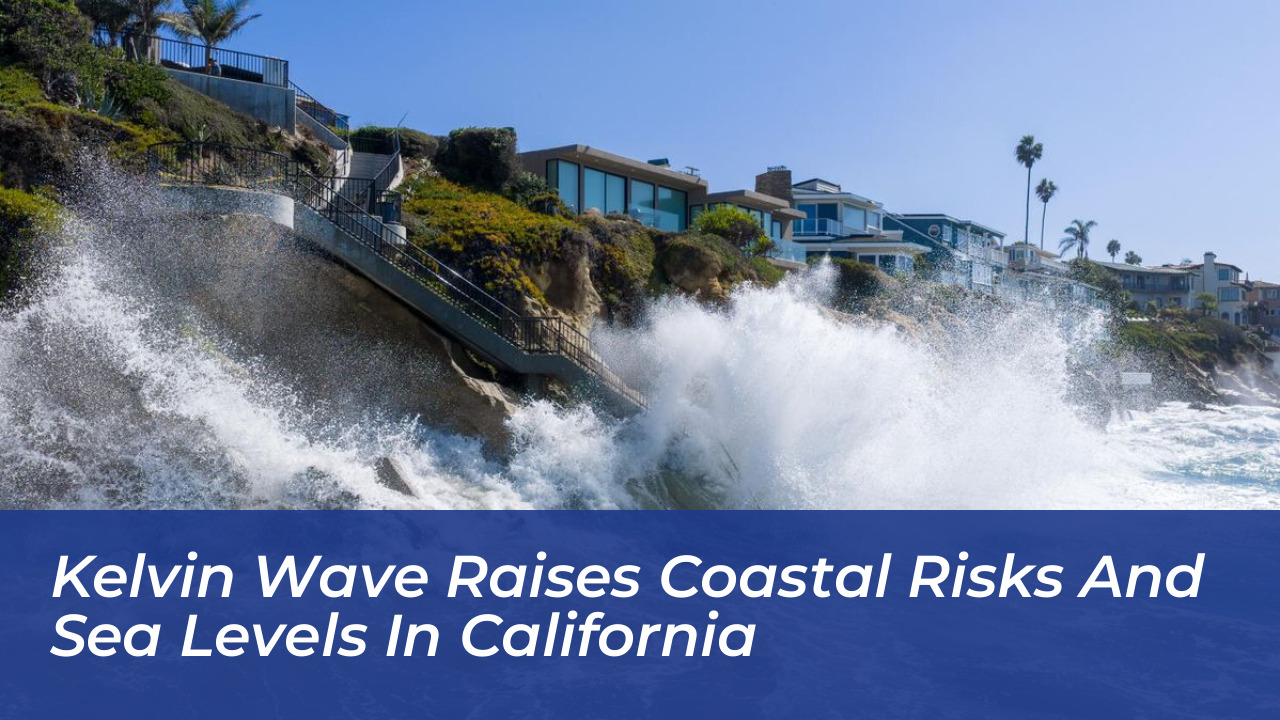


A large Pacific Kelvin wave has reached Southern California and the broader U.S. West Coast, raising background sea levels by 6 to 12 inches. Climate scientists and weather officials tracking the event report that this phenomenon significantly increases vulnerabilities to coastal flooding, severe beach erosion, and storm swells as a strengthening El Niño pattern develops for the fall and winter seasons.
Unlike standard surface breakers observed at the beach, a Kelvin wave is an extensive, slow-moving pulse of warm subsurface water that can persist for months. Originating in the western equatorial Pacific, these waves travel eastward along the equator before deflecting north and south along the American coastlines. Weather authorities, including the National Weather Service, warn that southerly swells from weather systems easily combine with these elevated baseline seas to multiply coastal hazards.
The Mechanics of Pacific Kelvin Waves
Kelvin waves are fundamentally tied to the mechanics of El Niño events. Under normal conditions, consistent trade winds push warm surface water toward the western tropical Pacific. When those trade winds weaken or momentarily reverse, accumulated volumes of warm water slide eastward along the equator.
As oceanographer Michael Jacox from the Southwest Fisheries Science Center and NOAA Physical Sciences Laboratory explains, these underwater waves travel roughly 6 miles per hour, or about 150 miles per day. Once the wave reaches South America, it splits and continues as a coastally trapped wave tracking northward up the Central and North American coasts. These movements shift warm water deeper, alter regional surface temperatures, and temporarily lift the ocean surface.
Compounding Coastal Flooding and Erosion Risks
By themselves, Kelvin waves do not manifest as towering, destructive tsunamis or sudden wall-like breakers. Instead, they act as a subtle yet powerful baseline shifter. Raising regional sea levels by roughly 15 to 30 centimeters (6 to 12 inches) removes a critical buffer of safety for vulnerable coastal infrastructure.
- Elevated Tides: Ordinary high tides, King Tides, and normal storm surges push significantly farther inland because the ocean baseline is already higher.
- Coastal Erosion: Persistent wave energy acting on elevated water levels accelerates the erosion of beaches, bluffs, and coastal dunes.
- Infrastructure Stress: Low-lying roads, seawalls, and beachfront properties face heightened vulnerability to nuisance flooding and structural wave damage.
- Marine Ecosystem Impacts: Warmer subsurface waters suppress the upwelling of cold, nutrient-dense water, disrupting phytoplankton growth at the base of the marine food web.
The Role of El Niño and Real-Time Tracking
The current progression draws intense scrutiny from researchers because it coincides with a rapidly strengthening El Niño event. Sea-surface temperature anomalies in the eastern equatorial Pacific have exceeded 3 degrees Celsius in select areas, prompting forecasters to project a high probability of a severe El Niño phase.
Combined with ongoing marine heatwaves, these conditions have kept coastal sea levels abnormally high for months. Scientific agencies, including NASA and NOAA, track the progression of these coastal Kelvin waves in real time using advanced satellite observations, ocean models, and tide gauges. Residents and visitors living in low-lying coastal areas should closely monitor local weather advisories, tide charts, and coastal-flooding bulletins throughout the storm season.
Frequently Asked Questions
What is a Kelvin wave?
A Kelvin wave is a broad, planetary-scale pulse of warm subsurface ocean water that travels eastward along the equatorial Pacific and subsequently moves poleward along the west coast of North America.
Is a Kelvin wave a tsunami?
No. Kelvin waves are not destructive surface waves or tsunamis. They are deep, slow-moving temperature pulses that temporarily raise coastal sea levels and warm adjacent ocean waters.
How much will sea levels rise along California?
NOAA notes that typical Kelvin-wave-related changes lift local sea levels by approximately 6 to 12 inches (15 to 30 centimeters). The exact impact depends heavily on local tides, wind patterns, and local coastline geometry.
Why is the Kelvin wave linked to El Niño?
When trade winds weaken or reverse across the tropical Pacific, large masses of warm water slosh eastward. This transfer fuels the development and strengthening of El Niño conditions and spawns eastward-moving Kelvin waves.
Do Kelvin waves pose a direct threat to Canada?
The most immediate and direct coastal flooding concerns concentrate along California and the U.S. West Coast. While broader El Niño patterns influence continental weather across North America, the Kelvin wave itself primarily impacts West Coast ocean temperatures and sea levels.