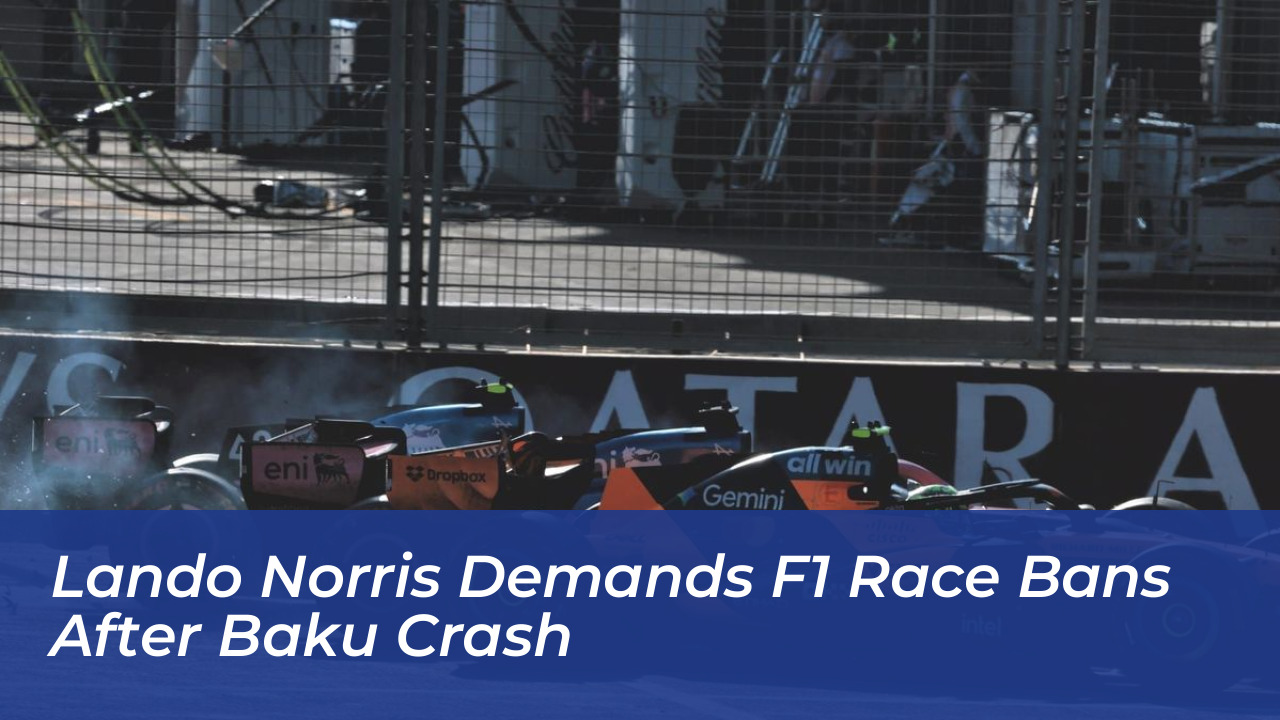
Formula One world champion Lando Norris has escalated demands for strict disciplinary action after a chaotic multi-car collision at the Azerbaijan Grand Prix. The high-speed restart crash at Baku City Circuit eliminated Norris, Williams driver Franco Colapinto, and Alpine driver Pierre Gasly, sparking an intense paddock debate over driver standards and penalty severity.
- Anatomy of the Baku Turn 1 Restart Chaos
- The Mechanics of a Cold-Brake Lock-Up
- The Chain Reaction Collisions
- Norris Unleashes Scathing Critique on Driver Standards
- The Financial Toll on Cost-Cap Teams
- Demanding Stricter FIA Intervention
- Team and Driver Responses to the Baku Disaster
- Franco Colapinto Admission
- Alpine and Pierre Gasly Reaction
- F1 Penalty System Under Global Scrutiny
- Evaluating the Superlicence Threshold
- Future Enforcement Challenges
- Frequently Asked Questions
- Why did Lando Norris demand race bans after Baku?
- What caused the multi-car crash at Turn 1?
- How does the current F1 penalty point system work?
- How do crashes impact F1 teams under the cost cap?
Anatomy of the Baku Turn 1 Restart Chaos
Turn 1 at the Baku City Circuit remains one of the most perilous braking zones on the calendar. Drivers approach the 90-degree left-hander at speeds exceeding 300 km/h before slamming on the brakes. During safety car periods, brake discs and tire temperatures drop significantly, creating a narrow operating window of grip upon restart.
The field accelerates rapidly out of the safety car phase, bunching cars together and obstructing forward visibility. This sudden transition from slow pacing to maximum speed amplifies the risk profile exponentially.
Tight street circuits naturally limit escape routes, leaving drivers with minimal room for error when unexpected mechanical lock-ups occur mid-corner.
The Mechanics of a Cold-Brake Lock-Up
- Franco Colapinto attempted to react to Kimi Antonelli decelerating ahead.
- Low-grip asphalt failed to provide sufficient friction for cold carbon brakes.
- Front wheels locked instantly, rendering steering inputs completely useless.
- Surface dust off the racing line reduced available traction even further.
The Chain Reaction Collisions
- Franco Colapinto misjudged closing speeds and accepted full responsibility.
- Pierre Gasly ran strongly in seventh position before being collected on the apex.
- Lando Norris caught the outside line and spun violently into the perimeter wall.
- Secondary impacts damaged suspension components across multiple trailing vehicles.
Norris Unleashes Scathing Critique on Driver Standards
Speaking to the media post-race, Norris argued that standard time penalties or minor grid drops fail to deter reckless driving during restarts. He maintained that drivers operating at the pinnacle of motorsport should possess the car control required to anticipate low-grip conditions.
The McLaren driver emphasized that current enforcement does not protect innocent competitors from losing valuable championship points due to avoidable errors by rivals.
Establishing harsher sporting regulations ensures that competitors maintain higher standards of situational awareness during chaotic race restarts.
The Financial Toll on Cost-Cap Teams
- Modern budget caps make spare parts manufacturing a critical logistical hurdle.
- Destroyed aerodynamic upgrades eat directly into development funds.
- Repair bills for multi-car crashes strain team operational limits.
- Unplanned chassis replacements delay scheduled upgrade packages for subsequent rounds.
Demanding Stricter FIA Intervention
- Norris asserted that higher disciplinary stakes protect competitors from careless mistakes.
- Standard penalties do not compensate innocent drivers for lost championship points.
- Immediate race bans serve as stronger psychological deterrents than financial fines.
- Stewards must prioritize driver safety over lenient sporting leniency.
Team and Driver Responses to the Baku Disaster
Franco Colapinto offered a swift and unreserved apology to both teams and his garage mechanics, acknowledging the severity of his misjudgment. For Alpine, the retirement represents a catastrophic missed opportunity in the Constructors Championship as Gasly drove a flawless race.
Gasly addressed the incident with measured pragmatism, emphasizing the importance of maintaining professional standards inside the paddock despite high-stress sporting heartbreaks.
Engineering departments spent long hours assessing structural damage to ensure cars met safety standards for the next event.
Franco Colapinto Admission
- Cold brakes and cold tires caused an immediate loss of control.
- Public apologies extended to both affected teams and mechanics.
- Data analysis confirmed the braking input triggered a textbook front axle lock.
- The young driver accepted full accountability without shifting blame to rivals.
Alpine and Pierre Gasly Reaction
- Gasly lost a crucial points-scoring finish in the development battle.
- Emphasis remained on paddock professionalism despite high-stress heartbreaks.
- Engineers lamented the lost data from a promising race setup.
- Strategic reviews focused on avoiding similar mid-pack incidents in future races.
F1 Penalty System Under Global Scrutiny
The call for race bans reignites a long-standing debate regarding the effectiveness of the FIA superlicence penalty point system. Currently, drivers accumulate points over a rolling 12-month period, triggering a mandatory one-race ban only after reaching 12 points.
Critics argue that this high threshold fails to address single-incident reckless driving that wipes out multiple innocent competitors during volatile restart scenarios.
Motorsport lawmakers face mounting calls to introduce dynamic penalty scales for avoidable collisions occurring during safety car phases.
Evaluating the Superlicence Threshold
- Colapinto sat on four points prior to Baku with no additions for Turn 1.
- Critics argue the 12-point threshold is too high for reckless restart driving.
- Single severe infractions can currently go underpunished within the existing framework.
- Safety delegates continue reviewing potential updates to the rulebook.
Future Enforcement Challenges
- Race control faces mounting pressure to enforce harsher deterrents.
- Bunching and poor visibility during safety car restarts amplify multi-car risks.
- Track designers analyze Turn 1 runoff areas to prevent similar pile-ups.
- Drivers urge consistency from race stewards when evaluating controversial racing incidents.
Frequently Asked Questions
Why did Lando Norris demand race bans after Baku?
Norris argued that standard time penalties fail to stop reckless driving during restarts, and harsher punishments are needed to protect innocent competitors.
What caused the multi-car crash at Turn 1?
Cold carbon brakes and low tire temperatures caused an instant wheel lock-up for Franco Colapinto, triggering a chain reaction.
How does the current F1 penalty point system work?
Drivers accumulate points over a rolling 12-month period, resulting in a mandatory one-race ban only after reaching 12 total points.
How do crashes impact F1 teams under the cost cap?
Heavy crash damage drains limited development budgets and forces teams to divert resources toward manufacturing replacement parts.